Houthis call for revenge over death of Hezbollah leader

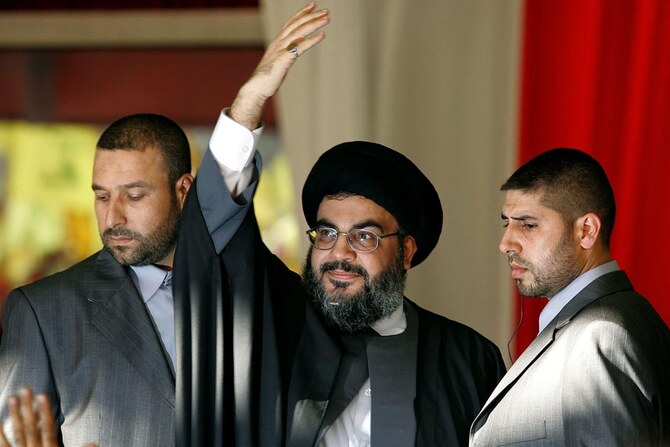
Hezbollah chief Hassan Nasrallah, flanked by two of his bodyguards, waves to the crowds at the massive “divine” rally in the southern suburbs of Beirut, in Sept. 2006. (AFP)
Short Url
Updated 28 September 2024
Follow

Houthis call for revenge over death of Hezbollah leader

  • “The resistance will not be broken,” the group said
  • Both Hezbollah and the Houthis are part of the Axis of Resistance

AL-MUKALLA: Yemen’s Houthi militia on Saturday strongly condemned Israel’s killing of Hezbollah leader Hassan Nasrallah and vowed to support the Lebanese group in retaliation.

However, the Houthi’s calls for revenge came as many Yemenis expressed joy over Nasrallah’s death.

The Houthi Supreme Political Council described the Hezbollah leader as a “great mujahid” who opposed Israel and the US, while also supporting Palestinians, adding that his death would result in “the elimination of the Israeli enemy.”

The Houthi government also strongly condemned the killing, and called for punishment of both Israel and the US.

“We urge all free people around the world to continue working for justice and punishing the Israeli and American enemies,” the Houthi government in Sanaa said.

Nasrallah was killed on Friday in an Israeli strike on the group’s headquarters on the southern outskirts of Beirut.

Houthi sympathizers expressed support for the Lebanese group and called for vengeance.

“Revenge is coming, and victory is unavoidable,” Nasruddin Amer, a Houthi media official, said on X.

The Houthis are members of the so-called Axis of Resistance, which includes Iran-backed militias in the region, such as Hezbollah, and have long expressed support for the Lebanese group.

Hezbollah has been accused of training Houthi fighters both outside and inside Yemen, facilitating the transfer of Iranian weapons to Yemen, and harboring Houthis in Lebanon.

At the same time, critics of the Houthi militia have celebrated Nasrallah’s death, blaming him for fueling Houthi military expansions across Yemen that have resulted in the death of thousands of Yemenis and the displacement of millions.

Mohammed Al-Dhabyani, a Yemeni journalist who shared an old video of the Hezbollah leader expressing his support for the deadly Houthi offensive on Yemen’s central city of Marib, said that Nasrallah was responsible for the deaths of over a million people in Syria and half a million in Yemen, as well as the destruction of cities in both countries.

“If Hezbollah had not entered Yemen and provided training, armament, management, media, and political support to the Houthis, they would not have risen to their current status,” Al-Dhabyani told Arab News.

“We celebrate this criminal’s death because his hands are stained with our blood and has displaced us,” he added.

In early 2021, the Houthis renewed a major military offensive to seize control of the energy-rich city of Marib, an offensive that lasted more than a year and killed thousands of people.

The Houthis were forced to halt their attacks after failing to achieve their objective.

Nasrallah said at the start of the offensive that Marib would fall to the Houthis and that the militia would win the war, a remark that sparked outrage in Yemen against Hezbollah and was interpreted as proof of the organization’s support for the Houthis.

“If you celebrate the death of someone who murdered, raped, and displaced your family for more than a decade, you are a normal, very normal person, even if the killer is also your enemy,” Ahmed Al-Qurashi, a human rights activist, said on Facebook. 

According to Najeeb Ghallab, an undersecretary at Yemen’s Information Ministry and a political analyst, Iran has empowered Hezbollah to create a copy of the group in Yemen to serve its regional agendas.

Nasrallah’s death, he said, has reignited Yemenis’ hopes for the formation of an international coalition to assist the Yemeni government in defeating the Houthis.

“Yemenis are optimistic that the Houthis will face the same fate as Hezbollah. They do not want Israel to intervene, but they do want the international community to assist the Yemenis in a military operation to remove the Houthis,” Ghallab said.

He added: “The Iranian agent in Lebanon (Hezbollah) was in charge of completely supervising the Houthi establishment. As a result, the Houthis appear to be a copy of Hezbollah in terms of media, politics, and administration.”

Yemen’s war began a decade ago, when the Houthis militarily seized power and spread across the country, resulting in thousands of deaths, millions of displacements, and the world’s worst humanitarian crisis.  


Last Christians gather in ruins of Turkiye’s quake-hit Antakya

Updated 58 min 12 sec ago
Follow

Last Christians gather in ruins of Turkiye’s quake-hit Antakya

  • Saint Peter’s, one of the world’s oldest rock churches, is a sacred rallying point for the isolated Christians still left in quake-hit Antakya in southeastern Turkiye

ANTAKYA: Saint Peter’s, one of the world’s oldest rock churches, is a sacred rallying point for the isolated Christians still left in quake-hit Antakya in southeastern Turkiye, the city known in ancient times as Antioch.
“Since the earthquake, our community has scattered,” said worshipper Mari Ibri.
“Those who remain are trying to regroup. We each had our own church but, like mine, they have been destroyed.”
The landscape around the cave remains scarred by the disaster nearly three years ago, when two earthquakes devastated Hatay province on February 6, 2023 and its jewel, Antakya, the gateway to Syria.
Sad fields of rubble and the silhouettes of cracked, abandoned buildings still scar the city — all enveloped in the ever-present grey dust.
Since the earthquakes, Antakya city has emptied and the Christian community has shrunk from 350 families to fewer than 90, Father Dimitri Dogum told AFP.
“Before, Christmas at our house was grandiose,” Ibri recalled.
“Our churches were full. People came from everywhere.”
Ibri’s own church in the city center was rendered inaccessible by the earthquakes.
Now she and other worshippers gather at the cave on December 24 — Christmas Eve in some Christian calendars.
It is here, they believe, that Peter, the disciple Jesus assigned to found the Christian church, held his first religious service in the 1st century.
The rock church was later enlarged and 11th-century crusaders added a pale stone facade.
It is now a museum, opened to the faithful only on rare occasions.
Christmas Eve is one.
The morning sun was still glowing red in the sky when Fadi Hurigil, leader of Antakya’s Orthodox Christian community, and his assistants prepared the service.
They draped the stone altar and unpacked candles, holy oil, chalices and plastic chairs.
Out in front they placed figurines of Christ and three saints near a bottle of rough red wine, bread baskets and presents for the children.
The sound system played a recording of the bells of Saint Peter and Paul church, which now stands empty in Antakya city center.
“That was my church,” said Ibri, crossing herself. “They recorded the peals.”
Around one hundred worshippers soon squeezed into the incense-filled cave and at least as many congregated outside.
A large police contingent looked on. Sniffer dogs had already inspected the cave and esplanade.
“It’s normal,” said Iliye, a 72-year-old from Iskenderun, 60 kilometers (40 miles) further north. “We’re a minority. It’s to protect us.”
The slow chanting of Orthodox hymns heralded the start of the two-hour service, conducted entirely in chants sung in Arabic and Turkish by Dogum and another cleric.
“It’s very moving for us to be here in the world’s first cave church, where the first disciples gathered,” the priest said.
“There used to be crowds here,” he added.
“In 2022, there were at least 750 people outside, Christians and non-Christians alike.”
Since the earthquakes, the gathering has been much smaller, although it is now starting to grow again.
At the end of the service, when Christmas carols fill the air, Dogum and Hurigil cut a huge rectangular cake.
The Nativity scene at its center — Mary, baby Jesus, the ox and the ass — was edged with whipped cream.
“There’s the religious dimension but it’s also important that people can gather here again,” a worshipper said.
“After February 6, our fellow citizens scattered. But they’re starting to come back. We’re happy about that.”