Pakistan says inflation to remain between 8-9% in September-October

A man checks the quality of rice at a grocery shop in Karachi on September 26, 2024. (AFP)
Short Url
Updated 28 September 2024
Follow

Pakistan says inflation to remain between 8-9% in September-October

  • Inflation, which peaked at 38% in May 2023, has been on a downward trend for the past few months 
  • Pakistan’s exports and imports expected to observe an increase in momentum during Sept., says economic outlook

ISLAMABAD: Pakistan’s Finance Division said this week that inflation is expected to remain in the 8-9% range from September to October, adding that the country’s economic recovery will be bolstered by a favorable external economic environment and a stable exchange rate. 

Pakistan’s annual consumer price inflation (CPI) rate eased to 9.6% in August, the first single-digit reading in almost three years. Islamabad undertook tough economic measures which included increasing taxes and electricity prices, to enter into a $7 billion loan agreement with the International Monetary Fund (IMF) which was formally approved on Wednesday. 

However, inflation has been on a downward trend in the country which peaked at 38% in May 2023. Pakistan’s August annual CPI figures were clocked at 27.4% in August 2023 and 11.1% in July 2024. The government has credited its tough reforms and economic policies for the declining trend of inflation. 

“Inflation is expected to remain within the range of 8.0% to 9.0% in September and October 2024,” the Finance Division’s monthly Economic Outlook report for September 2024 said on Friday. 

The report said that Pakistan’s exports and imports are expected to observe an increase in momentum, with exports expected to remain in the range of $ 2.5-3 billion while imports will remain in the $4.5-5 billion range in September. 

It said workers’ remittances were expected to remain in the $ 2.7-3.2 billion range this month. 

The report said that Pakistan’s external account had improved at the back of increased workers remittances and surging exports. 

“During Jul-Aug FY2025, the current account registered a deficit of $ 0.2 billion compared to $ 0.9 billion last year however, it recorded a surplus of $ 75 million in August 2024,” the report said.

The report pointed out that from July to August, goods exports increased by 7.2 percent to reach $4.9 billion while imports stood at $ 9.5 billion compared to $ 8.4 billion last year, leading to a trade deficit of $ 4.7 billion. 


Education spending surges 251% as students return from autumn break: SAMA

Updated 12 December 2025
Follow

Education spending surges 251% as students return from autumn break: SAMA

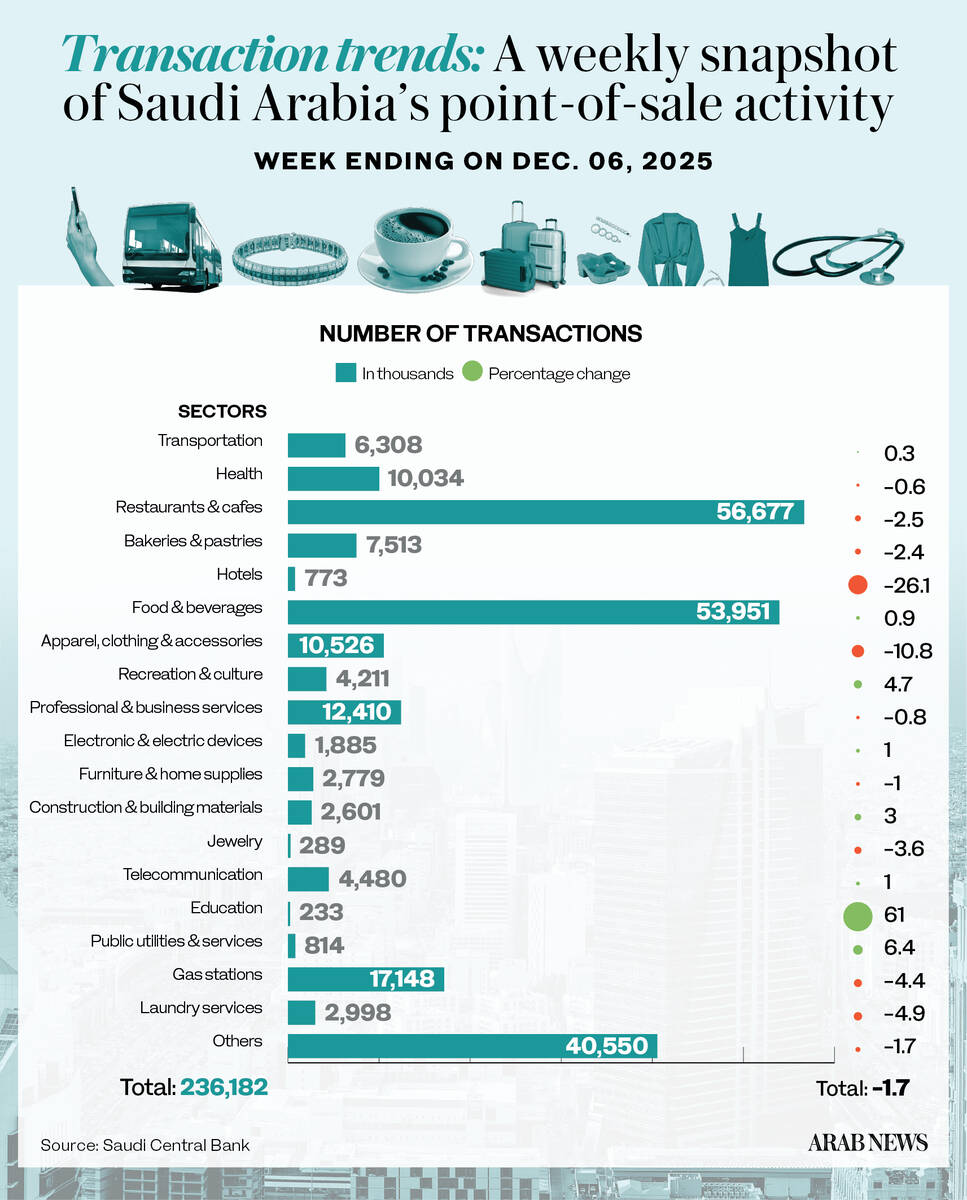
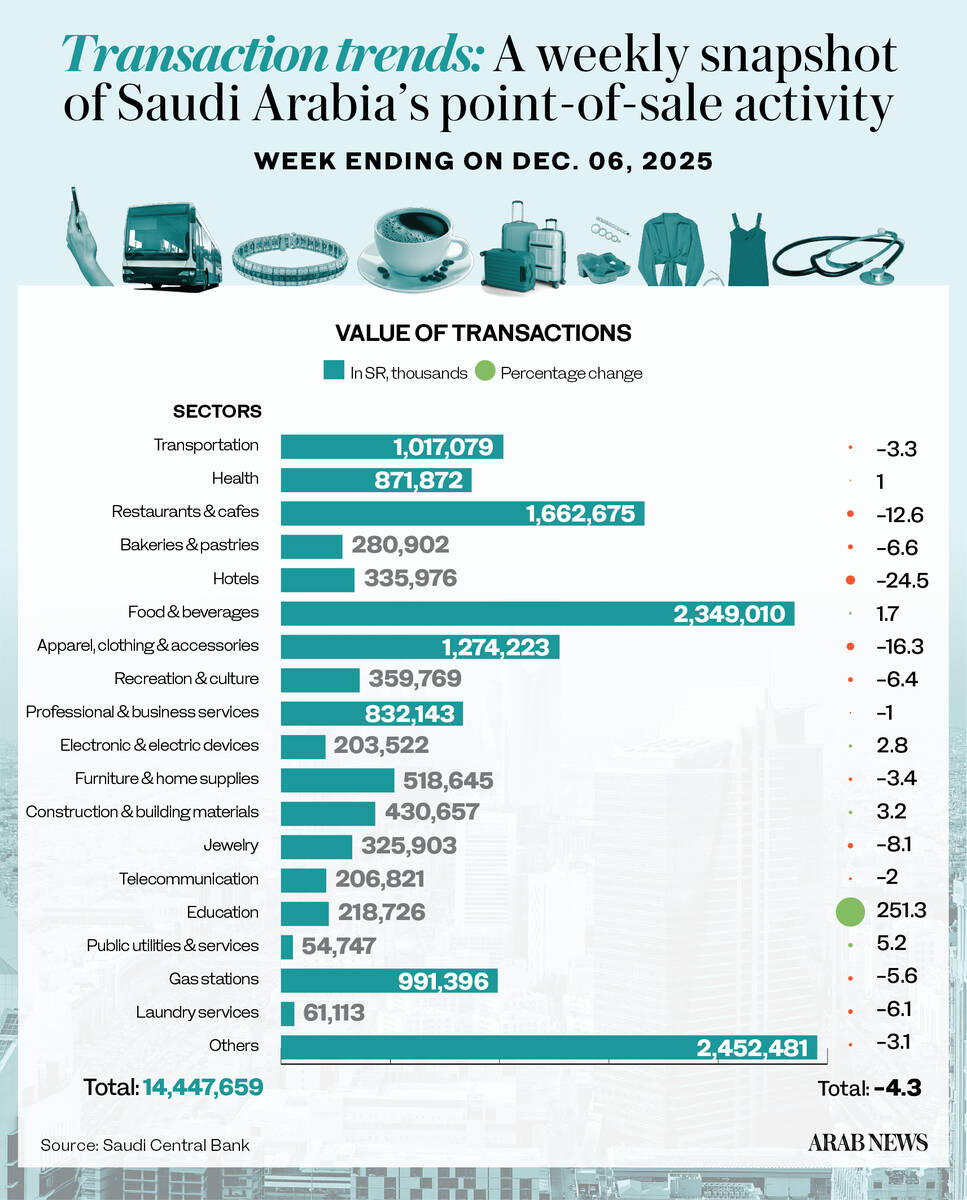
RIYADH: Education spending in Saudi Arabia surged 251.3 percent in the week ending Dec. 6, reflecting the sharp uptick in purchases as students returned from the autumn break.

According to the latest data from the Saudi Central Bank, expenditure in the sector reached SR218.73 million ($58.2 million), with the number of transactions increasing by 61 percent to 233,000.

Despite this surge, overall point-of-sale spending fell 4.3 percent to SR14.45 billion, while the number of transactions dipped 1.7 percent to 236.18 million week on week.

The week saw mixed changes between the sectors. Spending on freight transport, postal and courier services saw the second-biggest uptick at 33.3 percent to SR60.93 million, followed by medical services, which saw an 8.1 percent increase to SR505.35 million.

Expenditure on apparel and clothing saw a decrease of 16.3 percent, followed by a 2 percent reduction in spending on telecommunication.

Jewelry outlays witnessed an 8.1 percent decline to reach SR325.90 million. Data revealed decreases across many other sectors, led by hotels, which saw the largest dip at 24.5 percent to reach SR335.98 million. 

Spending on car rentals in the Kingdom fell by 12.6 percent, while airlines saw a 3.7 percent increase to SR46.28 million.

Expenditure on food and beverages saw a 1.7 percent increase to SR2.35 billion, claiming the largest share of the POS. Restaurants and cafes retained the second position despite a 12.6 percent dip to SR1.66 billion.

Saudi Arabia’s key urban centers mirrored the national decline. Riyadh, which accounted for the largest share of total POS spending, saw a 3.9 percent dip to SR4.89 billion, down from SR5.08 billion the previous week.

The number of transactions in the capital settled at 74.16 million, down 1.4 percent week on week.

In Jeddah, transaction values decreased by 5.9 percent to SR1.91 billion, while Dammam reported a 0.8 percent surge to SR713.71 million.

POS data, tracked weekly by SAMA, provides an indicator of consumer spending trends and the ongoing growth of digital payments in Saudi Arabia. 

The data also highlights the expanding reach of POS infrastructure, extending beyond major retail hubs to smaller cities and service sectors, supporting broader digital inclusion initiatives. 

The growth of digital payment technologies aligns with the Kingdom’s Vision 2030 objectives, promoting electronic transactions and contributing to the nation’s broader digital economy.