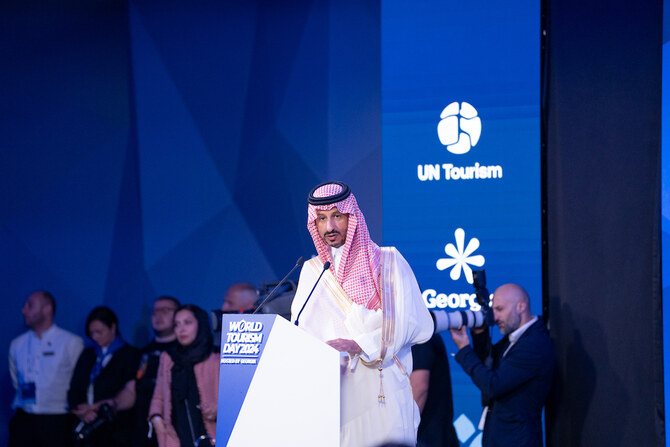
TBILISI: Saudi Minister of Tourism Ahmed Al-Khateeb emphasized on Friday the importance of connectivity, sustainability manpower and the challenges of “overtourism.”
He was speaking during the World Tourism Day celebrations in Tbilisi, Georgia, on Friday.
One of the main issues facing tourism, Al-Khateeb said, is sustainability, which is vital for the country’s economy, job creation and inclusion.
“We look at sustainability in Saudi Arabia from three angles: from social, economic and environmental perspectives,” he said.
“We were hit hard by COVID-19, especially small and medium enterprises, and we learned the hard way.”
Al-Khateeb hopes that the 80 percent of small and medium enterprises contributing to the Kingdom’s industry and the 45 percent of women working in the sector will not suffer due to any future crisis.
The minister stressed the importance of creating policies that would help smaller countries in the sector and at the same time protect their nature and heritage.
The minister also highlighted the importance of environmental sustainability and how Saudi Arabia has established the well-funded Global Tourism Sustainability Center.
He said: “Eighty percent of people in the workforce in our industry are youth. We need to hire the youth.”
According to Al-Khateeb, the international tourism industry accounts for about 10 percent of the global economy and is expected to increase to about 20 percent by 2032.
“In 2019, tourism used to represent only 3 percent of Saudi economy. Today, it has reached 5 percent. And our target is to make it reach 10 percent by 2030,” he said.
“Last year, we received 27 million international arrivals to Saudi Arabia. In 2019, they were only 12 million.”


Saudi tourism minister highlights challenges facing sector
https://arab.news/v7f3x
Saudi tourism minister highlights challenges facing sector

- One of the main issues facing tourism, Al-Khateeb said, is sustainability, which is vital for the country’s economy, job creation and inclusion
- “We look at sustainability in Saudi Arabia from three angles: from social, economic and environmental perspectives”


Saudi Arabia celebrates Flag Day with displays, special events
- Nation goes green in show of unity, belonging
- Current design of the flag, which represents unity and sovereignty, was adopted in 1937
RIYADH: A new art exhibition has opened at King Abdulaziz Public Library in Riyadh, as the country celebrates Flag Day, which fell on Wednesday.
The event, titled “In Love with Green,” is being held in collaboration with the Saudi Art Association and features 20 fine art paintings inspired by the Saudi flag, as well as other cultural and contemporary images and landmarks.
The current design of the flag, which represents unity and sovereignty, was adopted in 1937. It features the Shahada and a sword symbolizing justice and safety, representing the unification of the Kingdom during the reign of King Abdulaziz Al-Saud.
The exhibition, at the library’s services branch and reading halls on Khurais Road, was opened by the library’s Director General Bandar Al-Mubarak and the association’s board chair Hanaa Al-Shibly.
Visitors can attend from 9 p.m. to 1 a.m.
Elsewhere in the country, public spaces and buildings have become a sea of green for Flag Day.
In Al-Baha, government buildings, squares and main roads were decorated with green lighting and national flags were hoisted in public squares.
It was a similar picture in Makkah, where people celebrated the annual show of pride and belonging against a green backdrop.
In Tabuk, authorities installed more than 7,000 flags along roads, squares and bridges, while the region’s landmarks and tunnels were illuminated with green and white lights.
More than 10,000 Saudi flags were also hoisted in Jazan, where Souk Al-Awalin in Jazan City is set to host a range of events and performances to mark the special occasion.