

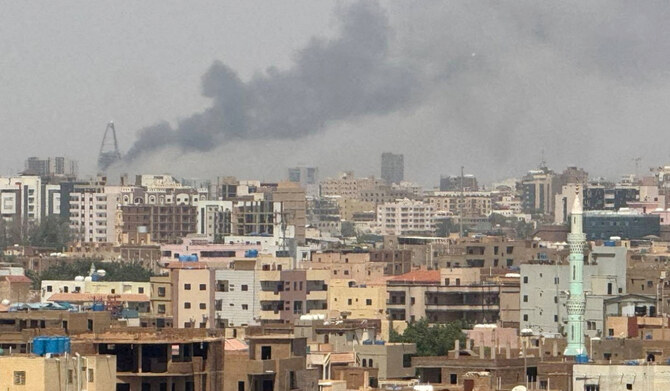


PORT SUDAN, Sudan: Two days of attacks by Sudanese paramilitaries on the Darfur city of El-Fasher killed 48 people, a medical source told AFP on Friday, after world leaders appealed for an end to the country’s suffering.
Artillery fire from the Rapid Support Forces (RSF) killed 30 people and wounded dozens on Friday alone, a medical source at El-Fasher Teaching Hospital told AFP, as the paramilitaries and regular army vie for control of the North Darfur state capital.
The shelling comes a day after an assault on a market brought “18 dead to the hospital” on Thursday, “some of them burned and others killed by shrapnel,” the source said, requesting anonymity for their own protection in light of repeated attacks on health workers and hospitals.
The plight of Sudan, and El-Fasher in particular, has been under discussion this week at the UN General Assembly in New York after 17 months of devastating fighting between the RSF and the regular army.
“We must compel the warring parties to accept humanitarian pauses in El-Fasher, Khartoum and other highly vulnerable areas,” the US ambassador to the United Nations, Linda Thomas-Greenfield, said on Wednesday.
The Teaching Hospital is one of the last still receiving patients in El-Fasher, where reports of a “full-scale assault” by RSF last weekend led UN chief Antonio Guterres to call for an urgent ceasefire.
The paramilitaries have besieged El-Fasher since May, and famine has already been declared in Zamzam refugee camp near the city of two million.
The war has killed tens of thousands of people. The World Health Organization has cited a toll of at least 20,000 but US envoy Tom Perriello has said some estimates reach 150,000.
US President Joe Biden, who raised particular concern over the assault on El-Fasher, on Tuesday urged all countries to cut off weapons supplies to the country’s warring generals, armed forces chief Abdel Fattah Al-Burhan and RSF commander Mohamed Hamdan Dagalo.
“The world needs to stop arming the generals,” Biden told the UN General Assembly.
On the sidelines of the UN talks, Guterres met with Burhan, expressing concern about “escalation” and the risk of “a regional spillover,” the UN said.
Both sides have been repeatedly accused of war crimes.
The RSF, which has its origins in Darfur’s notorious Arab tribal militias, the Janjaweed, has been specifically accused of crimes against humanity and ethnic cleansing.
Darfur, a region the size of France, is home to around a quarter of Sudan’s population but more than half of its 10 million people are internally displaced.
Dagalo released a video Thursday in which he rejected Burhan’s participation in the UN General Assembly as Sudan’s representative, saying the RSF had “formed a force to protect civilians” and was “open to all initiatives” aimed at peace.
Also on Thursday, air strikes and shelling rocked Khartoum as the army attacked paramilitary positions across the Sudanese capital, witnesses and a military source said.
What appeared to witnesses in the capital to be a “large-scale offensive” by the army — its first in months — continued Friday, with gunfire and artillery ringing through Khartoum and “a cloud of smoke” rising over army-controlled areas, a resident said.
By Friday evening, the army claimed “complete control” over one area of Khartoum North, which the RSF has held almost since the war began.
Witnesses in the Hajjar Al-Asal area in River Nile State, north of the capital, reported RSF forces “retreating” in the face of an army attack.
A hallmark of the war, which has mostly been fought in densely populated areas, has been mass human rights violations including systematic sexual violence, summary executions and the looting of humanitarian aid.
A UN Women report published Thursday showed that as of December, some 6.7 million people in Sudan were in need of services related to gender-based violence, but “this figure is estimated to be even higher today.”
Sudan, which is facing what the UN called on Wednesday “the world’s largest hunger crisis,” is home to 5.8 million internally displaced women and girls, who UN Women said were acutely vulnerable.
As famine threatens displaced populations across the country, “women are eating least and last,” the report warned.
UN human rights chief Volker Turk warned Thursday that, “if El-Fasher falls, there is a high risk of ethnically-targeted violations and abuses, including summary executions and sexual violence, by the RSF and allied militia.”


