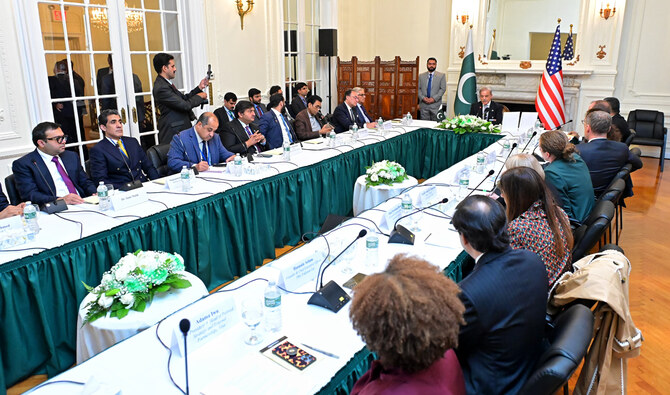
ISLAMABAD: Prime Minister Shehbaz Sharif on Friday met a delegation of the US-Pakistan Business Council (USPBC) in New York, introducing them to a special civil-military investment body set up last year to attract foreign funding and briefing them on government measures taken to improve ease of doing business.
Sharif’s government has actively pursued economic diplomacy in recent months and wants to strengthen ties with the US — strained in recent years by political tensions — and boost bilateral trade in goods and services, which the Pakistani embassy in Washington says now totals about $12 billion.
Sharif’s meeting with USPBC took place on the sidelines of the annual United Nations General Assembly, which the PM is scheduled to address later today, presenting his country’s stance on Israel’s war on Gaza, the lingering Kashmir dispute, growing global security deficit and climate change risks.
“In introducing the Special Investment Facilitation Council (SIFC) to the participants, the Prime Minister underscored that SIFC was a high-level, one-window agency empowered to facilitate foreign investors in planning and implementing their ventures in four key areas: agriculture, IT, energy, and mining,” a statement from Sharif’s office said after he met the USPBC delegation.
“The Prime Minister added that the SIFC aimed at bolstering investor confidence and expediting project implementation through customized solutions and demand-driven facilitation.”
Sharif identified various areas in Pakistan’s economy, particularly agriculture, technology, pharmaceutical, oil and gas and mining where he said US companies could benefit through mutually beneficial investments.
As Pakistan has sought approval for a $7 billion IMF loan in recent months — the approval was received this week — it has actively sought external financing from allies as well as looked at more sustainable forms such as direct investment and climate financing.
On Friday, an IMF official said Pakistan had received “significant financing assurances” from China, Saudi Arabia and the United Arab Emirates linked to the new IMF program that go beyond a deal to roll over $12 billion in bilateral loans owed to them by Islamabad.
The IMF’s Executive Board on Wednesday approved the new 37-month loan agreement for Pakistan that requires “sound policies and reforms” to strengthen macroeconomic stability.
The approval releases an immediate $1 billion disbursement to Islamabad.


![]()

Pakistan PM briefs US-Pakistan Business Council on special body set up for foreign investments
Short Url
https://arab.news/5beru
Pakistan PM briefs US-Pakistan Business Council on special body set up for foreign investments
- Sharif’s government has actively pursued economic diplomacy in recent months and wants to strengthen ties with the US
- Islamabad aims to boost bilateral trade in goods and services, which Pakistani embassy in Washington says totals $12 billion
Latest updates


© 2026 SAUDI RESEARCH & PUBLISHING COMPANY, All Rights Reserved And subject to Terms of Use Agreement.