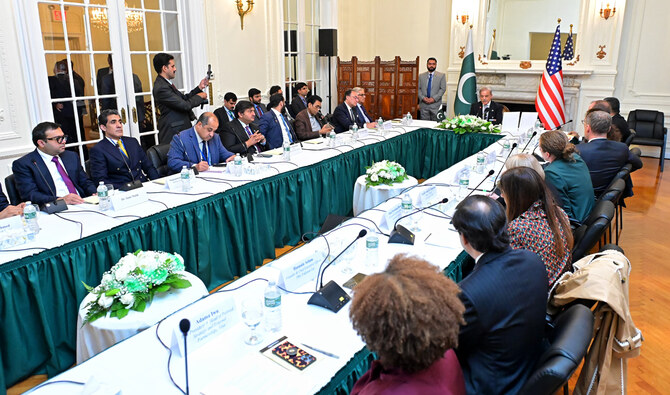
ISLAMABAD: Prime Minister Shehbaz Sharif on Friday met a delegation of the US-Pakistan Business Council (USPBC) in New York, introducing them to a special civil-military investment body set up last year to attract foreign funding and briefing them on government measures taken to improve ease of doing business.
Sharif’s government has actively pursued economic diplomacy in recent months and wants to strengthen ties with the US — strained in recent years by political tensions — and boost bilateral trade in goods and services, which the Pakistani embassy in Washington says now totals about $12 billion.
Sharif’s meeting with USPBC took place on the sidelines of the annual United Nations General Assembly, which the PM is scheduled to address later today, presenting his country’s stance on Israel’s war on Gaza, the lingering Kashmir dispute, growing global security deficit and climate change risks.
“In introducing the Special Investment Facilitation Council (SIFC) to the participants, the Prime Minister underscored that SIFC was a high-level, one-window agency empowered to facilitate foreign investors in planning and implementing their ventures in four key areas: agriculture, IT, energy, and mining,” a statement from Sharif’s office said after he met the USPBC delegation.
“The Prime Minister added that the SIFC aimed at bolstering investor confidence and expediting project implementation through customized solutions and demand-driven facilitation.”
Sharif identified various areas in Pakistan’s economy, particularly agriculture, technology, pharmaceutical, oil and gas and mining where he said US companies could benefit through mutually beneficial investments.
As Pakistan has sought approval for a $7 billion IMF loan in recent months — the approval was received this week — it has actively sought external financing from allies as well as looked at more sustainable forms such as direct investment and climate financing.
On Friday, an IMF official said Pakistan had received “significant financing assurances” from China, Saudi Arabia and the United Arab Emirates linked to the new IMF program that go beyond a deal to roll over $12 billion in bilateral loans owed to them by Islamabad.
The IMF’s Executive Board on Wednesday approved the new 37-month loan agreement for Pakistan that requires “sound policies and reforms” to strengthen macroeconomic stability.
The approval releases an immediate $1 billion disbursement to Islamabad.

Pakistan PM briefs US-Pakistan Business Council on special body set up for foreign investments
https://arab.news/5beru
Pakistan PM briefs US-Pakistan Business Council on special body set up for foreign investments
- Sharif’s government has actively pursued economic diplomacy in recent months and wants to strengthen ties with the US
- Islamabad aims to boost bilateral trade in goods and services, which Pakistani embassy in Washington says totals $12 billion
Pakistan, UK sign £35 million Green Compact to strengthen climate resilience
- Pakistan ranks among nations most vulnerable to climate change and has seen erratic changes in its weather patterns
- UK will help Pakistan mobilize climate finance, strengthen regulatory frameworks and develop bankable climate projects
ISLAMABAD: Pakistan and the United Kingdom (UK) have formalized a comprehensive climate partnership with the launch of a Green Compact that aims to enhance climate resilience, accelerate clean energy transition and scale up nature-based solutions, including mangrove conservation, Pakistani state media reported on Sunday.
The agreement, signed in Islamabad by Federal Minister for Climate Change and Environmental Coordination Dr. Musadik Malik and UK Minister for International Development Jennifer Chapman, unlocks £35 million in targeted support for green development and long-term climate action, according to Radio Pakistan broadcaster.
Pakistan ranks among nations most vulnerable to climate change and has seen erratic changes in its weather patterns that have led to frequent heatwaves, untimely rains, storms, cyclones, floods and droughts in recent years. In 2022, monsoon floods killed over 1,700 people, displaced another 33 million and caused over $30 billion losses, while another 1,037 people were killed in floods this year.
Mohammad Saleem Shaikh, a spokesperson for Pakistan’s Ministry of Climate Change, described the compact as a “decisive move toward action-oriented climate cooperation,” noting that its implementation over the next decade will be critical for Pakistan which regularly faces floods, heatwaves and water stress.
“The Compact is structured around five core pillars: climate finance and investment, clean energy transition, nature-based solutions, innovation and youth empowerment, and adaptation and resilience,” the report read.
“Under the agreement, the UK will work with Pakistan to mobilize public and private climate finance, strengthen regulatory frameworks for green investment, and develop bankable climate projects.”
Clean energy forms a central component of Pakistan’s transition, with Islamabad planning to expand solar and wind generation to reduce fossil fuel dependence, improve energy security and stabilize power costs, according to Shaikh.
“Renewable energy is now economically competitive, making the transition both environmentally and financially viable,” he was quoted as saying.
“Nature-based solutions, particularly large-scale mangrove restoration, will protect coastal communities from storm surges and erosion while enhancing biodiversity and carbon sequestration.”
Under the Compact, technical support, mentoring and access to investors will be provided to climate-smart startups and young innovators, reflecting Pakistan’s recognition of youth-led initiatives as central to future climate solutions.
On the occasion, Chapman, on her first official visit to Pakistan, underscored the urgency of climate action, highlighting the UK’s support for renewable energy, mangrove and ecosystem restoration, early-warning systems, climate budgeting and international investment flows into Pakistan.
Shaikh described the Green Compact as “a strategic turning point” in Pakistan–UK relations on climate change, saying its effective implementation is essential for Pakistan to meet its national climate targets.


