

Pakistan’s finance minister announces plan to abolish ‘non-filer’ status with punitive actions

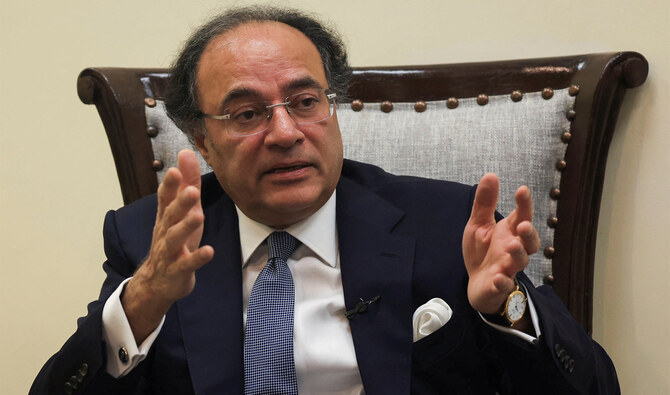
Pakistan Finance Minister Muhammad Aurangzeb speaks during an interview with Reuters at his office in Islamabad, Pakistan, on July 19, 2024. (REUTERS/File)
Short Url
Updated 27 September 2024
Follow

Pakistan’s finance minister announces plan to abolish ‘non-filer’ status with punitive actions

  • Previously, people in Pakistan paid nominal rates on various transactions to avoid filing tax returns
  • Muhammad Aurangzeb says the government is taking steps to improve tax compliance, enforcement

ISLAMABAD: Federal Minister for Finance and Revenue Muhammad Aurangzeb said on Thursday the government plans to eliminate the “non-filer” category by taking punitive actions against those who previously paid nominal amounts on various transactions to avoid filing tax returns.

The minister made the statement in an interview with Voice of America, a day after the International Monetary Fund (IMF) approved a $7 billion loan program to support Pakistan’s cash-strapped economy.

The government has implemented stringent economic reforms in recent years, including the removal of subsidies and increased power tariffs, based on recommendations from the global lender to stabilize the financial outlook before achieving macroeconomic stability.

Aurangzeb noted, after the loan approval in a separate statement, that Pakistan will face “transitional pain” if it aims to make this the last IMF program by continuing with structural reforms.

“Previously, we had this system where if someone was a non-filer, we said you can pay a nominal rate and stay outside the tax system,” he said during the interview. “Now, we’re taking it to a punitive level. It’s about time we address this invention of the non-filer status, which I think only exists in our country.”

“As a country, our hand has been forced,” he continued. “We no longer have the capacity to allow anyone in this country to remain a non-filer.”

The minister acknowledged that the IMF conditionalities had become more stringent with every loan program, attributing it to the “credibility and trust deficit.”

“We sign the structural benchmarks but never follow through,” he said. “That’s why they are strict. This time, we are going to go through the reforms.”

He maintained the government aims to widen the tax net by incorporating the agriculture, retail and wholesale sectors.

He also pointed out that measures are being taken to improve compliance and enforcement, which had previously been weak.

The IMF and World Bank chiefs have already praised Pakistan’s recent economic reforms, though international lending agencies also stress the need to stay the course in order to further strengthen the national economy.


Pakistan, China to sign multiple MoUs at major agriculture investment conference today

Updated 18 January 2026
Follow

Pakistan, China to sign multiple MoUs at major agriculture investment conference today

  • Hundreds of Chinese and Pakistani firms to attend Islamabad event
  • Conference seen as part of expanding CPEC ties into agriculture, trade

KARACHI: Islamabad and Beijing are set to sign multiple memorandums of understanding (MoUs) to boost agricultural investment and cooperation at a major conference taking place in the capital today, Monday, with hundreds of Chinese and Pakistani companies expected to participate.

The conference is being billed by Pakistan’s Ministry of National Food Security and Research as a platform for deepening bilateral agricultural ties and supporting broader economic engagement between the two countries.

“Multiple memorandums of understanding will be signed at the Pakistan–China Agricultural Conference,” the Ministry of National Food Security said in a statement. “115 Chinese and 165 Pakistani companies will participate.”

The conference reflects a growing emphasis on expanding Pakistan-China economic cooperation beyond the transport and energy foundations of the flagship China-Pakistan Economic Corridor (CPEC) into agriculture, industry and technology.

Under its first phase launched in 2015, CPEC, a core component of China’s Belt and Road Initiative, focused primarily on transportation infrastructure, energy generation and connectivity projects linking western China to the Arabian Sea via Pakistan. That phase included motorways, power plants and the development of the Gwadar Port in the country's southwest, aimed at helping Pakistan address chronic power shortages and enhance transport connectivity.

In recent years, both governments have formally moved toward a “CPEC 2.0” phase aimed at diversifying the corridor’s impact into areas such as special economic zones, innovation, digital cooperation and agriculture. Second-phase discussions have highlighted Pakistan’s goal of modernizing its agricultural sector, attracting Chinese technology and investment, and boosting export potential, with high-level talks taking place between planning officials and investors in Beijing.

Agri-sector cooperation has also seen practical collaboration, with joint initiatives examining technology transfer, export protocols and value-chain development, including partnerships in livestock, mechanization and horticulture.

Organizers say the Islamabad conference will bring together government policymakers, private sector investors, industry associations and multinational agribusiness firms from both nations. Discussions will center on investment opportunities, technology adoption, export expansion and building linkages with global buyers within the framework of Pakistan-China economic cooperation.