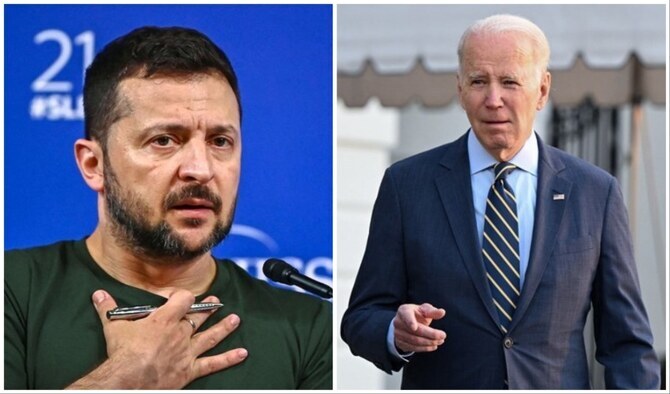
WASHINGTON: Ukrainian President Volodymyr Zelensky met Joe Biden at the White House Thursday to present his wartime “victory plan,” after the US president announced an $8 billion surge in military aid for Kyiv’s fight against Russia.
But Zelensky’s visit was clouded by a blazing row with Republican presidential candidate Donald Trump that underscored how November’s US election could upend the support that Kyiv receives from its biggest backer.
“Russia will not prevail. Ukraine will prevail, and we’ll continue to stand by you every step of the way,” Biden said as he hosted Zelensky in the Oval Office, after thanking him for presenting the so-called victory plan.
Dressed in his trademark military-style outfit, Zelensky replied that “we deeply appreciate that Ukraine and America have stood side by side.”
Zelensky is looking to shore up support for his war effort at the same time as Biden tries to lock in aid for Ukraine, ahead of the white-knuckle vote pitting Biden’s Vice President Kamala Harris against firebrand Trump.
The Democrat pledged nearly $8 billion in military aid in his announcement on Thursday, including $5.5 billion to be authorized before it expires at the end of the US fiscal year on Monday.
Biden said in a statement that the “surge in security assistance for Ukraine” would “help Ukraine win this war.”
Biden also announced Washington would provide Ukraine with the Joint Standoff Weapon (JSOW) long-range munition and called a summit of allies in Germany in October.
The White House however played down Ukraine’s hopes that Zelensky’s visit would achieve his long-held goal of getting permission to fire long-range Western-made missiles into Russian territory.
“I’m not expecting there to be any new announcements on this particular action or a decision coming out of this meeting,” Press Secretary Karine Jean-Pierre told reporters.
Harris was due to meet Zelensky separately at the White House on Thursday.
Zelensky also visited the US Congress — where his government said he had also presented his victory plan — and gave a defiant address at the UN General Assembly on Wednesday.
But Zelensky’s visit has prompted fresh nuclear saber rattling from Moscow, which has repeatedly warned the West against giving Ukraine long-range arms.
President Vladimir Putin on Wednesday announced plans to broaden Moscow’s rules on the use of its atomic weaponry in the event of a “massive” air attack.
US Secretary of State Antony Blinken called the nuclear threat “totally irresponsible” while EU foreign policy spokesman Peter Stano said Putin was making a “gamble with his nuclear arsenal.”
Kyiv faces an increasingly difficult battlefield situation two and a half years into Russia’s invasion, with Russian forces continuing to push into eastern Ukraine.
But the US presidential election means Washington’s support now hangs on the balance — and with Zelensky apparently at odds with Trump and the Republicans.
Trump had also been due to meet Zelensky during his US visit, but their talks now appear to be on ice.
Trump accused Zelensky on the eve of the visit of refusing to strike a deal with Moscow and once again questioned why the United States was giving billions of dollars to Kyiv.
At an election rally on Wednesday, the Republican called the Ukrainian president “probably the greatest salesman on Earth.”
Republicans were livid after Zelensky visited an arms factory in Biden’s hometown in the battleground state of Pennsylvania earlier this week, with House Speaker Mike Johnson calling for the Ukrainian ambassador to be sacked.
Zelensky also sparked fury in Republican ranks when he told The New Yorker magazine this week that Trump and his running mate J.D. Vance did not understand the war’s complexity.
Trump has echoed many of Putin’s talking points about previous US policy being to blame for the Russian invasion, and has been critical of Zelensky for years.
The United States has provided around $175 billion in both military and economic assistance to Ukraine during the war, despite frequent opposition from Republicans.


![]()

Zelensky meets Biden after US unveils Ukraine military aid surge
Short Url
https://arab.news/223sv
Zelensky meets Biden after US unveils Ukraine military aid surge
- Zelensky’s visit was clouded by a blazing row with Republican presidential candidate Donald Trump
- “Russia will not prevail. Ukraine will prevail, and we’ll continue to stand by you every step of the way,” Biden said


Latest updates


© 2026 SAUDI RESEARCH & PUBLISHING COMPANY, All Rights Reserved And subject to Terms of Use Agreement.