

Philippines to launch first nuclear power plant by 2032 

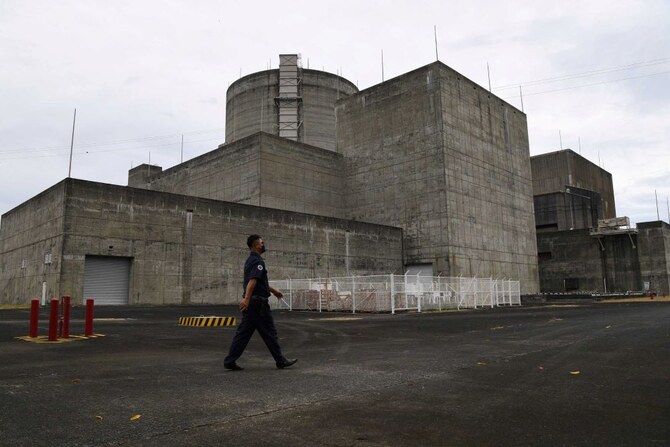
A security guard walks in front of the main gate of the Bataan Nuclear Power Plant in the town of Morong in Bataan province, north of Manila, April 5, 2022. (AFP)
Short Url
Updated 26 September 2024
Follow

Philippines to launch first nuclear power plant by 2032 

  • Under national energy plan, Manila aims to have 4,800 MW of nuclear capacity by 2050
  • Philippine energy demand is expected to increase fourfold from 2020 to 2040

MANILA: The Philippines is planning for its first nuclear facility to be operational by 2032 and aims to add at least 1,200 megawatts of atomic power to the country’s grid, the Department of Energy has announced.

The government is exploring nuclear as an alternative energy option to reduce the Philippines’s dependency on coal, which is mostly imported and accounts for over half its power generation. 

“We aim to have commercially operational nuclear power plants by 2032, with at least 1,200 MW initially entering the country’s power mix, gradually increasing to 4,800 MW by 2050,” Undersecretary of Energy Sharon Garin said in a statement on Wednesday. 

As part of the Philippine Energy Plan, the government will establish an independent nuclear regulatory authority to oversee the safe and secure development of the Philippines’ nuclear energy program. It will prioritize legislation focused on nuclear safety, covering aspects of public health, environmental protection and national security, according to the Department of Energy. 

“The beneficial uses of nuclear technology have been extensive across sectors, leading to improved quality of life. These uses span the fields of health and medical, agriculture, industrial and energy,” Garin said. 

The Philippines joins other Asian countries, including Vietnam and Indonesia, which are considering nuclear power in order to meet rapidly rising power demands and reduce dependence on fossil fuels. 

Manila stopped accepting new proposals for coal-based power projects in 2020 to encourage investment in other energy sources. 

Under the national energy plan, the government aims to increase the share of renewable energy sources in the energy mix from 22 percent currently to 50 percent by 2040.

Philippine authorities expect the country’s power demand to increase almost fourfold from 2020 to 2040, especially as it remains dependent on imported fossil fuels and has insufficient renewables.

“The Philippines energy mix is precarious — 60 percent imported coal, 20 percent from depleting Malampaya gas,” Carlo Arcilla, director of the Philippine Nuclear Research Institute, told Arab News, referring to a gas field in the western Philippines that is expected to run dry by 2027.

“We actually need more nuclear because most of the Philippines’ electricity comes from coal ... Coal and gas, which are base load, are polluting and expensive. No choice (for the Philippines) but clean and dependable nuclear as base load support for renewables.”

The Philippines is home to Southeast Asia’s first nuclear power plant, which was completed in 1986 but has never produced electricity. It was never used and was closed due to safety concerns following the Chernobyl disaster in Ukraine in April 1986.


N Korean leader’s daughter fuels succession speculation with mausoleum visit

Updated 2 sec ago
Follow

N Korean leader’s daughter fuels succession speculation with mausoleum visit

SEOUL: The North Korean leader’s daughter Kim Ju Ae has made her first public visit to a mausoleum housing her grandfather and great-grandfather, state media images showed Friday, further solidifying her place as likely next in line to run the nuclear-armed dictatorship.
The Kim family has ruled North Korea with an iron grip for decades, and a cult of personality surrounding their so-called “Paektu bloodline” dominates daily life in the isolated country.
Current leader Kim Jong Un is the third in line to rule in the world’s only communist monarchy, following his father Kim Jong Il and grandfather Kim Il Sung.
The two men — dubbed “eternal leaders” in state propaganda — are housed in the Kumsusan Palace of the Sun, a vast mausoleum in downtown Pyongyang.
The state-run Korean Central News Agency (KCNA) reported that Kim Jong Un had visited the palace, accompanied by top officials. Images released by the agency showed daughter Ju Ae alongside him.
South Korea’s spy agency said last year she was now understood to be the next in line to rule North Korea after she accompanied her father on a high-profile visit to Beijing.

- ‘Presented as Kim’s successor’ -

And Cheong Seong-chang at Seoul’s Sejong Institute said he expected her to soon be “formally confirmed as the next successor both domestically and internationally.”
Cheong, author of a book on the Kim leadership, said her placement in the center of the front row during her visit to the place — a place typically reserved for her father — was especially notable.
It could be “interpreted as reporting to the ‘eternal leaders’ Kim Il Sung and Kim Jong Il that she is being presented as his successor,” he said.
Ju Ae was publicly introduced to the world in 2022 when she accompanied her father to an intercontinental ballistic missile launch.
North Korean state media have since referred to her as “the beloved child,” and a “great person of guidance” — “hyangdo” in Korean — a term typically reserved for top leaders and their successors.
Before 2022, the only confirmation of her existence had come from former NBA star Dennis Rodman, who made a visit to the North in 2013.
Analysts have suggested that she could be elected First Secretary of the Central Committee, the second most powerful position in the North Korean ruling party, at a landmark congress due to be held in the coming weeks.
On Thursday, footage showed Ju Ae accompanying her parents at New Year celebrations in Pyongyang.
While first lady Ri Sol Ju kept a low profile, state TV showed Ju Ae placing one hand on the North Korean leader’s face and kissing him on the cheek — a rare public display of affection which drew headlines in South Korea.