

Pakistan opposition party moves court against ordinance seen as curtailing senior judiciary’s powers 

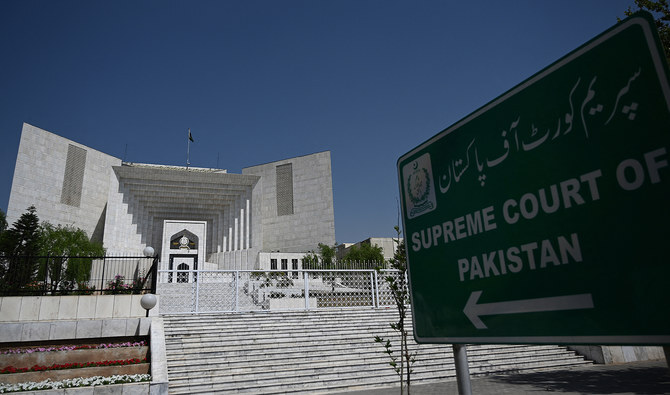
A general view of the Pakistan's Supreme Court is pictured in Islamabad, Pakistan, on April 6, 2022. (AFP/File)
Short Url
Updated 26 September 2024
Follow

Pakistan opposition party moves court against ordinance seen as curtailing senior judiciary’s powers 

  • Under new ordinance, top court cases to be heard by bench comprising CJ, next most senior judge and SC judge nominated by CJ
  • PTI party has filed petition against the ordinance calling for it to be declared unconstitutional, threat to separation of powers

ISLAMABAD: The Pakistan Tehreek-e-Insaf (PTI) opposition party on Thursday moved the top court against a new ordinance passed by the coalition government of Prime Minister Shehbaz Sharif, and which is widely seen as a tool to curtail the powers of the country’s senior judiciary.

The Supreme Court (Practice and Procedure) Act 2023 was passed in the last days of Sharif’s first term in government, which ended last year. However, before the law could be enacted on April 21, 2023, an eight-member bench constituted by then Chief Justice Umar Ata Bandial issued a stay order on it on April 13, 2023.

Last Friday, however, President Asif Ali Zardari signed the Supreme Court (Practice and Procedure) Amendment Ordinance 2024 into law.

PTI Chairman Gohar Khan on Thursday filed a petition against the ordinance, requesting that it be declared “unconstitutional” and all decisions of the Practice and Procedure Committee, which assigns judges to Supreme Court cases, taken after the approval of the ordinance be declared “illegal” and “annulled.”

The plea calls on the court to suspend the newly constituted Practice and Procedure Committee as long as the constitutional petition was pending. 

“Further, the committee purportedly re-constituted pursuant to the Impugned Ordinance may kindly be restrained from constituting benches and fixing any cases before them and the lawfully constituted Committee under Supreme Court (Practice and Procedure) Act, 2023 consisting of the Chief Justice of Pakistan and the two next senior most judges may be allowed to continue functioning,” the plea said. 

The new ordinance reads:

“Every cause, appeal, or matter before the Supreme Court shall be heard and disposed of by a Bench comprising the Chief Justice of Pakistan, the next most senior judge of the Supreme Court and a Judge of the Supreme Court nominated by the Chief Justice of Pakistan from time to time.”

One provision, which is widely seen as limiting the power of Supreme Court judges to initiate cases of public importance or fundamental laws on their own through suo moto proceedings, said a bench hearing a matter under Article 184(3) of the constitution would decide and identify through a “reasoned and speaking order” the question of public importance in the case and what fundamental right it was seeking to enforce.

Article 184 of the constitution confers original jurisdiction, the authority to hear a case at its initiation, often referred to as Public Interest Litigation, in the form of judicial review to Pakistan’s Supreme Court. Clause (3) of Article 184 is cited as the source of suo motu powers. In essence, it gives the apex court the extraordinary power to assume jurisdiction over any “question of public importance with reference to the enforcement of any fundamental right”.

Under the new law, each case would be heard in turn, that is the cases filed first will be heard first, and a reason furnished for taking up cases out of turn. All hearings will be recorded and transcripts publicly available. 

The PTI petition says the ordinance violates the principles of separation of powers and the independence of the judiciary.

“Therefore, it is liable to be struck down,” it said. 

“The rights of access to justice and fair trial also require a judiciary that is separate and independent of the Executive. The Impugned Ordinance is a direct attempt to interfere, alter, and control the inner working of the Supreme Court and is thus unconstitutional and liable to be struck down.”

The plea stated that if the ordinance was upheld or accepted as valid law, it would amount to accepting that whenever the government was particularly interested in a case fixed before the SC, it would have the power to alter and amend how and when the case was fixed and before whom through the exercise of its temporary or permanent legislative power.

“This is a gross violation of the independence of judiciary, and guarantee of fair trial, and is clearly unconstitutional,” the PTI plea says. 


Pakistan, global crypto exchange discuss modernizing digital payments, creating job prospects 

Updated 05 December 2025
Follow

Pakistan, global crypto exchange discuss modernizing digital payments, creating job prospects 

  • Pakistani officials, Binance team discuss coordination between Islamabad, local banks and global exchanges
  • Pakistan has attempted to tap into growing crypto market to curb illicit transactions, improve oversight

ISLAMABAD: Pakistan’s finance officials and the team of a global cryptocurrency exchange on Friday held discussions aimed at modernizing the country’s digital payments system and building local talent pipelines to meet rising demand for blockchain and Web3 skills, the finance ministry said.

The development took place during a high-level meeting between Finance Minister Muhammad Aurangzeb, Pakistan Virtual Assets Regulatory Authority (PVARA) Chairman Bilal bin Saqib, domestic bank presidents and a Binance team led by Global CEO Richard Teng. The meeting was held to advance work on Pakistan’s National Digital Asset Framework, a regulatory setup to govern Pakistan’s digital assets.

Pakistan has been moving to regulate its fast-growing crypto and digital assets market by bringing virtual asset service providers (VASPs) under a formal licensing regime. Officials say the push is aimed at curbing illicit transactions, improving oversight, and encouraging innovation in blockchain-based financial services.

“Participants reviewed opportunities to modernize Pakistan’s digital payments landscape, noting that blockchain-based systems could significantly reduce costs from the country’s $38 billion annual remittance flows,” the finance ministry said in a statement. 

“Discussions also emphasized building local talent pipelines to meet rising global demand for blockchain and Web3 skills, creating high-value employment prospects for Pakistani youth.”

Blockchain is a type of digital database that is shared, transparent and tamper-resistant. Instead of being stored on one computer, the data is kept on a distributed network of computers, making it very hard to alter or hack.

Web3 refers to the next generation of the Internet built using blockchain, focusing on giving users more control over their data, identity and digital assets rather than big tech companies controlling it.

Participants of the meeting also discussed sovereign debt tokenization, which is the process of converting a country’s debt such as government bonds, into digital tokens on a blockchain, the ministry said. 

Aurangzeb called for close coordination between the government, domestic banks and global exchanges to modernize Pakistan’s payment landscape.

Participants of the meeting also discussed considering a “time-bound amnesty” to encourage users to move assets onto regulated platforms, stressing the need for stronger verifications and a risk-mitigation system.

Pakistan has attempted in recent months to tap into the country’s growing crypto market, crack down on money laundering and terror financing, and promote responsible innovation — a move analysts say could bring an estimated $25 billion in virtual assets into the tax net.

In September, Islamabad invited international crypto exchanges and other VASPs to apply for licenses to operate in the country, a step aimed at formalizing and regulating its fast-growing digital market.