

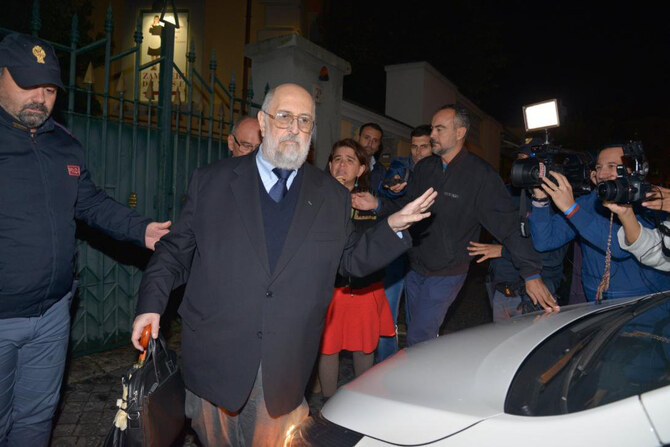

VATICAN CITY: Pope Francis took the unusual decision Wednesday to expel 10 people – a bishop, priests and laypeople — from a troubled Catholic movement in Peru after a Vatican investigation uncovered “sadistic” abuses of power, authority and spirituality.
The move against the leadership of the Sodalitium Christianae Vitae, or Sodalitium of Christian Life, followed Francis’ decision last month to expel the group’s founder, Luis Figari, after he was found to have sodomized his recruits.
It was announced by the Peruvian Bishops Conference, which posted a statement from the Vatican embassy on its website that attributed the expulsions to a “special” decision taken by Francis.
The statement was astonishing because it listed abuses uncovered by the Vatican investigation that have rarely if ever been punished canonically — such as hacking someone’s communications — and cited the people the pope held responsible.
According to the statement, the Vatican investigators uncovered physical abuses “including with sadism and violence,” sect-like abuses of conscience, spiritual abuse, abuses of authority, economic abuses in administering church money and the “abuse in the exercise of the apostolate of journalism.”
The latter was presumably aimed at a Sodalitium journalist who has attacked critics of the movement on social media.
Figari founded the SCV, as it is known, in 1971 as a lay community to recruit “soldiers for God,” one of several Catholic societies born as a conservative reaction to the left-leaning liberation theology movement that swept through Latin America, starting in the 1960s. At its height, the group counted about 20,000 members across South America and the United States. It was enormously influential in Peru.
Victims of Figari’s abuses complained to the Lima archdiocese in 2011, though other claims against him reportedly date to 2000. But neither the local church nor the Holy See took concrete action until one of the victims, Pedro Salinas, wrote a book along with journalist Paola Ugaz detailing the twisted practices of the Sodalitium in 2015, entitled “Half Monks, Half Soldiers.”

Front page of the Lima-based Spanish-language newspaper Peru 21 featuring the expulsion of Solidatium founder Luis Figari from the Roman Catholic church. The main story says, "The fall of the abuser". (X: @valienteslatam)
An outside investigation ordered by Sodalitium later determined that Figari was “narcissistic, paranoid, demeaning, vulgar, vindictive, manipulative, racist, sexist, elitist and obsessed with sexual issues and the sexual orientation” of Sodalitium’s members.
The investigation, published in 2017, found that Figari sodomized his recruits and forced them to fondle him and one another. He liked to watch them “experience pain, discomfort and fear,” and humiliated them in front of others to enhance his control over them, the report found.
Still, the Holy See declined to expel Figari from the movement in 2017 and merely ordered him to live apart from the Sodalitium community in Rome and cease all contact with it. The Vatican was seemingly tied in knots by canon law that did not foresee such punishments for founders of religious communities who weren’t priests. Victims were outraged.
But according to the findings of the latest Vatican investigation, the abuses went beyond Figari. They included Sodalitium clergy and also involved harassing and hacking the communications of their victims, all while covering up crimes committed as part of their official duties, according to the statement.
The investigation was carried out by the Vatican’s top sex crimes investigators, Maltese Archbishop Charles Scicluna and Monsignor Jordi Bertomeu, from the Dicastery for the Doctrine of the Faith, who traveled to Lima last year to take testimony from victims.
The highest-ranking person ordered expelled was Archbishop Jose Antonio Eguren, whom Francis already forced to resign as bishop of Piura in April over his record, after he sued Salinas and Ugaz for their reporting.
In addition to Figari’s own abuses, their reporting had exposed the alleged forced eviction of peasants on lands in Eguren’s diocese by a Sodalitium-linked real estate developer.
Ugaz, the journalist, welcomed the expulsions and said the reference to Sodalitium hacking referred to her: She said her communications had been hacked in 2023 after she reported on the Sodalitium’s off-shore holdings and other financial dealings, and said she believed the group was trying to identify her sources.
“It is a demonstration that in Peru, the survivors would never have found justice and reparation (without Bertomeo and Scicluna) because the Sodalitium is an organization with a lot of political, social and economic power,” she said in a statement to The Associated Press.
Salinas, for his part, repeated that the group should be dissolved entirely and that some key figures were not included on the list.
“It’s very good news after 24 years of impunity,” he said in a message to AP. “It is to be hoped that this historic and memorable news is only the first of more, perhaps more impactful than what we know today.”
The release of such detailed information by the Vatican was highly unusual for an institution that is known more for secrecy, opacity and turning a blind eye to even obvious church crimes.
It is unclear how exactly the expulsions can be enforced or what they will mean in practical terms, especially for the laypeople involved. But at a minimum, the very public announcement would suggest that at least for this particular group, Francis was willing to take an unorthodox approach to interpreting the church’s in-house laws to send a message.
“To take such a disciplinary decision, consideration was given to the scandal that was produced by the number and gravity of the abuses that were denounced by victims, which are particularly contrary to the balanced and liberating experience of the evangelical councils,” the Vatican embassy statement said in explaining the rationale for the punishments.
The Vatican statement said the Peruvian bishops joined Francis in “seeking the forgiveness of the victims” while calling on the troubled movement to initiate a journey of justice and reparation.
There was no immediate response to a request for comment from the Sodalitium.


