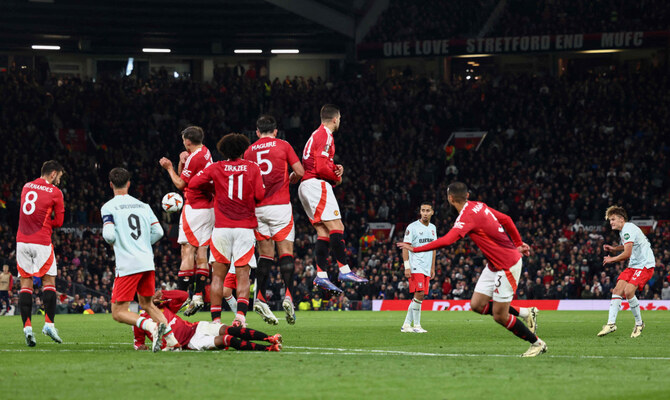
MANCHESTER, England: Manchester United manager Erik ten Hag questioned his players’ killer instinct after they were held to a 1-1 draw by his old club FC Twente in the revamped Europa League on Wednesday.
Sam Lammers capitalized on a mistake by Christian Eriksen in the second half at Old Trafford and raced away to fire an equalizer for the Dutch underdog.
“You saw that was the game of their life. They fought for every yard and we didn’t,” Ten Hag said. “99 percent is not enough, You have to give 100 percent. You have kill the game. You have to finish it off.”
Eriksen had put United ahead with a stunning first-half strike but was caught in possession by Lammers, whose goal secured an unexpected point for the visitors.
Ten Hag had spoken before the game of his affection for the team he supported as a boy in the Netherlands and represented as a player. He said it was “not nice to have to hurt something you love.”
Instead it was United fans left in pain, despite Eriksen seemingly putting the home team on course for victory.
United has won just three of seven games in all competitions this season and Wednesday’s draw came after a 0-0 draw at Crystal Palace in the Premier League on Saturday.
Eriksen swept United ahead in the 35th with a first-time shot into the top corner. Connecting with a loose ball just inside the box, the playmaker didn’t break stride as he whipped his effort past past Twente goalkeeper Lars Unnerstall with power and precision.
With one fist clenched, he ran to the corner to celebrate in front of the home fans.
But it was Twente’s supporters left cheering the loudest after Lammers’ goal in the 68th when beating Andre Onana at his near post.
“There’s a lot of football (still to play) when you (are) one up and the game takes more than 90 minutes,” Ten Hag said. “And you have to fight until the end and score the second goal.”
Like the Champions League, the second-tier Europa League has a new format and 36 teams instead of 32. It features a league system in which each team plays eight games against different opponents through January, replacing the old group stage.
Lazio cruises, Osimhen assists
In a clash between the Turkish and Greek champions, Galatasaray beat PAOK 3-1. Victor Osimhen, who moved from Napoli to Galatasaray earlier in September, made his presence felt. The Nigeria striker’s goalbound header was deflected by defender Abdul Rahman Baba into his own net early in the second half. Giannis Konstantelias equalized on a rebound before Osimhen set up Yunus Akgün to net the winner. Mauro Icardi added a stoppage-time goal.
Lazio cruised past Dynamo Kyiv 3-0. Boulaye Dia struck twice and Fisayo Dele-Bashiru added one. Both teams ended the game with 10 men.
Real Sociedad, struggling in La Liga, got a goal from Ander Barrenetxea at Nice but the home team salvaged a 1-1 draw thanks to Pablo Rosario’s goal late in the first half.
Another team struggling domestically, Bundesliga’s Hoffenheim took home a point from Denmark in a 1-1 draw with Danish Superliga’s leader Midtjylland. Darío Osorio put the hosts ahead late in the first half before substitute Max Moerstedt leveled it in the final minute.
In Brussels, Anderlecht struck twice in the span of five minutes in the second half on the way to a 2-1 victory over Ferencváros. Yari Verschaeren scored on the hour and Kasper Dolberg added the second from the spot.
Slavia Prague scored in each half for a 2-0 win at Bulgaria’s Ludogorets.
Early wins
Norwegian club Bodø/Glimt and Dutch side AZ Alkmaar became the first teams to claim victories earlier on Wednesday.
Jens Petter Hauge’s two goals guided 10-man Bodø/Glimt from a goal down to a 3-2 win over Porto while Troy Parrott netted the winner from the penalty spot for Alkmaar to beat Sweden’s Elfsborg 3-2.
Porto, a two-time champion in Europe’s second-tier league, got an early goal from Samu. Kasper Høgh’s equalized and Hauge netted twice for a 3-1 lead. Porto reduce the deficit to one in the final minute through substitute Deniz Gül.
Alkmaar answered Timothy Ouma’s opener with two goals from Ruben van Bommel on both sides of the interval. Simon Hedlund made it 2-2 before Parrott’s late penalty.
Ahead of a late game between Dynamo Kyiv and Lazio, a group of about 60 Lazio fans were stopped by German authorities in Hamburg after attempting to avoid a police escort and were found to be carrying knives, clubs and other weapons. Fans who were held overnight were banned from attending Wednesday’s game but there were no arrests.
Dynamo plays its home Europa League games in Hamburg because of the Russian invasion of Ukraine.


![]()

Man United stunned 1-1 by Dutch club Twente in revamped Europa League
Short Url
https://arab.news/57qq7
Man United stunned 1-1 by Dutch club Twente in revamped Europa League
- United has won just three of seven games in all competitions this season and Wednesday’s draw came after a 0-0 draw at Crystal Palace in the Premier League on Saturday


Latest updates


Recommended


© 2026 SAUDI RESEARCH & PUBLISHING COMPANY, All Rights Reserved And subject to Terms of Use Agreement.