

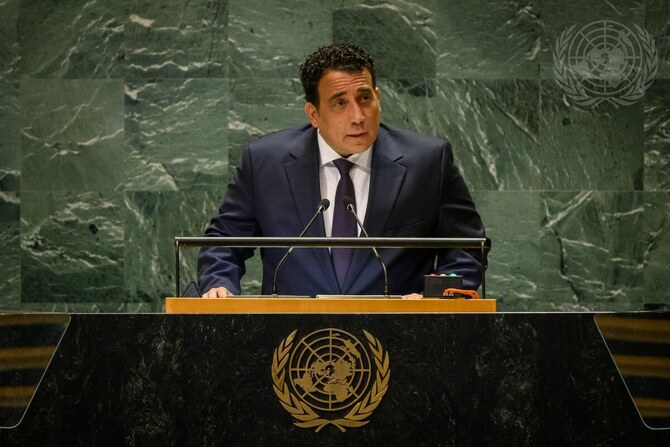

NEW YORK CITY: The head of Libya’s Presidential Council on Wednesday joined growing voices of condemnation at the UN General Assembly of Israel’s actions in the Middle East as he spoke of its “crimes of genocide and ethnic cleansing” perpetrated against the Palestinian people.
Mohamed Al-Menfi, who was speaking during the second day of the general debate in New York City, said that Israel’s onslaught in the Gaza Strip amid its battle with Hamas, which has claimed the lives of tens of thousands of Palestinian civilians, was a blatant violation of international law.
He reaffirmed Libya’s solidarity with Palestine, while emphasizing the right of the Palestinian people to determine their own destiny and establish an independent state with East Jerusalem as its capital.
“In this regard, we refer to Libya’s joining South Africa in the case raised before the International Criminal Court regarding Israel and its serious violations of laws, resolutions, and international charters, to promote accountability for the violations and genocide that the Palestinian people are being exposed to,” he said.
Al-Menfi also addressed the “urgent issues” of illegal migration and terrorism facing Libya today.
He said that his country, one that serves as a major transit point for migrants attempting to reach Europe, bears a burden in managing migration flows, adding it was an issue which required the assistance of the international community to tackle.
“We believe that solving this issue requires collective efforts, while ensuring the consideration of national legislations and humanitarian aspects and protecting the rights of migrants,” he said. “There’s need for a balanced approach that respects the dignity of migrants, acknowledging their vulnerabilities in the face of harsh migration conditions.”
Al-Menfi was frank about the scourge of terrorism on Libya, particularly the threat posed by extremist groups such as Daesh.
He said that while Libya had made strides in combating terrorism with the help of the international community, a coordinated effort from within the country was essential to keeping its impact at bay.
“We continue to work on enhancing internal security and securing the borders through cooperation with the international community to establish security centers for coordinating efforts among various national security forces and neighboring countries,” he said.
“The fight against terrorism is not just a military confrontation, it is a multifaceted phenomenon that requires the concerted efforts of local and international parties, and a comprehensive approach that addresses its various dimensions.
“Despite the importance of the UN’s efforts in this regard, we see the necessity of developing a national mechanism to confront these challenges away from negative interventions,” he added.
During his address, Al-Menfi also urged unity among Libyans to overcome internal divisions and foreign interventions that he said threatened national stability.
He called on the international community to support Libya in its journey toward national reconciliation and to help foster a stable and peaceful future for its citizens by backing legitimate elections.
“A comprehensive political solution is the only path to unify institutions and ensure stability, leading to elections, renewing legitimacy for all institutions, and allowing the Libyan people to determine their destiny,” he said.
“The Libyans should be given the opportunity to decide their future by renewing legitimacy and restoring authority that some parties seek to exclude, the Libyan people are the best to determine their fate, and the people should be the arbiter in choosing their representatives.
“Returning to them through free referendums and holding inclusive elections is the best solution to end any political deadlock.”


