

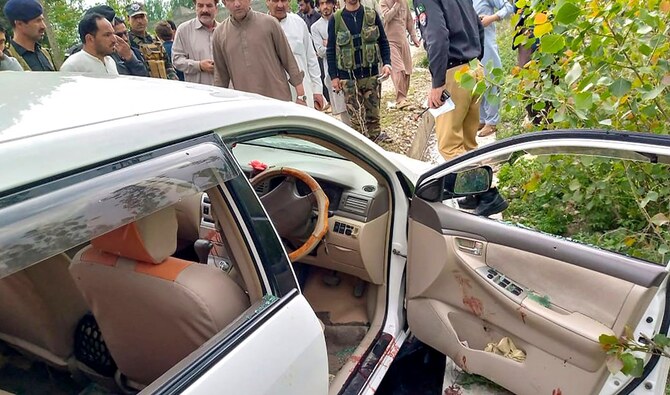
25 people killed in days-long sectarian clashes in Pakistan

This handout photograph taken and released by the Pakistan's Office of Assistant Commissioner Parachinar district Kurram, on May 4, 2023 shows security personnel and officials at the site of sectarian violence in a school on the outskirts of Parachinar. (AFP/File)
Short Url
Updated 25 September 2024
Follow

25 people killed in days-long sectarian clashes in Pakistan

  • Last round of hostilities in northwestern Kurram district killed 35 in July 
  • Heavy weapons including mortar shells are being used in ongoing clash.

PESHAWAR: The death toll from sectarian clashes between two tribes in northwestern Pakistan has risen to 20, a local official said Wednesday, as a deadly feud entered its fifth day.

The dispute has injured 75 people in Kurram district near the border with Afghanistan, an area with a history of bloody clashes between Shia and Sunni tribes.

The last round of hostilities in July killed 35 people and ended only after a jirga, or tribal council, called a ceasefire. Officials are now attempting to broker a fresh truce.

“Dozens of homes have been damaged... all efforts by the government and other tribes to end the fighting have failed,” a senior administrative official stationed in Kurram told AFP on condition of anonymity.

Heavy weapons including mortar shells are being used in the ongoing clash.

“One side is reportedly using Iranian-made weapons, though this will be investigated later,” said Aftab Alam, the law minister of Khyber Pakhtunkhwa province.

Feuds can be particularly violent in the northwestern province, where clashes between tribes are common.

In Pakistan, a predominantly Sunni Muslim country, the Shiite community says they have long suffered discrimination and violence.


IAEA approves safeguards for Pakistan’s Chashma nuclear power plant unit — FO

Updated 6 sec ago
Follow

IAEA approves safeguards for Pakistan’s Chashma nuclear power plant unit — FO

  • Move reflects world’s confidence in Pakistan’s commitment to peaceful use of nuclear energy, non-proliferation, says FO
  • Says after completion, power plant’s unit will provide substantial source of low-carbon electricity to the national grid

ISLAMABAD: Pakistan’s foreign office said on Wednesday that the International Atomic Energy Agency’s (IAEA) board of governors has approved a safeguards agreement with Islamabad for a unit of its Chashma nuclear power plant, reflecting the world’s growing confidence in the South Asian country’s commitment to peaceful use of nuclear energy. 

Under a safeguards agreement, the IAEA has the right and obligation to ensure that safeguards are applied on all nuclear material in the territory, jurisdiction or control of a state to verify that such material is not diverted to nuclear weapons or other nuclear explosive devices.

The agreement pertains to Unit 5 of the Chashma nuclear power plant located in Pakistan’s eastern Punjab province. The plant will have a gross capacity to generate 1,200 megawatts, with its pressurized water reactor expected to become operational by 2030, the foreign office said. 

“This important development reflects the international community’s continued confidence in Pakistan’s commitment to the peaceful use of nuclear energy and its adherence to global non-proliferation and safeguards obligations,” the statement said. 

It said after completion, the plant’s Unit 5 will provide a substantial source of low-carbon electricity to Pakistan’s national grid, contributing to energy security, climate goals and sustainable economic growth.

Over the past year, nuclear power accounted for 18.3 percent of Pakistan’s national electricity mix and 34 percent of the country’s total low-carbon electricity generation. 

Pakistan currently operates six nuclear power plants with a combined installed capacity of 3,530 megawatts, the foreign office said. 

“With more than 100 reactor-years of operational experience, Pakistan maintains a strong record of safe, secure and fully safeguarded nuclear power operations in line with international standards,” the statement included. 

Despite contributing less than one percent to greenhouse gas emissions worldwide, Pakistan is ranked among the world’s most vulnerable nations to climate change effects. 

Torrential rains and floods in 2022 and 2025 wreaked havoc across the country, killing thousands and inflicting damages of billions of dollars on the country.