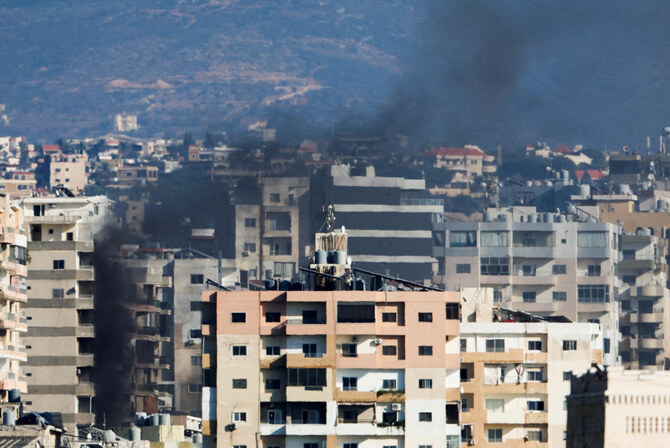
NEW YORK: The US, France and other allies jointly called Wednesday for an “immediate” 21-day ceasefire to allow for negotiations in the escalating conflict between Israel and Hezbollah that has killed more than 600 people in Lebanon in recent days.
The joint statement, negotiated on the sidelines of the United Nations General Assembly in New York, says the recent fighting is “intolerable and presents an unacceptable risk of a broader regional escalation.”
“We call for an immediate 21-day ceasefire across the Lebanon-Israel border to provide space for diplomacy,” the statement reads. “We call on all parties, including the Governments of Israel and Lebanon, to endorse the temporary ceasefire immediately.”
The signatories include the United States, Australia, Canada, the European Union, France, Germany, Italy, Japan, Saudi Arabia, United Arab Emirates and Qatar.
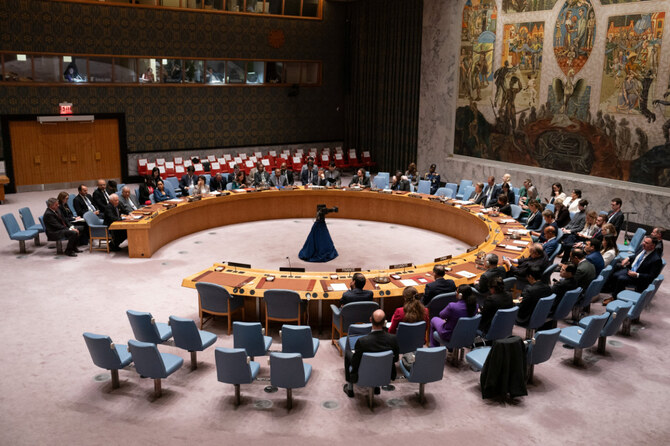
French Foreign Minister Jean-Noël Barrot told the UN Security Council during a meeting that “we are counting on both parties to accept it without delay.”
Barrot said France, a former colonial power to Lebanon, and the US had consulted with the sides on “final parameters for a diplomatic way out of this crisis,” adding that “war is not unavoidable.”
US deputy ambassador to the UN Robert Wood encouraged the council to support the diplomatic efforts but didn’t offer specifics about the plan.
“We are working with other countries on a proposal that we hope will lead to calm and enable discussions to a diplomatic solution,” he said.
Earlier Wednesday, Secretary of State Antony Blinken said the US administration was “intensely engaged with a number of partners to deescalate tensions in Lebanon and to work to get a ceasefire agreement that would have so many benefits for all concerned.”
Blinken and other advisers to President Joe Biden have spent the past three days at and on the sidelines of the annual UN General Assembly meeting of world leaders in New York lobbying other countries to support the plan, according to US officials, who spoke on condition of anonymity to discuss sensitive diplomatic conversations.
Americans hope such a ceasefire could lead to longer-term stability along the border between Israel and Lebanon. Months of Israeli and Hezbollah exchanges of fire across the border drove tens of thousands of people from their homes on both sides of the border, and escalated attacks this week have rekindled fears of a broader war in the Middle East.
Biden’s national security adviser Jake Sullivan and senior advisers Brett McGurk and Amos Hochstein have been meeting with Middle East allies in New York and have been in touch with Israeli officials about the proposal, one of the US officials said. McGurk and Hochstein have been the White House’s chief interlocutors with Israel and Lebanon since the Oct. 7 attack on Israel by Hamas, another Iranian-backed militant group.
An Israeli official said Netanyahu has given the green light to pursue a possible deal, but only if it includes the return of Israeli civilians to their homes. The official spoke on condition of anonymity because they were discussing behind-the-scenes diplomacy.
Lebanese Prime Minister Najib Mikati threw his support behind the French-US plan that “enjoys international support and which would put an end to this dirty war.”
He called on the Security Council “to guarantee the withdrawal of Israel from all the occupied Lebanese territories and the violations that are repeated on a daily basis.”
Israel’s UN Ambassador, Danny Danon, told journalists at the United Nations that Israel would like to see a ceasefire and the return of people to their homes near the border: “It will happen, either after a war or before a war. We hope it will be before.”
Addressing the Security Council later Wednesday night, he made no mention of negotiations on a temporary ceasefire but said Israel “does not seek a full-scale war.”
Both Danon and Mikati reffirmed their governments’ commitment to a Security Council resolution that ended the 2006 Israeli-Hezbollah war in Lebanon. Never fully implemented, it called for a cessation of hostilities between Israel and Hezbollah, the withdrawal of Israeli forces from Lebanon to be replaced by Lebanese forces and UN peacekeepers, and the disarmament of all armed groups including Hezbollah.
Danon demanded that the resolution be enforced in full without delay: “I make this declaration here today, to remove any doubt: Never again. Never again will the Jewish people hide from the monsters whose purpose in life is to murder Jews.”
Earlier Wednesday, Biden warned in an appearance on ABC’s “The View” that “an all-out war is possible” but said he thinks the opportunity also exists “to have a settlement that can fundamentally change the whole region.”
Biden suggested that getting Israel and Hezbollah to agree to a ceasefire could help achieve a cessation of hostilities between Israel and Hamas in Gaza. That war is approaching the one-year mark after Hamas raids in southern Israel on Oct. 7 killed about 1,200 people. Israel responded with an offensive that has since killed more than 41,000 Palestinians, according to Gaza health officials, who do not provide a breakdown of civilians and fighters in their count.
“It’s possible and I’m using every bit of energy I have with my team … to get this done,” Biden said. “There’s a desire to see change in the region.”
The US and other international mediators have tried and failed for months to broker a ceasefire in Gaza that also would release hostages held by Hamas.
The US government also raised the pressure with additional sanctions Wednesday targeting more than a dozen ships and other entities it says were involved in illicit shipments of Iranian petroleum for the financial benefit of Iran’s Revolutionary Guard and Hezbollah.
Meanwhile, the chief of Israel’s army said Wednesday that the military is preparing for a possible ground operation in Lebanon as Hezbollah hurled dozens of projectiles into Israel, including a missile aimed at Tel Aviv that was the militant group’s deepest strike yet.
Blinken has been urging both Israel and Hezbollah to step back from their intensifying conflict, saying that all-out war would be disastrous for the region and that escalation was not the way to get people back to their homes on the Israel-Lebanon border.
“It would be through a diplomatic agreement that has forces pulled back from the border, create a secure environment, people return home,” Blinken told NBC News. “That’s what we’re driving toward because while there’s a very legitimate issue here, we don’t think that war is the solution.”

US, France and allies call for ‘immediate’ 21-day ceasefire between Israel and Hezbollah
Short Url
https://arab.news/93mmf
US, France and allies call for ‘immediate’ 21-day ceasefire between Israel and Hezbollah
- In a joint statement, the allies said the recent fighting is “intolerable and presents an unacceptable risk of a broader regional escalation”
- The signatories include Saudi Arabia, United Arab Emirates, Qatar, the European Union, Germany, Italy, Japan, Australia and Canada
Death toll in Iran protests rises to more than 500, rights group says
DUBAI/JERUSALEM: Unrest in Iran has killed more than 500 people, a rights group said on Sunday, as Tehran threatened to target US military bases if President Donald Trump carries out threats to intervene on behalf of protesters.
With the Islamic Republic’s clerical establishment facing the biggest demonstrations since 2022, Trump has repeatedly threatened to intervene if force is used on protesters.
According to its latest spreadsheet — based on activists inside and outside Iran, US-based rights group HRANA said it had verified the deaths of 490 protesters and 48 security personnel, with more than 10,600 people arrested.
Reuters was unable to independently verify the tolls.
Iranian Parliament Speaker Mohammad Baqer Qalibaf, speaking in parliament on Sunday, warned the United States against “a miscalculation.”
“Let us be clear: in the case of an attack on Iran, the occupied territories (Israel) as well as all US bases and ships will be our legitimate target,” said Qalibaf, a former commander in Iran’s elite Revolutionary Guards.
Authorities intensify crackdown
The protests began on December 28 in response to soaring prices, before turning against the clerical rulers who have governed since the 1979 Islamic Revolution.
Authorities accuse the US and Israel of fomenting unrest. Iran’s police chief Ahmad-Reza Radan said security forces had stepped up efforts to confront “rioters.”
The flow of information from Iran has been hampered by an Internet blackout since Thursday.
Footage posted on social media on Saturday from Tehran showed large crowds marching along a street at night, clapping and chanting. The crowd “has no end nor beginning,” a man is heard saying.
In footage from the northeastern city of Mashhad, smoke can be seen billowing into the night sky from fires in the street, masked protesters, and a road strewn with debris, another video posted on Saturday showed. Explosions could be heard.
Reuters verified the locations.
State TV aired footage of dozens of body bags on the ground at the Tehran coroner’s office on Sunday, saying the dead were victims of events caused by “armed terrorists.”
Three Israeli sources, who were present for Israeli security consultations over the weekend, said Israel was on a high-alert footing for the possibility of any US intervention.
An Israeli military official said the protests were an internal Iranian matter, but Israel’s military was monitoring developments and was ready to respond “with power if need be.” An Israeli government spokesperson declined to comment.
Israel and Iran fought a 12-day war in June last year, which the United States briefly joined by attacking key nuclear installations. Iran retaliated by firing missiles at Israel and an American air base in Qatar.
US ready to help, says Trump
Trump, posting on social media on Saturday, said: “Iran is looking at FREEDOM, perhaps like never before. The USA stands ready to help!!!“
In a phone call on Saturday, Israeli Prime Minister Benjamin Netanyahu and US Secretary of State Marco Rubio discussed the possibility of US intervention in Iran, according to an Israeli source present for the conversation.
Reza Pahlavi, the exiled son of Iran’s last shah and a prominent voice in the fragmented opposition, said Trump had observed Iranians’ “indescribable bravery.” “Do not abandon the streets,” Pahlavi, who is based in the US, wrote on X.
Maryam Rajavi, president-elect of the National Council of Resistance of Iran, a Paris-based Iranian opposition group, wrote on X that people in Iran had “asserted control of public spaces and reshaped Iran’s political landscape.”
Her group, also known as Mujahideen-e-Khalq (MEK), joined the 1979 revolution but later broke from the ruling clerics and fought them during the Iran-Iraq war in the 1980s.
Netanyahu, speaking during a cabinet meeting, said Israel was closely monitoring developments. “We all hope that the Persian nation will soon be freed from the yoke of tyranny,” he said.
With the Islamic Republic’s clerical establishment facing the biggest demonstrations since 2022, Trump has repeatedly threatened to intervene if force is used on protesters.
According to its latest spreadsheet — based on activists inside and outside Iran, US-based rights group HRANA said it had verified the deaths of 490 protesters and 48 security personnel, with more than 10,600 people arrested.
Reuters was unable to independently verify the tolls.
Iranian Parliament Speaker Mohammad Baqer Qalibaf, speaking in parliament on Sunday, warned the United States against “a miscalculation.”
“Let us be clear: in the case of an attack on Iran, the occupied territories (Israel) as well as all US bases and ships will be our legitimate target,” said Qalibaf, a former commander in Iran’s elite Revolutionary Guards.
Authorities intensify crackdown
The protests began on December 28 in response to soaring prices, before turning against the clerical rulers who have governed since the 1979 Islamic Revolution.
Authorities accuse the US and Israel of fomenting unrest. Iran’s police chief Ahmad-Reza Radan said security forces had stepped up efforts to confront “rioters.”
The flow of information from Iran has been hampered by an Internet blackout since Thursday.
Footage posted on social media on Saturday from Tehran showed large crowds marching along a street at night, clapping and chanting. The crowd “has no end nor beginning,” a man is heard saying.
In footage from the northeastern city of Mashhad, smoke can be seen billowing into the night sky from fires in the street, masked protesters, and a road strewn with debris, another video posted on Saturday showed. Explosions could be heard.
Reuters verified the locations.
State TV aired footage of dozens of body bags on the ground at the Tehran coroner’s office on Sunday, saying the dead were victims of events caused by “armed terrorists.”
Three Israeli sources, who were present for Israeli security consultations over the weekend, said Israel was on a high-alert footing for the possibility of any US intervention.
An Israeli military official said the protests were an internal Iranian matter, but Israel’s military was monitoring developments and was ready to respond “with power if need be.” An Israeli government spokesperson declined to comment.
Israel and Iran fought a 12-day war in June last year, which the United States briefly joined by attacking key nuclear installations. Iran retaliated by firing missiles at Israel and an American air base in Qatar.
US ready to help, says Trump
Trump, posting on social media on Saturday, said: “Iran is looking at FREEDOM, perhaps like never before. The USA stands ready to help!!!“
In a phone call on Saturday, Israeli Prime Minister Benjamin Netanyahu and US Secretary of State Marco Rubio discussed the possibility of US intervention in Iran, according to an Israeli source present for the conversation.
Reza Pahlavi, the exiled son of Iran’s last shah and a prominent voice in the fragmented opposition, said Trump had observed Iranians’ “indescribable bravery.” “Do not abandon the streets,” Pahlavi, who is based in the US, wrote on X.
Maryam Rajavi, president-elect of the National Council of Resistance of Iran, a Paris-based Iranian opposition group, wrote on X that people in Iran had “asserted control of public spaces and reshaped Iran’s political landscape.”
Her group, also known as Mujahideen-e-Khalq (MEK), joined the 1979 revolution but later broke from the ruling clerics and fought them during the Iran-Iraq war in the 1980s.
Netanyahu, speaking during a cabinet meeting, said Israel was closely monitoring developments. “We all hope that the Persian nation will soon be freed from the yoke of tyranny,” he said.
© 2026 SAUDI RESEARCH & PUBLISHING COMPANY, All Rights Reserved And subject to Terms of Use Agreement.