

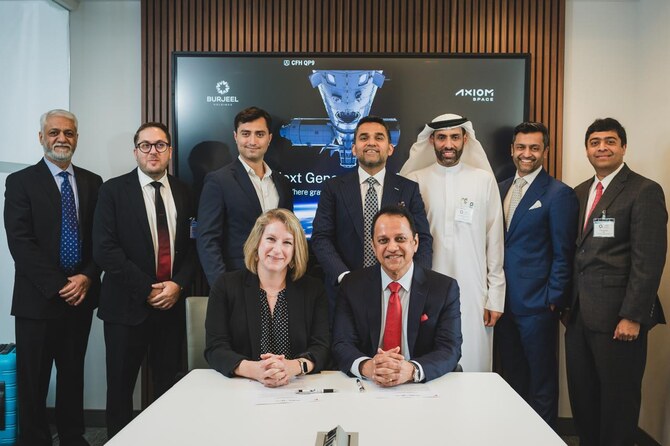
Saudi health care investor Burjeel Holdings partners with US-based Axiom Space for space medical research

Short Url
Updated 25 September 2024
Follow

Saudi health care investor Burjeel Holdings partners with US-based Axiom Space for space medical research

In a significant milestone for both global healthcare and space exploration, Burjeel Holdings, a leading healthcare investor in Saudi Arabia, has announced a partnership with Axiom Space, a global leader in human spaceflight services. The partnership, unveiled at New York’s iconic Times Square, is set to push the boundaries of medical research and innovation by leveraging the unique environment of space to study how the human body reacts in microgravity.

This long-term collaboration with Axiom Space, renowned for its comprehensive missions to the International Space Station, will focus on space-based medical research. As their first initiative, Axiom Space and Burjeel are working on sending a suite of medical capabilities to space to further science research on how the human body reacts in microgravity. The suite consists of best-in-class technologies used in hospitals and clinics around the world, including Burjeel Holdings’ flagship facility Burjeel Medical City in the UAE. The research seeks to study how the microgravity environment affects relevant biomarkers, drug substance quality, and remote health services.

Axiom Space astronauts intend to wear and operate these technologies remotely throughout their training, launch, and during Axiom Mission 4 (Ax-4), which is scheduled to launch next spring. The insights gained from this research are expected to pave the way for innovative healthcare solutions that could benefit patients worldwide, including those in Saudi Arabia.

“Through our groundbreaking partnership with Axiom Space, we are not only advancing the frontiers of medical innovation in microgravity but also ensuring that patients around the globe benefit from next-generation healthcare solutions. Just as we continue to benefit from innovations born from space missions over 50 years ago — transforming everything, from telecommunications to medical imaging — this partnership represents a commitment to leveraging the unique environment of space to develop and enhance treatment methodologies,” said Dr. Shamsheer Vayalil, founder and chairman of Burjeel Holdings.

Dr. Lucie Low, chief scientist at Axiom Space, highlighted the significance of the partnership with Burjeel Holdings, noting how Axiom Space is creating opportunities for organizations worldwide to conduct medical research in space.

“We are reimagining how humans live and work in low-Earth orbit by utilizing microgravity to deepen our understanding of the human body. At the same time, we are educating the global community on how to harness the microgravity environment for scientific and technological advancements that benefit humanity,” said Dr. Low.

Since its 2022 expansion plans, Burjeel Holdings has rapidly advanced in Saudi Arabia, successfully launching PhysioTherabia, a network of physiotherapy, wellness and rehabilitation centers, with plans to open 60 centers by 2025. Additionally, Burjeel is set to launch two Specialized Day Surgery Centers in Riyadh, reinforcing its commitment to elevating healthcare standards in the Kingdom. 


World Defense Show 2026: KPMG highlights human capital as strategic defense asset

Updated 03 February 2026
Follow

World Defense Show 2026: KPMG highlights human capital as strategic defense asset

KPMG published a series of four white papers as official knowledge partner for the World Defense Show 2026, reinforcing its commitment to supporting Saudi Arabia’s Vision 2030 and the Kingdom’s ambition to build a sovereign, future-ready defense ecosystem grounded in integrated capability development, localization, and digital readiness.

As global defense priorities evolve from procurement-led models toward capability-driven ecosystems, one of the papers in the defense integration series highlights a clear inflection point for the sector. According to KPMG analysis, defense localization in Saudi Arabia has increased from around 4 percent in 2018 to 24.9 percent in 2024, with the Kingdom targeting 50 percent localization by 2030. At the same time, local content across the defense sector has reached 40.7 percent, up from 38.4 percent in 2023, reflecting deeper integration across procurement, industrial participation, technology adoption, and workforce development.

KPMG’s findings emphasize that modern defense power is no longer defined by platforms and equipment alone, but by the ability to design, operate, integrate, and sustain advanced systems at scale. While technology, infrastructure, and capital investment remain critical enablers, the firm’s WDS position paper highlights that defense transformation has a significant human-capital focus, recognizing that skills, data literacy, and local expertise are essential to maximizing the performance, resilience, and sovereignty of advanced defense capabilities.

Christopher Moore, head of defense and security, said: “Saudi Arabia’s defense transformation has a significant human-capital focus, alongside major investments in technology, equipment, and industrial capacity. The progress we are seeing in localization and local content demonstrates that the Kingdom is not only acquiring advanced systems, but also building the skills, institutions, and operating models required to sustain them. Through our partnership with the World Defense Show, KPMG is proud to contribute insight and frameworks that help translate Vision 2030 ambition into operational readiness.”

This human-capital perspective forms part of a broader KPMG defense thought-leadership series developed for WDS 2026, which examines defense transformation through multiple, interconnected pillars. These include accelerating sovereign defense ecosystems, integrating business and technology infrastructure, financing future deterrence through public-private partnerships, strengthening industrial and technological autonomy, and building a future-ready defense workforce — reflecting KPMG’s holistic view of defense as an integrated national ecosystem.

KPMG’s research also situates Saudi Arabia’s progress within a global economic context. International benchmarks cited in the firm’s WDS analysis show that every $1 billion in defense manufacturing output in the US supports approximately 5,700 jobs, while the UK defense sector contributes around £25 billion ($34.2 billion) to GDP and sustains 260,000 skilled jobs. Across the EU, defense industries employ more than 1.6 million people and generate approximately 70 billion euros ($82.9 billion) in annual value. KPMG notes that similar dynamics are beginning to emerge in Saudi Arabia as localization accelerates and private-sector participation expands.

To support measurable progress, KPMG has proposed a Defense Workforce Capability Index — a framework that links workforce outcomes directly to operational readiness. The index tracks localization rates, technical qualification levels in advanced and digital systems, and the share of maintenance and sustainment conducted domestically, aligning human-capital metrics with broader defense performance objectives.

Taking place in Riyadh from Feb. 8 to 12, the World Defense Show will bring together senior government leaders, defense manufacturers, and technology innovators from around the world. The other three papers in the defense integration series focus on sovereignty, financing and technology.