Ukraine urges world leaders not to seek ‘an out’ from Russia’s war instead of true peace

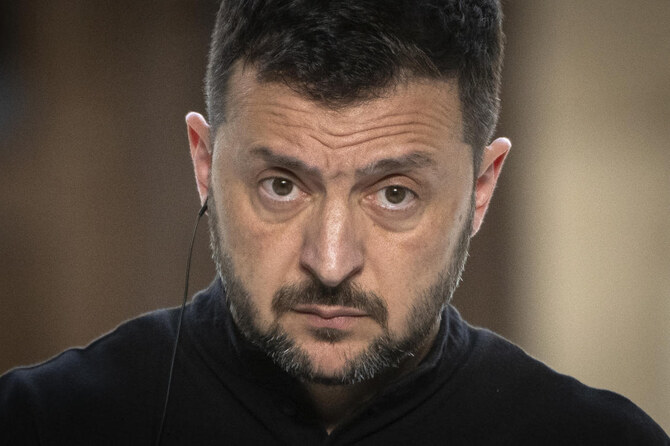
Ukraine’s president Volodymyr Zelensky urged global leaders Wednesday to stand with his country and not seek “an out” instead of a “real, just peace” more than two years into Russia’s war. (AP/File)
Short Url
Updated 25 September 2024
Follow

Ukraine urges world leaders not to seek ‘an out’ from Russia’s war instead of true peace

  • “Any parallel or alternative attempts to seek peace are, in fact, efforts to achieve an out instead of an end to the war,” Zelensky said
  • “Do not divide the world. Be united nations,” he implored

UNITED NATIONS: Ukraine’s president urged global leaders Wednesday to stand with his country and not seek “an out” instead of a “real, just peace” more than two years into Russia’s war.
At a time when he faces growing pressure from Western allies and some of his fellow Ukrainians to negotiate a ceasefire, President Volodymyr Zelensky told the UN General Assembly there’s no alternative to the “peace formula” he presented two years ago. Among other things, it seeks the expulsion of all Russian forces from Ukraine and accountability for war crimes.
“Any parallel or alternative attempts to seek peace are, in fact, efforts to achieve an out instead of an end to the war,” he said.
“Do not divide the world. Be united nations,” he implored. “And that will bring us peace.”
Russia hasn’t yet had its turn to speak at the assembly’s annual gathering of presidents, prime ministers, monarchs and other high officials. Low-level Russian diplomats occupied the country’s seats in the huge assembly hall during Zelensky’s speech. Russian President Vladimir Putin is not attending this year’s high-level meetings at the General Assembly.
The war in Ukraine was center stage the last two times that world leaders convened for the UN’s signature annual meeting. But this year, the Israel-Hamas war in Gaza and the escalating developments along the Israeli-Lebanese border have gotten much of the spotlight.
Ukraine and Russia, with one of the world’s most potent armies, are locked in a grinding fight along a 1,000-kilometer (600-mile) front line.
The war began when Russia invaded in February 2022 and has killed tens of thousands of people. Russia has gained momentum in Ukraine’s east; Ukraine, meanwhile, startled Russia by sending troops across the border in a daring incursion last month.
Zelensky argued Tuesday at the UN Security Council that Russia needs to ” be forced into peace,” saying there’s no point in pursuing peace talks with Putin.
In Moscow, Kremlin spokesperson Dmitry Peskov responded Wednesday that the Ukrainian president’s call for compulsion was “a fatal mistake” and “a profound misconception, which, of course, will inevitably have consequences for the Kyiv regime.”
Zelensky is expected to present a victory plan this week to US President Joe Biden.


Lawsuit challenges Trump administration’s ending of protections for Somalis

Updated 10 March 2026
Follow

Lawsuit challenges Trump administration’s ending of protections for Somalis

  • The lawsuit cites a series of statements Trump has made describing Somalis as “garbage” and “low IQ people” who “contribute nothing.”

BOSTON: Immigrant rights advocates filed a lawsuit on Monday seeking to stop US President Donald Trump’s administration from next ​week ending legal protections that allow nearly 1,100 Somalis to live and work in the United States. The lawsuit, brought by four Somalis and two advocacy groups, challenges the US Department of Homeland Security’s decision to end Temporary Protected Status for Somali immigrants, whom Trump has derided in public remarks. Outgoing Homeland Security Secretary Kristi Noem in January announced that TPS for Somalis would end on March 17, arguing that Somalia’s conditions had improved, despite fighting continuing between Somali forces and Al-Shabab militants. The plaintiffs, who ‌include the groups ‌African Communities Together and Partnership for the Advancement ​of ‌New ⁠Americans, in the ​lawsuit filed ⁠in Boston federal court argue the move was procedurally flawed and driven by a discriminatory, predetermined agenda.
The lawsuit cites a series of statements Trump has made describing Somalis as “garbage” and “low IQ people” who “contribute nothing.”
The plaintiffs said the administration is ending TPS for Somalia and other countries due to unconstitutional bias against non-white immigrants, not based on objective assessments of country conditions.
“The termination of TPS for Somalia is racism masking as immigration policy,” ⁠Omar Farah, executive director at the legal group Muslim Advocates, said ‌in a statement.
DHS did not respond to ‌a request for comment. It has previously said TPS ​was “never intended to be a de ‌facto amnesty program.”
TPS is a form of humanitarian immigration protection that shields eligible migrants ‌from deportation and allows them to work. Under Noem, DHS has moved to end TPS for a dozen countries, sparking legal challenges. The administration on Saturday announced plans to pursue an appeal at the US Supreme Court in order to end TPS for over 350,000 Haitians. It ‌also wants the high court to allow it to end TPS for about 6,000 Syrians.

SOMALI COMMUNITY TARGETED
Somalia was first designated ⁠for TPS in ⁠1991, with its latest extension in 2024. About 1,082 Somalis currently hold TPS, and 1,383 more have pending applications, according to DHS. Somalis in Minnesota in recent months had become a target of Trump’s immigration crackdown, with officials pointing to a fraud scandal in which many people charged come from the state’s large Somali community. The Trump administration cited those fraud allegations as a basis for a months-long immigration enforcement surge in Democratic-led Minnesota, during which about 3,000 immigration agents were deployed, spurring protests and leading to the killing of two US citizens by federal agents.
In November, Trump announced he would end TPS for Somalis in Minnesota, and a month later said ​he wanted them sent “back to where they ​came from.”
The US Department of State advises against traveling to Somalia, citing crime and civil unrest among numerous factors.