Committee formed to probe bomb attack on foreign diplomats in northwestern Pakistan

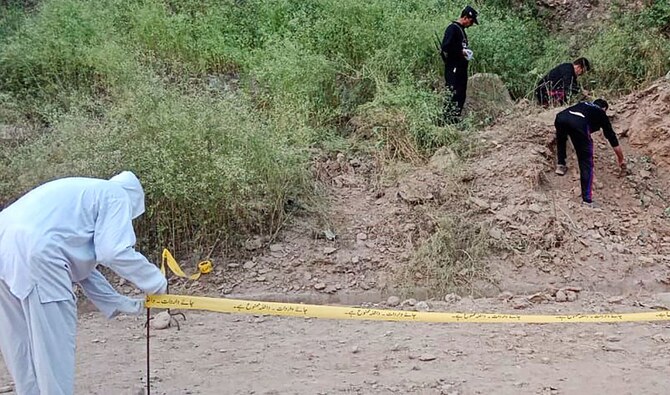
Security personnel examine the site of a bomb explosion, at Malam Jabba in the Swat district of Khyber Pakhtunkhwa province on September 22, 2024. (AFP)
Short Url
Updated 25 September 2024
Follow

Committee formed to probe bomb attack on foreign diplomats in northwestern Pakistan

  • One policeman was killed, three others injured in IED explosion targeting convoy of foreign diplomats in Swat last Sunday
  • Two-member committee to submit report within seven days, says KP Home and Tribal Affairs department

PESHAWAR: The Khyber Pakhtunkhwa (KP) government announced on Wednesday it had formed a fact-finding committee to probe an attack on a convoy of foreign diplomats in northwestern Pakistan last week. 

At least one policeman was killed while three others were injured in Swat’s Malam Jabba tourist resort on Sunday in a roadside bomb attack targeting a convoy of foreign diplomats. Police said the diplomats, who hailed mostly from Central Asian and European countries, were visiting Malam Jabba’s scenic spots when the incident took place. All diplomats remained unhurt and returned safely to Islamabad after the attack.

The two-member committee includes Zubair Ahmed, a grade 20 officer of KP’s Home and Tribal Affairs department and Muhammad Alam Shinwari, additional inspector-general (investigation) of the Central Police Office, Peshawar. 

“The committee shall submit the report within seven days positively,” a notification from the Home and Tribal Affairs department read. 

Pakistan has seen a rise in militant attacks in recent months, with many of them taking place in KP that borders Afghanistan where Islamabad says groups like the outlawed Pakistani Taliban are hiding and from where they daily target police and security forces.

Swat, known for its picturesque landscape and historic religious sites, hosts thousands of local and foreign tourists each year.
In 2007, the Pakistani Taliban seized partial control of the district before being ousted two years later in a major military operation. During this time, the militants had unleashed a reign of terror, killing and beheading politicians, singers, soldiers and opponents. They banned woman education and destroyed nearly 200 schools for girls.
Last week, militants opened fire on a security post in KP’s South Waziristan district and killed at least six Pakistani soldiers, the military said.
No group has claimed responsibility for the attacks, including the one on the convoy of diplomats but officials in Islamabad say militants associated with the Pakistani Taliban are primarily responsible for violence in the region. Islamabad has even blamed Kabul’s Afghan Taliban rulers for “facilitating” anti-Pakistan militants, a charge Kabul denies.


Pakistan raises fuel prices by Rs55 per liter as Middle East conflict drives oil surge

Updated 10 sec ago
Follow

Pakistan raises fuel prices by Rs55 per liter as Middle East conflict drives oil surge

  • Government says adequate fuel stocks in place despite global energy shock
  • Oil prices jump from about $78 to over $106 per barrel amid regional conflict

ISLAMABAD: Pakistan on Friday increased petrol and diesel prices by Rs55 ($0.20) per liter each as escalating conflict in the Middle East sent global oil prices sharply higher and disrupted energy supply routes, officials said.

Global oil markets have been rattled since coordinated strikes by the United States and Israel against Iran began last week, triggering retaliatory attacks across the region, raising fears of disruption to key energy shipping routes and pushing petroleum prices sharply upward.

The price adjustment in Pakistan was announced after a joint press conference by Finance Minister Muhammad Aurangzeb, Deputy Prime Minister and Foreign Minister Ishaq Dar and Petroleum Minister Ali Pervaiz Malik, who said the government was monitoring international energy markets and domestic supply conditions amid the crisis.

“So, the decision we have made by changing the levy a little bit is that we are going ahead with increasing the price of both fuels, petrol and diesel, by Rs55 ($0.20),” Malik told reporters. 

“And as soon as this matter settles, we will revise the prices downward with the same speed and take steps on how to increase people’s income and purchasing power.”

He said Pakistan entered the crisis with “comfortable energy reserves” due to earlier planning but rising global prices had forced the government to adjust domestic fuel rates to maintain supply continuity.

He said international petrol prices had climbed from roughly $78 per barrel on March 1 to around $106.8 per barrel, while diesel prices had risen to about $150 per barrel.

Malik added that the government had taken steps to minimize the burden on consumers, noting diesel plays a critical role in agriculture, transportation and public mobility.

Malik also warned that authorities would take strict action against anyone attempting to hoard fuel or manipulate supply for profiteering.

The minister said Pakistan was working with international partners to secure additional energy supplies, including arrangements with Saudi Aramco and the use of Pakistan National Shipping Corporation vessels to transport crude oil imports.

Finance Minister Aurangzeb said a high-level government committee formed by Prime Minister Shehbaz Sharif had been meeting daily to review developments in global petroleum markets and their potential impact on Pakistan’s economy.

“Pakistan currently maintains adequate energy stocks and macroeconomic stability,” Aurangzeb said, adding that the government’s response was based on preparedness rather than panic.

He said the committee, which includes senior ministers, the governor of the State Bank of Pakistan and other officials, was assessing short-, medium- and long-term implications of the crisis for inflation, foreign exchange reserves and broader economic indicators.

Deputy PM Dar said the regional conflict had significantly disrupted global energy markets, with international petroleum prices rising by as much as 50–70 percent in recent days.

The deputy prime minister added that Pakistan was also engaged in diplomatic efforts aimed at de-escalating tensions and restoring stability in the region.

Petroleum prices will now be reviewed more frequently, potentially on a weekly basis, and any reduction in global oil prices would be passed on to consumers.

Pakistan, which relies heavily on imported fuel to meet its energy needs, is particularly vulnerable to global oil price shocks that can quickly feed into inflation and pressure the country’s external accounts.