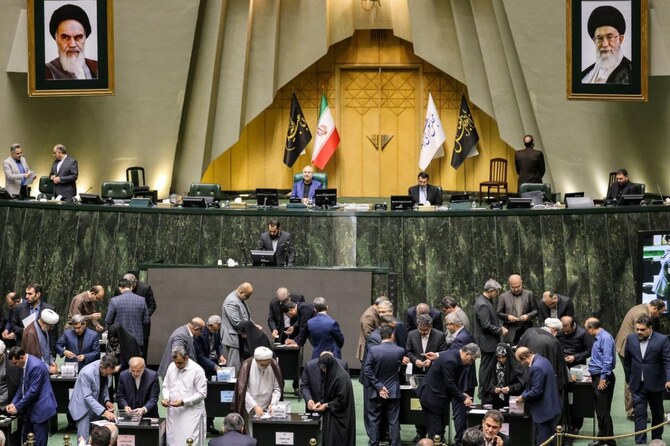
TEHRAN: The Iranian parliament on Wednesday blocked the appointment of a politician from the Sunni minority as vice president, state media reported.
In August, President Masoud Pezeshkian had announced the appointment of Abdolkarim Hosseinzadeh as his vice president for rural development and disadvantaged areas, citing his “valuable experience.”
But on Wednesday lawmakers voted against his resignation from parliament to take up the vice president post, the official IRNA news agency said.
“Parliament members voted 107 in favor, 129 against, and five abstentions out of the 247 representatives present,” it added.
Sunni Muslims account for around 10 percent of Iran’s population, where the vast majority are Shiites and that branch of Islam is the official state religion.
They have very rarely held key positions of power since the Islamic revolution in 1979.
Iran has numerous vice presidents, who are tasked with leading organizations related to presidential affairs in the country.
A 44-year-old reformist, Hosseinzadeh has since 2012 represented the northwestern cities of Naghadeh and Oshnavieh in the Iranian parliament.
He has spoken out publicly on several occasions in defense of the rights of Iran’s Sunnis.
During his election campaign Pezeshkian, himself a reformist, criticized the lack of representation for ethnic and religious minorities, in particular Sunni Kurds, in important positions.

Iran parliament blocks appointment of Sunni to VP post
Short Url
https://arab.news/jkxcs
Iran parliament blocks appointment of Sunni to VP post
Israeli settlers burn tents, vehicles in West Bank village
- Videos show masked men rampaging into the Palestinian village of Susiya near Hebron and burning vehicles and property
- Similar attacks have become common as settlers seek to control large swathes of land in the West Bank
SUSIYA, West Bank: Israeli settlers set fire to vehicles and tents in the Palestinian village of Susiya on Tuesday night, residents said, in the latest incident of settler violence against Palestinians in the Israeli-occupied West Bank.
Videos verified by Reuters showed a masked group of men, who residents said were Israeli settlers, approaching the village near the city of Hebron, and later burning vehicles and Palestinian property.
“They attack us almost every day, repeatedly, because we live near the main road...Last night they burned everywhere,” Halima Abu Eid, a Susiya resident told Reuters on Wednesday.
The Israeli military said they had dispatched soldiers to deal with reports of “deliberate burnings of Palestinian property” and had opened an investigation into the incident.
Violence by Israeli settlers against Palestinians in the West Bank has increased sharply since the beginning of the war in Gaza in October 2023, with over 800 Palestinians displaced due to settler attacks in 2026 according to United Nations data.
Attacks where masked settlers arrive at night to destroy Palestinian property or attack residents have become common, as Israeli settlers seek to control large swathes of land in the West Bank.
An Israeli official previously blamed settler violence on a “fringe minority,” although Reuters reporting has shown well-organized plans to take Palestinian land in public settler social media channels.
The United Nations has documented at least 86 instances of settler violence from February 3 to 16, leading to the displacement of 146 Palestinians and the injury of 64.
Israeli indictments of settler violence are rare. At the end of 2025, Israeli monitoring group Yesh Din said of the hundreds of cases of settler violence it had documented since October 7, 2023, only 2 percent resulted in indictments. Israel’s far-right governing coalition has enabled the rapid spread of settlements, with some ministers openly stating they want to “bury” a Palestinian state.
Most world powers deem Israel’s settlements, on land it captured in a 1967 war, illegal, and numerous UN Security Council resolutions have called on Israel to halt all settlement activity.
Israel disputes the view that its settlements are unlawful and it cites biblical and historical ties to the land.
Videos verified by Reuters showed a masked group of men, who residents said were Israeli settlers, approaching the village near the city of Hebron, and later burning vehicles and Palestinian property.
“They attack us almost every day, repeatedly, because we live near the main road...Last night they burned everywhere,” Halima Abu Eid, a Susiya resident told Reuters on Wednesday.
The Israeli military said they had dispatched soldiers to deal with reports of “deliberate burnings of Palestinian property” and had opened an investigation into the incident.
Violence by Israeli settlers against Palestinians in the West Bank has increased sharply since the beginning of the war in Gaza in October 2023, with over 800 Palestinians displaced due to settler attacks in 2026 according to United Nations data.
Attacks where masked settlers arrive at night to destroy Palestinian property or attack residents have become common, as Israeli settlers seek to control large swathes of land in the West Bank.
An Israeli official previously blamed settler violence on a “fringe minority,” although Reuters reporting has shown well-organized plans to take Palestinian land in public settler social media channels.
The United Nations has documented at least 86 instances of settler violence from February 3 to 16, leading to the displacement of 146 Palestinians and the injury of 64.
Israeli indictments of settler violence are rare. At the end of 2025, Israeli monitoring group Yesh Din said of the hundreds of cases of settler violence it had documented since October 7, 2023, only 2 percent resulted in indictments. Israel’s far-right governing coalition has enabled the rapid spread of settlements, with some ministers openly stating they want to “bury” a Palestinian state.
Most world powers deem Israel’s settlements, on land it captured in a 1967 war, illegal, and numerous UN Security Council resolutions have called on Israel to halt all settlement activity.
Israel disputes the view that its settlements are unlawful and it cites biblical and historical ties to the land.
© 2026 SAUDI RESEARCH & PUBLISHING COMPANY, All Rights Reserved And subject to Terms of Use Agreement.


