PARIS: A French extremist linked to the perpetrators of the 2015 massacre at satirical magazine Charlie Hebdo made a surprise admission Tuesday that he was involved in the 2011 kidnapping of three French aid workers in Yemen.
Peter Cherif, 42, also known as Abou Hamza, is being tried in Paris for terrorism-related offenses committed between 2011 and 2018, when he allegedly belonged to Yemen-based militant group Al-Qaeda in the Arabian Peninsula (AQAP).
Arrested in Djibouti in 2018, he had previously denied involvement in the kidnapping.
But on Tuesday he told the court that “I accept the facts, I was the translator” between his fellow French and their captors.
“I regret being involved in all this,” he said, claiming that he was not aware of the plot to kidnap the aid workers and that they were better treated because of his presence.
Even before his unexpected admission, prosecutors had established that he was in Yemen in May 2011 when the three aid workers from the Triangle Generation Humanitaire charity were abducted as they returned to their lodgings in the village of Seiyun.
They were released in November 2011 after spending their captivity in desert caves.
Amelie, one of the hostages, had already testified at the trial that she recognized Cherif as the translator with the captors, who spoke neither English nor French.
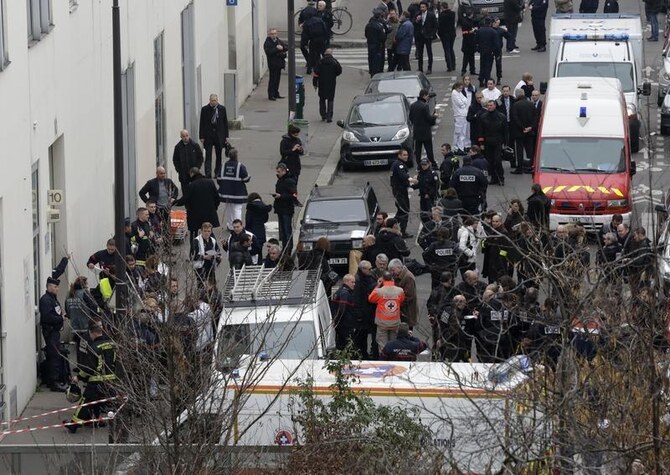
Cherif was linked to a Paris extremist cell and was named in the enquiry into the January 2015 attack on satirical magazine Charlie Hebdo, due to his regular contact with the perpetrators, Said and Cherif Kouachi.
Twelve people were killed in the massacre that sent shock waves across France. The brothers died in a shootout with police two days later.
Investigating judges believe Cherif recruited the brothers into AQAP and had knowledge of the plan to carry out an attack in France.
According to several witnesses, AQAP advised foreign fighters in Yemen to return to their countries of origin to stage attacks.
In 2020, Cherif was called as a witness during a trial over the 2015 attacks and claimed to have had “nothing to do” with the massacre.
In 2004, Cherif left Paris to fight in Iraq and was captured by coalition forces in the ruins of Fallujah a few months later.
He escaped to Syria in 2007, eventually reporting to the French embassy in Damascus and was deported in early 2008.
He went on trial in early 2011, but before he was sentenced to five years in prison, he fled to Yemen where he joined AQAP.
He spent seven years there before traveling under a false identity with his wife and two children in 2018 to Djibouti, where he was arrested and handed over to France.
The trial is scheduled to last until early October.


French extremist admits role in kidnapping of aid workers in Yemen
https://arab.news/66a4m
French extremist admits role in kidnapping of aid workers in Yemen

- Amelie, one of the hostages, had already testified at the trial that she recognized Cherif as the translator with the captors
- Cherif was linked to a Paris extremist cell and was named in the enquiry into the January 2015 attack on satirical magazine Charlie Hebdo


Sudan defense minister dismisses ‘intelligence document’ as fabrication after convoy strike
- Gen. Hassan Kabroun tells Arab News claims that army hid weapons in aid convoy are “completely false”
RIYADH: Sudan’s defense minister has firmly denied reports attributed to Sudanese intelligence alleging that a convoy targeted in North Kordofan was secretly transporting weapons under the cover of humanitarian aid.
Gen. Hassan Kabroun described the claims as “false” and an attempt to distract from what he called a militia crime.
The controversy erupted after news reports emerged that a document attributed to Sudan’s General Intelligence Service claimed the convoy struck in Al-Rahad on Friday was not a purely humanitarian mission, but was instead carrying “high-quality weapons and ammunition” destined for Sudanese Armed Forces units operating in the state.
The report further alleged that the convoy had been outwardly classified as humanitarian in order to secure safe passage through conflict zones, and that the Rapid Support Forces had destroyed it after gathering intelligence on its route and cargo.
Kabroun categorically rejected the narrative.
“First of all, we would like to stress the fact that this news is false,” he told Arab News. “Even the headline that talks about the security of the regions, such as Al-Dabbah, is not a headline the army would use.”
He described the document as fabricated and politically motivated, saying it was designed to “cover up the heinous crime they committed.”
The minister affirmed that the area targeted by drones is under full control of the Sudanese Armed Forces and does not require any covert military transport.
“Second, we confirm that the region that was targeted by drones is controlled by the army and very safe,” Kabroun said. “It does not require transporting any military equipment using aid convoys as decoys because it is a safe area controlled by the army, which has significant capabilities to transport humanitarian aid.”
According to the minister, the Sudanese military has both the logistical capacity and secure routes necessary to move equipment openly when needed.
“The army is professional and does not need to deliver anything to Kadugli or Dalang on board aid convoys,” he said. “The road between Dalang and Kadugli is open. The Sudanese forces used that road to enter and take control of the region. The road is open and whenever military trucks need to deliver anything, they can do so without resorting to any form of camouflage.”
Kabroun further rejected any suggestion that the military uses humanitarian operations as cover.
“Aid is transported by dedicated relief vehicles to the areas in need of this assistance,” he said. “Aid is not transported by the army. The army and security apparatus do not interfere with relief efforts at all, and do not even accompany the convoys.”
He stressed that the Sudanese Armed Forces maintains a clear institutional separation between military operations and humanitarian work, particularly amid the country’s crisis.
“These are false claims,” he said. “This fake news wanted to cover up the heinous crime they committed.”
Sudan has been gripped by conflict since April 2023, when fighting broke out between the Sudanese Armed Forces and the Rapid Support Forces, plunging the country into what the United Nations has described as one of the world’s worst humanitarian disasters.
The latest dispute over the convoy comes amid intensified fighting in South Kordofan, a strategically sensitive region linking central Sudan with the contested areas of Darfur and Blue Nile.
The false report suggested that intelligence monitoring had enabled the RSF to strike what it described as a military convoy disguised as humanitarian aid. But Kabroun dismissed that version outright.
“The intelligence agency is well aware of its duties,” he said. “The Sudanese Army has enough weapons and equipment to use in the areas of operations. These claims are completely false.”
He argued that the narrative being circulated seeks to shift blame for attacks on civilian infrastructure and humanitarian movements.
“This shows that they are trying to cover up the atrocities,” he added, referring to the militia.
Kabroun maintained that the army has regained momentum on multiple fronts and remains fully capable of sustaining its operations without resorting to deception.
“The region is secure, the roads are open, and the army does not need camouflage,” he said. “We are operating professionally and transparently.”
“These claims are completely false,” Kabroun said. “The Sudanese Army does not use humanitarian convoys for military purposes.”


