

Pakistan’s finance minister optimistic about $7 billion IMF bailout approval today

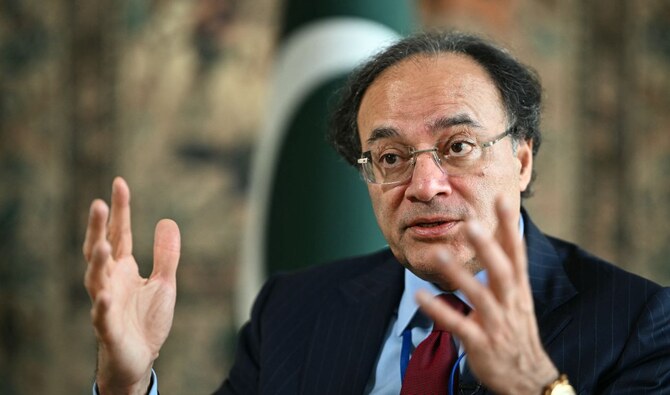
Pakistan's Finance Minister Muhammad Aurangzeb speaks during an interview with AFP at the Embassy of Pakistan in Washington, DC on April 15, 2024. (AFP/File)
Short Url
Updated 24 September 2024
Follow

Pakistan’s finance minister optimistic about $7 billion IMF bailout approval today

  • Muhammad Aurangzeb emphasizes the South Asian nation’s commitment to structural reforms
  • Pakistan has struggled with boom-bust cycles for decades and secured 22 IMF bailouts since 1958

ISLAMABAD: Federal Minister for Finance and Revenue Muhammad Aurangzeb on Tuesday expressed optimism about the approval of Pakistan’s $7 billion International Monetary Fund (IMF) program, when the board of the global lending agency meets on Wednesday.

The government reached a staff-level agreement with the IMF in July, though the approval for the 37-month program has been pending since.

Pakistan’s last $3 billion IMF program helped avert a sovereign default in 2023 amid a sharp decline in foreign exchange reserves, currency depreciation and record inflation.

“We have the IMF board meeting tomorrow in the US,” the minister said, while addressing a high-level private sector dialogue, ‘CPEC-II and the Region.’ “We are very hopeful that the board will approve the 37-month, $7 billion program under which we are very committed to do structural reforms.”

Assuring that the country would stay its current economic course, Aurangzeb pointed out that macroeconomic stability was the “basic foundation” of any economy.

“You have to grow and build from a stable base,” he added. “We have reached that level now. Now, we can say that we have a good foundation on which we can build from here.”

“Now we need to move forward and stay with the reform agenda whether it’s on the taxation or energy side [or] on the state-owned enterprises or privatization side.”

The finance minister said it was important that the KIBOR, or Karachi Interbank Offered Rate, used as a benchmark interest rate in Pakistan, was also coming down, which positively affects the industry. He added that the government was in “no desperation” to borrow money.

“If we want to borrow domestically, we will at our terms,” he said.

Aurangzeb said it was about time the banking sector started lending to the private sector.

Pakistan has struggled with boom-and-bust cycles for decades, leading to 22 IMF bailouts since 1958.

The latest economic crisis has been the most prolonged one, with the highest levels of inflation, pushing the country to the brink of a sovereign default last summer before the IMF loan.

The conditions of the IMF programs have become tougher in recent years, requiring the government to impose higher tariffs and remove subsidies. The latest bailout is aimed at cementing stability and inclusive growth in the crisis-plagued South Asian country, according to the IMF.

The latest IMF staff-level deal is subject to approval by its executive board and the confirmation of necessary financing assurances from Pakistan’s development and bilateral partners.


Pakistan’s Mahnoor Omer named among TIME’s ‘Women of the Year’ for 2026

Updated 01 March 2026
Follow

Pakistan’s Mahnoor Omer named among TIME’s ‘Women of the Year’ for 2026

  • Omer moved a Pakistani court against the so-called ‘period tax’ in Sept. 2025 which has since sparked a national debate
  • Taxes on sanitary pads in Pakistan can add up to 40 percent to retail price, UNICEF says only around 12 percent women use such products

ISLAMABAD: Pakistani women’s rights activist Mahnoor Omer, who fought against taxes on menstrual products, has been named among the TIME magazine’s ‘Women of the Year’ for 2026.

Omer’s efforts have been recognized alongside 16 activists, artists, athletes and businesswomen in the TIME’s Women of the Year 2026 list, including Olympic gold medalist Sydney McLaughlin-Levrone and Oscar-nominated filmmaker Chloe Zhao.

Dissatisfied with the efforts to educate Pakistani girls about sexual violence, Omer founded the Noor Foundation at the age of 14 and held her own workshops with village girls about everything from climate change to menstruation, according to the TIME magazine.

Two years later, a conversation with a domestic worker about the price of pads made her realize that not everyone could afford these essentials. She moved a court against the so-called “period tax” in Sept. 2025 and the case has sparked a national debate on the subject, considered a taboo by many in Pakistan, since its first hearing late last year.

“A decade and one law degree after her interest in activism was sparked, Omer, now 25, is putting her passion and expertise to work in the name of gender equity,” TIME wrote about Omer on its website.

Taxes imposed on sanitary products in Pakistan can add up to 40 percent to the retail price. UNICEF estimates just 12 percent of women in the country use commercially produced pads or tampons. The alternative, using cloth, risks health impacts including rashes and infections, and can make it impossible for girls to attend school while menstruating.

Omer’s suit, which awaits the government response, has sparked a national discussion. She says she spoke about menstruation to her father and male cousins, who thanked her for standing up for their daughters.
The 25-year-old, who is currently enrolled in a master’s degree in gender, peace, and security at the London School of Economics, sees this case as just the first of many.

“I’m not free until every woman is free,” she was quoted as saying by TIME. “I want to leave no stones unturned in terms of what I can do with the next few decades, as a lawyer for the women in my country and gender minorities in general.”
