Lawyers ask the ICC to investigate Tunisia opposition crackdown and migrant abuse

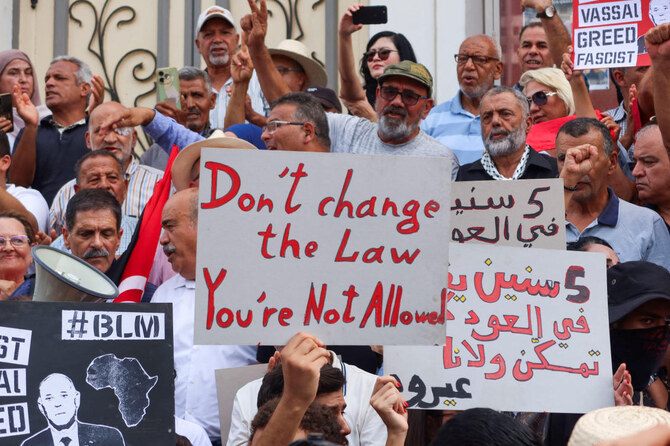
Members of civil society groups and opposition parties carry banners during a protest against Tunisia's President Kais Saied in Tunis, Tunisia. (Reuters)
Short Url
Updated 24 September 2024
Follow

Lawyers ask the ICC to investigate Tunisia opposition crackdown and migrant abuse

  • It is the second time Tunisian opposition members have sought an ICC probe
  • he request comes less than two weeks before Oct. 6 elections in which Saied is seeking a second term

THE HAGUE, Netherlands: Lawyers and families of jailed Tunisian opposition leaders called on the International Criminal Court on Tuesday to investigate a crackdown on political opposition and the abuse of Black African migrants in the North African country, which has been offered European Union financial support to help rein in migration.
It is the second time Tunisian opposition members have sought an ICC probe. Last year, the families of seven imprisoned politicians asked the court to investigate claims of political persecution and human rights violations by President Kais Saied’s administration.
Lawyers now say they are filing a second request for an investigation following new claims of abuse of migrants and persecution of opposition leaders. The request comes less than two weeks before Oct. 6 elections in which Saied is seeking a second term.
“The new evidence shows that Black African migrants are facing brutal and heartless treatment at the hands of the Tunisian authorities. The ICC has the jurisdiction to investigate these alleged crimes against humanity and should act with the full force of international law to protect those most vulnerable,” lawyer Rodney Dixon said in a statement.
“Countless migrants report similar experiences of arbitrary arrest on land or at sea followed by collective expulsion to desert regions along the border with Algeria and Libya, while being beaten, mistreated, and suffering psychological abuse,” the statement said.
For many sub-Saharan Africans — who don’t need a visa to travel to Tunisia — the North African country serves as a stepping stone to Europe, while others come from Libya, which shares a border with Tunisia.
The ICC’s prosecution office did not immediately respond to an email seeking confirmation that it had received the request. The court’s prosecutors are already investigating allegations of crimes against migrants in Libya including arbitrary detention, unlawful killing, enforced disappearances, torture and sexual and gender-based violence.
Tunisia is a member state of the Hague-based court.
One of the family members seeking ICC action is Elyes Chaouachi, the son of Ghazi Chaouchi, who is the detained former secretary general of the social democratic political party Attayar.
“In Tunisia, the pillars of democracy and human rights are under siege, as autocracy, racism, antisemitism and hate speech rise unchecked. We urge the ICC and the international community to take a stand — support humanity, uphold justice and restore dignity. Our voices for freedom and equality must not go unheard,” Chaouachi said in a statement released by the legal team that filed the request to the court.
Last year, European leaders held out the promise of more than 1 billion euros in financial aid to rescue its teetering economy and better police its borders, in an effort to restore stability to the North African country — and to stem migration from its shores to Europe.


Washington presses Syria to shift from Chinese telecom systems

Updated 26 February 2026
Follow

Washington presses Syria to shift from Chinese telecom systems

  • Syria is exploring the possibility of procuring Chinese technology
  • It was unclear whether the United States ⁠pledged financial or logistical support to Syria to do so

DAMASCUS: The United States has warned Syria against relying on Chinese technology in its telecommunications sector, arguing it conflicts with US interests and threatens US national security, according to three sources familiar with the matter.
The message was conveyed during an unreported meeting between a US State Department team and Syrian Communications Minister Abdulsalam Haykal in San Francisco on Tuesday. Washington has been coordinating closely with Damascus since 2024, when Syria’s now President Ahmed Al-Sharaa ousted longtime leader Bashar Assad, who had a strategic partnership with China.
Syria is exploring the possibility of procuring Chinese technology to support its telecommunications towers and the infrastructure of local Internet service providers, according to a Syrian businessman involved in the procurement talks.
“The US side asked for clarity on the ministry’s plans regarding Chinese telecom equipment,” said ⁠another source briefed on ⁠the talks.
But Syrian officials said infrastructure development projects were time-critical and that Damascus was seeking greater vendor diversity, the source added.
SYRIAN OFFICIALS CITE US EXPORT CONTROLS AS TELECOMS BARRIER
Syria is open to partnering with US firms but the matter was urgent and export controls and “over-compliance” remained an issue, according to person familiar with the meeting in San Francisco.
A US diplomat familiar with the discussions told Reuters that the US State Department “clearly urged Syrians to use American technology or technology from allied countries in the telecoms sector.”
It was unclear whether the United States ⁠pledged financial or logistical support to Syria to do so.
Responding to Reuters questions, a US State Department spokesperson said: “We urge countries to prioritize national security and privacy over lower-priced equipment and services in all critical infrastructure procurement. If it seems too good to be true, it probably is.”
The spokesperson added that Chinese intelligence and security services “can legally compel Chinese citizens and companies to share sensitive data or grant unauthorized access to their customers’ systems” and promises by Chinese companies to protect customers’ privacy were “entirely inconsistent with China’s own laws and well-established practices.”
China has repeatedly rejected allegations of it using technology for spying purposes.
The Syrian Ministry of telecommunications told Reuters any decisions related to equipment and infrastructure are made “in accordance with national technical and security standards, ensuring data protection and service continuity.”
The ministry said it is also prioritizing the diversification of partnerships and technology sources to ⁠serve the national interest.
Syria’s telecom ⁠infrastructure has relied heavily on Chinese technology due to US sanctions imposed on successive Assad governments over the civil war that grew from a crackdown on anti-government protests in 2011.
Huawei technology accounts for more than 50 percent of the infrastructure of Syriatel and MTN, the country’s only telecom operators, according to a senior source at one of the companies and documents reviewed by Reuters. Huawei did not immediately respond to a request for comment.
Syria is seeking to develop its private telecommunications sector, devastated by 14 years of war, by attracting foreign investment.
In early February, Saudi Arabia’s largest telecom operator, STC, announced it would invest $800 million to “strengthen telecommunications infrastructure and connect Syria regionally and internationally through a fiber-optic network extending over 4,500 kilometers.”
The ministry of telecommunications says that US restrictions “hinder the availability of many American technologies and services in the Syrian market,” emphasizing that it welcomes expanding cooperation with US companies when these restrictions are lifted.
Syria has inadequate telecommunications infrastructure, with network coverage weak outside city centers and connection speeds in many areas barely exceeding a few kilobits per second.