

Iran’s president urges immediate Gaza ceasefire for regional stability, development

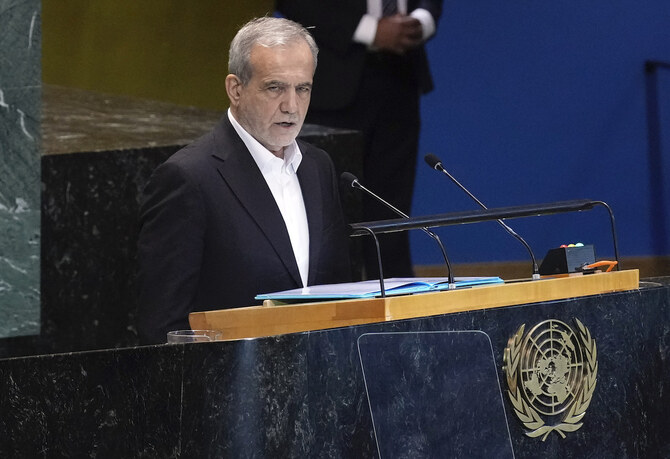
Iran's President Masoud Pezeshkian addresses the the Summit of the Future, in the United Nations General Assembly, Monday, Sept. 23, 2024. (AP)
Short Url
Updated 24 September 2024
Follow

Iran’s president urges immediate Gaza ceasefire for regional stability, development

  • Multilateralism key to solve global crises, says Masoud Pezeshkian
  • Opposes US arming of Israel for wars in south Lebanon and Gaza

Washington: Iran’s President Masoud Pezeshkian has urged the international community to ensure a multilateral approach to resolve the world’s crises including wars, discrimination and hunger.

Speaking at the UN’s Summit of the Future at the world body’s headquarters in New York on Monday, Pezeshkian said an immediate ceasefire in Gaza was a prerequisite for global development and regional stability.

He added that Israel should end its “genocide” of the Palestinian people and its occupation of the latter’s territories.


“An immediate ceasefire in Gaza is a prerequisite for global development, and that Iran is ready to work with other countries to achieve common goals,” he said.


Pezeshkian reportedly said at a gathering on the sidelines of the UN General Assembly in New York that “we are willing to put all of our weapons aside, so long as Israel is willing to do the same.”


He expressed his opposition to the US arming of Israel for its brutal war in Gaza and south Lebanon.


“We cannot have outside actors come in, arm one side to the teeth and prevent the other side from having the means to defend themselves,” he said.


On domestic issues, Pezeshkian said his government supports the UN’s 17 Sustainable Development Goals and has prioritized poverty alleviation measures and improving health care, social security and public education.


Addressing the US’ decades-long sanctions on Iran, Pezeshkian said these unilateral actions hinder the development and prosperity of targeted nations.


“I propose to the UN Security Council in collaboration with countries affected by unilateral sanctions (to) present a comprehensive report on this matter to the General Assembly,” he said.


He also called for the reform of international financial institutions by including developing nations in governance processes.


Addressing the issue of Tehran’s controversial atomic energy program, Pezeshkian said Iran supports a Middle East free of nuclear and other weapons of mass destruction.


He added that Iran was willing to work with other nations to fight terrorism and promote regional stability.


“Iran seeks a strong secure and stable region where the resources are used to advance the nations of the region,” he said.


Iran FM criticizes Israel for ‘doctrine of domination’

Updated 8 sec ago
Follow

Iran FM criticizes Israel for ‘doctrine of domination’

  • Doctrine allows Israel to expand its military arsenal while pressuring other countries in the region to disarm
  • His remarks came a day after renewed nuclear talks with Washington in Oman
DOHA: Iran’s Foreign Minister Abbas Araghchi on Saturday criticized what he said was a “doctrine of domination” that allows Israel to expand its military arsenal while pressuring other countries in the region to disarm.
His remarks came a day after renewed nuclear talks with Washington, with previous talks collapsing when Israel launched an unprecedented bombing campaign against Iran last June that triggered a 12-day war.
Araghchi was speaking at the Al Jazeera Forum conference in Qatar but made no reference to Friday’s talks with the United States.
“Israel’s expansionist project requires that neighboring countries be weakened: militarily, technologically, economically and socially,” Araghchi said.
“Under this project Israel is free to expand its military arsenal without limits ... Yet other countries are demanded to disarm. Others are pressured to reduce defensive capacity. Others are punished for scientific progress,” he added.
“This is a doctrine of domination.”
During the 12-day war Israel targeted senior Iranian military officials, nuclear scientists and sites as well as residential areas, with the US later launching its own attacks on key nuclear facilities.
Iran responded at the time with drone and missile attacks on Israel, as well as by targeting the largest US military base in the Middle East, located in Qatar.
On Friday, Araghchi led the Iranian delegation in indirect nuclear talks with US Middle East envoy Steve Witkoff in Muscat.
The top Iranian diplomat later described the atmosphere as having been “very positive,” while US President Donald Trump said the talks were “very good,” with both sides agreeing to proceed with further negotiations.
The talks followed threats from Washington and its recent deployment of an aircraft carrier group to the region following Iran’s deadly crackdown on anti-government protests last month.
The United States has sought to address Iran’s ballistic missile program and its support for militant groups in the region — issues which Israel has pushed to include in the talks, according to media reports.
Tehran has repeatedly rejected expanding the scope of negotiations beyond the nuclear issue.