

Family of doctor accused of blasphemy in Pakistan say police killed him in fake encounter

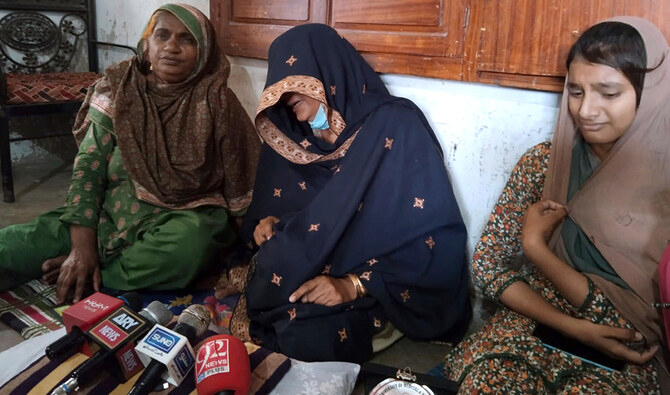
Family of Shah Nawaz, a doctor who was accused of blasphemy, from left, mother Rehmat Kunbhar, wife Niamat Bibi, and daughter Hareem Nawaz, speak to media at their residence in Umerkot, a district in the Pakistan's Sindh province, on September 21, 2024. (AP)
Short Url
Updated 24 September 2024
Follow

Family of doctor accused of blasphemy in Pakistan say police killed him in fake encounter

  • Shah Nawaz was arrested last week and later killed in an encounter, with his body burnt by a mob
  • Police suspend officers who killed Nawaz, who were applauded and showered with rose petals by locals

MULTAN: The family of a doctor accused of blasphemy said Monday he was killed by police while in custody in southern Pakistan after he voluntarily surrendered following assurances that he would be given a chance to prove his innocence, denying a police account that he was accidentally killed in a shootout.

If true, it would be the second extra-judicial killing in a week, drawing condemnation from human rights groups.

Shah Nawaz, a doctor in Umerkot district of Sindh province, had gone into hiding last week after being accused of insulting Islam’s Prophet Muhammad (PBUH) and sharing blasphemous content on Facebook. Nawaz said someone had hacked his account and that he had not posted anything against Islam.

His family said he was arrested last Wednesday and killed hours later in a fake encounter with police. A mob also burned Nawaz’s clinic on Wednesday, officials said.

Police said Nawaz was killed unintentionally when officers in the city of Mirpur Khas signalled for two men on a motorcycle to stop. Instead of stopping, the men opened fire and tried to flee, prompting police to shoot, killing one of them, police said.

They said it was only after the shootout that officers learned that the slain man was the doctor being sought by them for alleged blasphemy.

“I want justice for my son who was killed when he was in the custody of police,” said Rehmat Kunbhar, Nawaz’s mother.

“We asked him to face an investigation after police assured us that he would be given protection,” she said by telephone. “I did not know that police would kill him,” she said, sobbing.

She said the posts on Facebook had continued after his arrest, showing that someone had hacked it.

Nawaz’s father, Mohammad Saleh, said a mob had snatched his son’s body after his death and burned it in front of him. “They sprinkled petrol on the body of my son and burned it, as I watched helplessly,” he said.

Police said they arrested nine people on charges of taking the body and burning it. Noor Mohammad, a police official who is investigating the case, said officers are seeking the arrest of more than 100 people who were involved in the violence that erupted before and after Nawaz’s arrest.

On Friday, authorities suspended the policemen who had opened fire and killed Nawaz, who were applauded and showered with rose petals by local residents after the killing.

Members of civil society visited Nawaz’s village on Thursday and met with his family and put flowers on his grave in a sign of respect and support.

“We are terrified and we cannot send our children to school,” said Niamat Bibi, Nawaz’s widow.

Accusations of blasphemy — sometimes even just rumors — can spark riots and mob rampages in Pakistan. Although killings of blasphemy suspects by mobs are common, extra-judicial killings by police are rare.

A week before Nawaz’s killing, an officer opened fire inside a police station in the southwestern Pakistani city of Quetta, killing Syed Khan, another suspect held on accusations of blasphemy.

Khan was arrested after officers rescued him from an enraged mob that claimed he had insulted Islam’s prophet. The police officer who killed him, Mohammad Khurram, was quickly arrested. However, the family of the slain man later said they pardoned the officer.

Under Pakistan’s controversial blasphemy laws, anyone found guilty of insulting Islam or Islamic religious figures can be sentenced to death — though authorities have yet to carry out a death sentence for blasphemy.


Pakistan, global crypto exchange discuss modernizing digital payments, creating job prospects 

Updated 05 December 2025
Follow

Pakistan, global crypto exchange discuss modernizing digital payments, creating job prospects 

  • Pakistani officials, Binance team discuss coordination between Islamabad, local banks and global exchanges
  • Pakistan has attempted to tap into growing crypto market to curb illicit transactions, improve oversight

ISLAMABAD: Pakistan’s finance officials and the team of a global cryptocurrency exchange on Friday held discussions aimed at modernizing the country’s digital payments system and building local talent pipelines to meet rising demand for blockchain and Web3 skills, the finance ministry said.

The development took place during a high-level meeting between Finance Minister Muhammad Aurangzeb, Pakistan Virtual Assets Regulatory Authority (PVARA) Chairman Bilal bin Saqib, domestic bank presidents and a Binance team led by Global CEO Richard Teng. The meeting was held to advance work on Pakistan’s National Digital Asset Framework, a regulatory setup to govern Pakistan’s digital assets.

Pakistan has been moving to regulate its fast-growing crypto and digital assets market by bringing virtual asset service providers (VASPs) under a formal licensing regime. Officials say the push is aimed at curbing illicit transactions, improving oversight, and encouraging innovation in blockchain-based financial services.

“Participants reviewed opportunities to modernize Pakistan’s digital payments landscape, noting that blockchain-based systems could significantly reduce costs from the country’s $38 billion annual remittance flows,” the finance ministry said in a statement. 

“Discussions also emphasized building local talent pipelines to meet rising global demand for blockchain and Web3 skills, creating high-value employment prospects for Pakistani youth.”

Blockchain is a type of digital database that is shared, transparent and tamper-resistant. Instead of being stored on one computer, the data is kept on a distributed network of computers, making it very hard to alter or hack.

Web3 refers to the next generation of the Internet built using blockchain, focusing on giving users more control over their data, identity and digital assets rather than big tech companies controlling it.

Participants of the meeting also discussed sovereign debt tokenization, which is the process of converting a country’s debt such as government bonds, into digital tokens on a blockchain, the ministry said. 

Aurangzeb called for close coordination between the government, domestic banks and global exchanges to modernize Pakistan’s payment landscape.

Participants of the meeting also discussed considering a “time-bound amnesty” to encourage users to move assets onto regulated platforms, stressing the need for stronger verifications and a risk-mitigation system.

Pakistan has attempted in recent months to tap into the country’s growing crypto market, crack down on money laundering and terror financing, and promote responsible innovation — a move analysts say could bring an estimated $25 billion in virtual assets into the tax net.

In September, Islamabad invited international crypto exchanges and other VASPs to apply for licenses to operate in the country, a step aimed at formalizing and regulating its fast-growing digital market.