

Pakistan PM reaches US to attend UNGA session to highlight Palestine crisis, global issues 

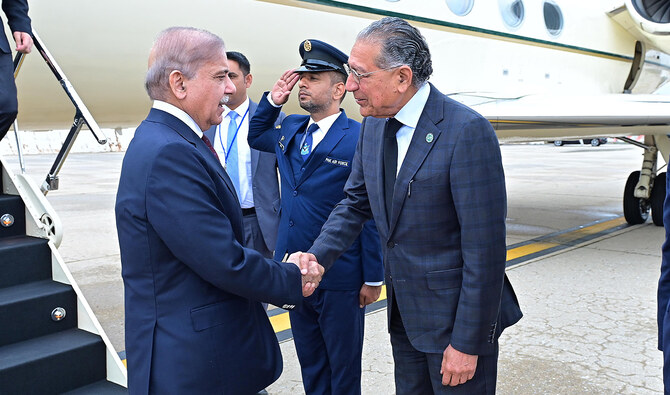
Pakistan's Permanent Representative to the United Nations, Munir Akram (right), receives Prime Minister Shehbaz Sharif in New York, US, on September 24, 2024. (PID)
Short Url
Updated 24 September 2024
Follow

Pakistan PM reaches US to attend UNGA session to highlight Palestine crisis, global issues 

  • Shehbaz Sharif to address United Nations General Assembly session on Friday
  • PM to attend reception hosted by UN secretary-general today with other world leaders

ISLAMABAD: Prime Minister Shehbaz Sharif arrived in New York on Tuesday to attend the 79th session of the United Nations General Assembly (UNGA), where he will engage with world leaders on key global issues and present Pakistan’s stance on Israel’s war in Gaza, the Kashmir dispute and “terrorism,” Information Minister Ataullah Tarar said. 

World leaders, policymakers, and international stakeholders are arriving in the city to attend this year’s UNGA. Policymakers and global leaders will hold high-level discussions and summits aimed at addressing the world’s most pressing issues.

Sharif will address the UNGA session on Friday, participate in Sustainable Development Goals Moment 2024, attend a high-level open debate of the United Nations Security Council (UNSC), titled ‘Leadership for Peace,’ and participate in a session on the looming threat of rising sea-level, the Prime Minister’s Office (PMO) said previously. 

“The prime minister will focus on Palestine and Kashmir issues as well as climate change and terrorism,” Tarar told reporters in New York.

The minister said that the war in Gaza was extremely important for Pakistan, adding that the South Asian country wanted an immediate ceasefire in the Middle East and Israel to be held accountable for its actions. 

“Peace is not possible in the world without peace in Palestine,” he said.

Israel launched its war on Gaza on Oct. 7 after Hamas fighters stormed into southern Israel, killing 1,200 and taking more than 250 hostages, according to Israeli figures. Israeli military campaign has since demolished swathes of the besieged territory killed more than 41,000 people, displaced nearly all of its 2.3 million people multiple times, and given rise to deadly hunger and disease in the area.

Pakistan does not recognize nor have diplomatic relations with Israel and calls for an independent Palestinian state based on “internationally agreed parameters” and the pre-1967 borders with Al-Quds Al-Sharif as its capital.
Tarar said the Pakistani prime minister would also focus on the effects of climate change during his visit. 

“Climate change is a major issue for Pakistan as the country contributes only 2 percent of the world’s carbon emissions but when it comes to bearing the brunt of climate-related disasters, Pakistan suffers disproportionately,” he explained. 

Meanwhile, the PMO said Sharif will spend a busy day in New York today.

“The prime minister will attend the reception given by the United Nations Secretary-General Antonio Guterres for the heads of member states, where he will have an informal meeting with the heads of various countries,” Sharif’s office said. 

“Shehbaz Sharif will also hold meetings with UN Secretary-General Antonio Guterres, President of the General Assembly Philemon Yang, President of European Commission Ursula von der Leyen, Founder of Gates Foundation Bill Gates, World Bank President Ajay Banga and Managing Director of the International Monetary Fund Ms. Kristalina Georgieva,” it said. 

The Pakistani premier will hold bilateral meetings with other heads of states and attend a dinner hosted by Muhammad Yunus, the chief adviser of Bangladesh’s interim government, on the completion of 50 years of his country’s membership of the United Nations.

Sharif will also meet the US-Pakistan Business Council and Pakistani bankers during his visit and inform them about his government’s business and investment-friendly policies.

Defense Minister Khawaja Muhammad Asif, Information Minister Attaullah Tarar, Education Minister Khalid Maqbool Siddiqui and Special Assistant Tariq Fatemi will also be accompanying the prime minister during the visit.


Sindh assembly passes resolution rejecting move to separate Karachi

Updated 21 February 2026
Follow

Sindh assembly passes resolution rejecting move to separate Karachi

  • Chief Minister Shah cites constitutional safeguards against altering provincial boundaries
  • Calls to separate Karachi intensified amid governance concerns after a mall fire last month

ISLAMABAD: The provincial assembly of Pakistan’s southern Sindh province on Saturday passed a resolution rejecting any move to separate Karachi, declaring its territorial integrity “non-negotiable” amid political calls to carve the city out as a separate administrative unit.

The resolution comes after fresh demands by the Muttahida Qaumi Movement (MQM) and other voices to grant Karachi provincial or federal status following governance challenges highlighted by the deadly Gul Plaza fire earlier this year that killed 80 people.

Karachi, Pakistan’s largest and most densely populated city, is the country’s main commercial hub and contributes a significant share to the national economy.

Chief Minister Syed Murad Ali Shah tabled the resolution in the assembly, condemning what he described as “divisive statements” about breaking up Sindh or detaching Karachi.

“The province that played a foundational role in the creation of Pakistan cannot allow the fragmentation of its own historic homeland,” Shah told lawmakers, adding that any attempt to divide Sindh or separate Karachi was contrary to the constitution and democratic norms.

Citing Article 239 of Pakistan’s 1973 Constitution, which requires the consent of not less than two-thirds of a provincial assembly to alter provincial boundaries, Shah said any such move could not proceed without the assembly’s approval.

“If any such move is attempted, it is this Assembly — by a two-thirds majority — that will decide,” he said.

The resolution reaffirmed that Karachi would “forever remain” an integral part of Sindh and directed the provincial government to forward the motion to the president, prime minister and parliamentary leadership for record.

Shah said the resolution was not aimed at anyone but referred to the shifting stance of MQM in the debate while warning that opposing the resolution would amount to supporting the division of Sindh.

The party has been a major political force in Karachi with a significant vote bank in the city and has frequently criticized Shah’s provincial administration over its governance of Pakistan’s largest metropolis.

Taha Ahmed Khan, a senior MQM leader, acknowledged that his party had “presented its demand openly on television channels with clear and logical arguments” to separate Karachi from Sindh.

“It is a purely constitutional debate,” he told Arab News by phone. “We are aware that the Pakistan Peoples Party, which rules the province, holds a two-thirds majority and that a new province cannot be created at this stage. But that does not mean new provinces can never be formed.”

Calls to alter Karachi’s status have periodically surfaced amid longstanding complaints over governance, infrastructure and administrative control in the megacity, though no formal proposal to redraw provincial boundaries has been introduced at the federal level.