

Pakistan PM reaches US to attend UNGA session to highlight Palestine crisis, global issues 

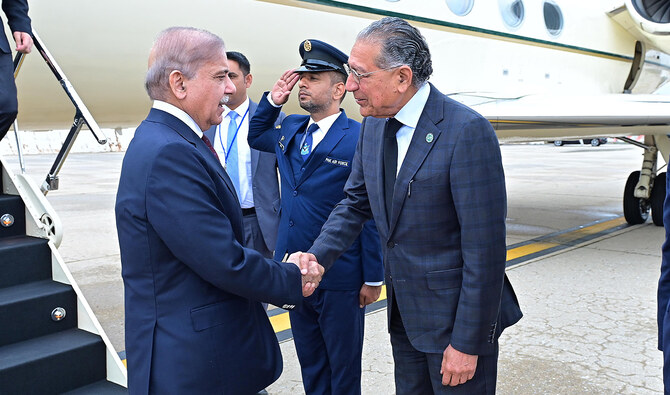
Pakistan's Permanent Representative to the United Nations, Munir Akram (right), receives Prime Minister Shehbaz Sharif in New York, US, on September 24, 2024. (PID)
Short Url
Updated 24 September 2024
Follow

Pakistan PM reaches US to attend UNGA session to highlight Palestine crisis, global issues 

  • Shehbaz Sharif to address United Nations General Assembly session on Friday
  • PM to attend reception hosted by UN secretary-general today with other world leaders

ISLAMABAD: Prime Minister Shehbaz Sharif arrived in New York on Tuesday to attend the 79th session of the United Nations General Assembly (UNGA), where he will engage with world leaders on key global issues and present Pakistan’s stance on Israel’s war in Gaza, the Kashmir dispute and “terrorism,” Information Minister Ataullah Tarar said. 

World leaders, policymakers, and international stakeholders are arriving in the city to attend this year’s UNGA. Policymakers and global leaders will hold high-level discussions and summits aimed at addressing the world’s most pressing issues.

Sharif will address the UNGA session on Friday, participate in Sustainable Development Goals Moment 2024, attend a high-level open debate of the United Nations Security Council (UNSC), titled ‘Leadership for Peace,’ and participate in a session on the looming threat of rising sea-level, the Prime Minister’s Office (PMO) said previously. 

“The prime minister will focus on Palestine and Kashmir issues as well as climate change and terrorism,” Tarar told reporters in New York.

The minister said that the war in Gaza was extremely important for Pakistan, adding that the South Asian country wanted an immediate ceasefire in the Middle East and Israel to be held accountable for its actions. 

“Peace is not possible in the world without peace in Palestine,” he said.

Israel launched its war on Gaza on Oct. 7 after Hamas fighters stormed into southern Israel, killing 1,200 and taking more than 250 hostages, according to Israeli figures. Israeli military campaign has since demolished swathes of the besieged territory killed more than 41,000 people, displaced nearly all of its 2.3 million people multiple times, and given rise to deadly hunger and disease in the area.

Pakistan does not recognize nor have diplomatic relations with Israel and calls for an independent Palestinian state based on “internationally agreed parameters” and the pre-1967 borders with Al-Quds Al-Sharif as its capital.
Tarar said the Pakistani prime minister would also focus on the effects of climate change during his visit. 

“Climate change is a major issue for Pakistan as the country contributes only 2 percent of the world’s carbon emissions but when it comes to bearing the brunt of climate-related disasters, Pakistan suffers disproportionately,” he explained. 

Meanwhile, the PMO said Sharif will spend a busy day in New York today.

“The prime minister will attend the reception given by the United Nations Secretary-General Antonio Guterres for the heads of member states, where he will have an informal meeting with the heads of various countries,” Sharif’s office said. 

“Shehbaz Sharif will also hold meetings with UN Secretary-General Antonio Guterres, President of the General Assembly Philemon Yang, President of European Commission Ursula von der Leyen, Founder of Gates Foundation Bill Gates, World Bank President Ajay Banga and Managing Director of the International Monetary Fund Ms. Kristalina Georgieva,” it said. 

The Pakistani premier will hold bilateral meetings with other heads of states and attend a dinner hosted by Muhammad Yunus, the chief adviser of Bangladesh’s interim government, on the completion of 50 years of his country’s membership of the United Nations.

Sharif will also meet the US-Pakistan Business Council and Pakistani bankers during his visit and inform them about his government’s business and investment-friendly policies.

Defense Minister Khawaja Muhammad Asif, Information Minister Attaullah Tarar, Education Minister Khalid Maqbool Siddiqui and Special Assistant Tariq Fatemi will also be accompanying the prime minister during the visit.


Islamabad dismisses claims about paying up to 8 percent interest on foreign loans as ‘misleading’

Updated 22 February 2026
Follow

Islamabad dismisses claims about paying up to 8 percent interest on foreign loans as ‘misleading’

  • Pakistan has long relied on external loans to help bridge persistent gaps in public finances and foreign exchange reserves
  • Pakistan’s total external debt, liabilities stand at $138 billion at an overall average cost of around 4 percent, ministry says

KARACHI: Pakistan’s finance ministry on Sunday dismissed as “misleading” claims that the country is paying up to 8 percent interest on external loans, saying the overall average cost of external public debt is approximately 4 percent.

Pakistan has long relied on external loans to help bridge persistent gaps in public finances and foreign exchange reserves, driven largely by a narrow tax base, chronic trade deficits, rising debt-servicing costs and repeated balance-of-payments pressures.

Over the decades, successive governments have turned to multilateral and bilateral lenders, including the International Monetary Fund, the World Bank and the Asian Development Bank, to support budgetary needs and shore up foreign exchange reserves.

The finance ministry on Sunday issued a clarification in response to a “recent press commentary” regarding the country’s external debt position and associated interest payments, and said the figures required contextual explanation to ensure accurate understanding of Pakistan’s external debt profile.

“Pakistan’s total external debt and liabilities currently stand at $138 billion. This figure, however, encompasses a broad range of obligations, including public and publicly guaranteed debt, debt of Public Sector Enterprises (both guaranteed and non-guaranteed), bank borrowings, private-sector external debt, and intercompany liabilities to direct investors. It is therefore important to distinguish this aggregate figure from External Public (Government) Debt, which amounts to approximately $92 billion,” it said.

“Of the total External Public Debt, nearly 75 percent comprises concessional and long-term financing obtained from multilateral institutions (excluding the IMF) and bilateral development partners. Only about 7 percent of this debt consists of commercial loans, while another 7 percent relates to long-term Eurobonds. In light of this composition, the claim that Pakistan is paying interest on external loans ‘up to 8 percent’ is misleading.

The overall average cost of External Public Debt is approximately 4 percent, reflecting the predominantly concessional nature of the borrowing portfolio.”

With respect to interest payments, public external debt interest outflows increased from $1.99 billion in Fiscal Year (FY) 2022 to $3.59 billion in FY2025, representing an increase of 80.4 percent, not 84 percent as reported. In absolute terms, interest payments rose by $1.60 billion over this period, not $1.67 billion, it said.

According to the State Bank of Pakistan’s records, Pakistan’s total debt servicing payments to specific creditors during the period under reference were as follows: the IMF received $1.50 billion, of which $580 million constituted interest; Naya Pakistan Certificates payments totaled $1.56 billion, including $94 million in interest; the Asian Development Bank received $1.54 billion, including $615 million in interest; the World Bank received $1.25 billion, including $419 million in interest; and external commercial loans amounted to nearly $3 billion, of which $327 million represented interest payments.

“While interest payments have increased in absolute terms, this rise cannot be attributed solely to an expansion in the debt stock,” the ministry said. “Although the overall debt stock has increased slightly since FY2022, the additional inflows have primarily originated from concessional multilateral sources and the IMF’s Extended Fund Facility (EFF) under the ongoing IMF-supported program.”

Pakistan secured a $7 billion IMF bailout in Sept. 2024 as part of Prime Minister Shehbaz Sharif’s efforts to stabilize the South Asian economy that narrowly averted a default in 2023. The government has since been making efforts to boost trade and bring in foreign investment to consolidate recovery.

“It is also important to note that the increase in interest payments reflects prevailing global interest rate dynamics. In response to the inflation surge of 2021–22, the US Federal Reserve raised the federal funds rate from 0.75-1.00 percent in May 2022 to 5.25–5.50 percent by July 2023. Although rates have since moderated to around 3.75 percent, they remain significantly higher than 2022 levels,” the finance ministry said.

“The government remains committed to prudent debt management, transparency, and the continued strengthening of Pakistan’s macroeconomic stability,” it added.