Leaders at climate meetings in New York warn of growing mistrust between nations

1 / 3
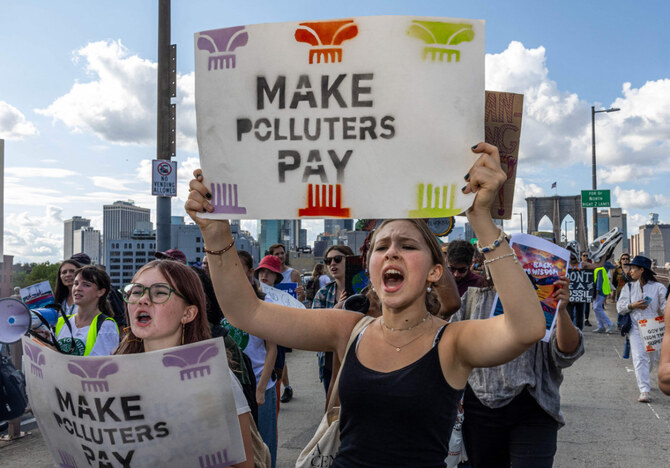
Activists cross the Brooklyn Bridge during a Youth Global Climate demonstration ahead of the UN Climate week and General Assembly in New York City on September 20, 2024. (AFP)
2 / 3
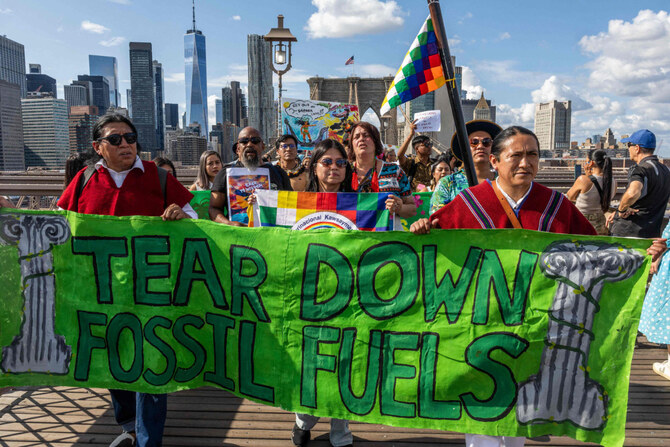
Activists cross the Brooklyn Bridge during a Youth Global Climate demonstration ahead of the UN Climate week and General Assembly in New York City on September 20, 2024. (AFP)
3 / 3
Activists cross the Brooklyn Bridge during a Youth Global Climate demonstration ahead of the UN Climate week and General Assembly in New York City on September 20, 2024. (AFP)
Short Url
Updated 23 September 2024
Follow

Leaders at climate meetings in New York warn of growing mistrust between nations

  • Climate Week kicks off in New York City
  • Organizers count some 900 Climate Week events

NEW YORK: UN Secretary General António Guterres launched a two-day, climate-themed “Summit for the Future” on Sunday as part of the UN General Assembly, where some leaders warned of growing mistrust between nations as climate-fueled disasters mount.
National leaders addressed the group after adopting a “Pact for the Future” aimed at ensuring and increasing cooperation between nations, with many calling for urgent access to more climate finance.
“International challenges are moving faster than our ability to solve them,” Guterres told leaders at the summit. “Crises are interacting and feeding off each other – for example, as digital technologies spread climate disinformation, that deepens distrust and fuels polarization.”
Prime Minister Mia Mottley of Barbados echoed Guterres’ warning and urged a “reset” in how global institutions are governed so they can better respond to crises and serve those most in need.
“The distress in our institutions of governance, the mistrust between the governors and the governed, will continue to foster social alienation the world over at the very time that we need to find as many people as possible to shape a new world,” Mottley said.
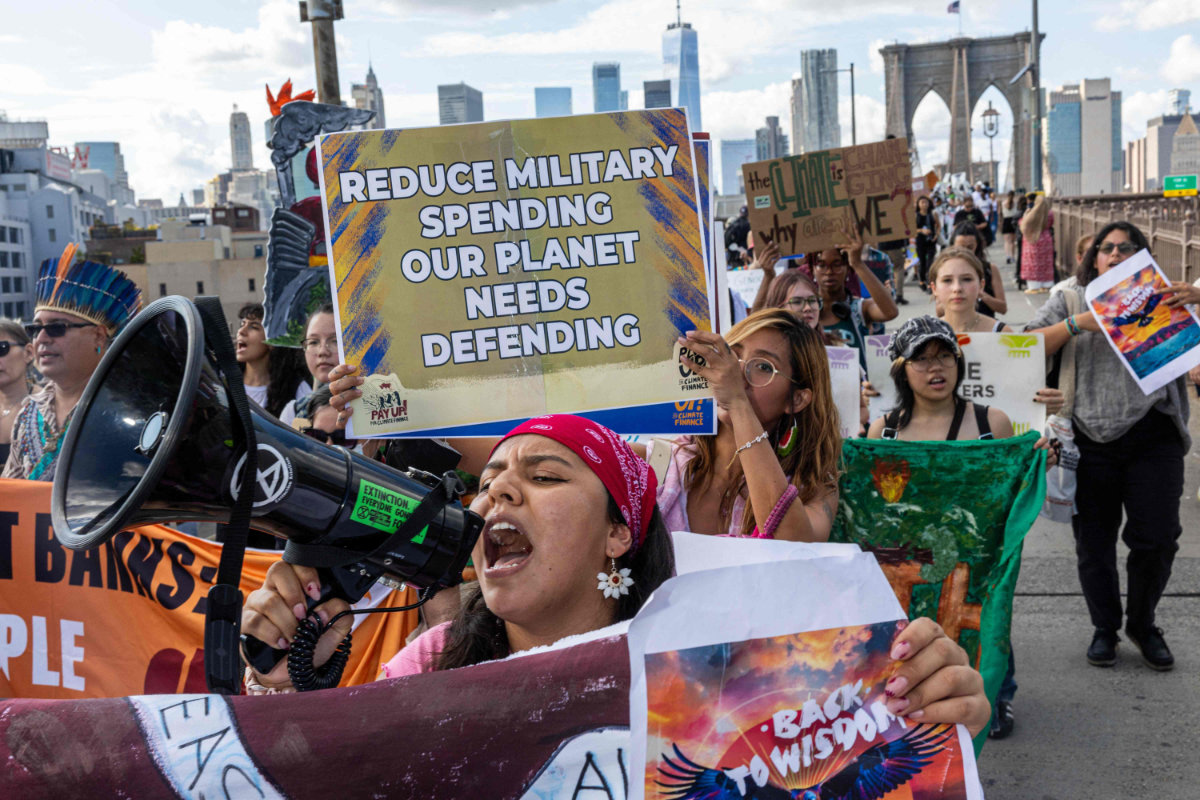


Activists cross the Brooklyn Bridge during a Youth Global Climate demonstration ahead of the UN Climate week and General Assembly in New York City on September 20, 2024. (AFP)

The UN climate summit continues on Monday with speeches from China, India, and the United States.
Elsewhere during the week, US President Joe Biden is expected to deliver a speech at an event also attended by actress and climate activist Jane Fonda and World Bank President Ajay Banga, among others. Another event hosted by the Clinton Foundation features speeches by Prince Harry, Duke of Sussex, and actor and water activist Matt Damon.
The Climate Group, which is coordinating Climate Week, counted some 900 climate-related events planned across the city this week, hosted by multinational corporations, international non-profits, governments and activists.

Big agenda
Climate summits and events like Climate Week, held alongside the UN General Assembly, have taken on a more urgent tone in recent years as rising temperatures fuel increasingly extreme disasters like heatwaves and storms.
Some observers to climate negotiations regretted that the global pact adopted Sunday morning by the General Assembly did not go further than last year’s COP28 summit in Dubai in affirming a commitment to transition away from fossil fuel use.
Countries are showing “collective amnesia” about the need to tackle these polluting fuels, said Alden Meyer, a senior associate at the climate think tank E3G.
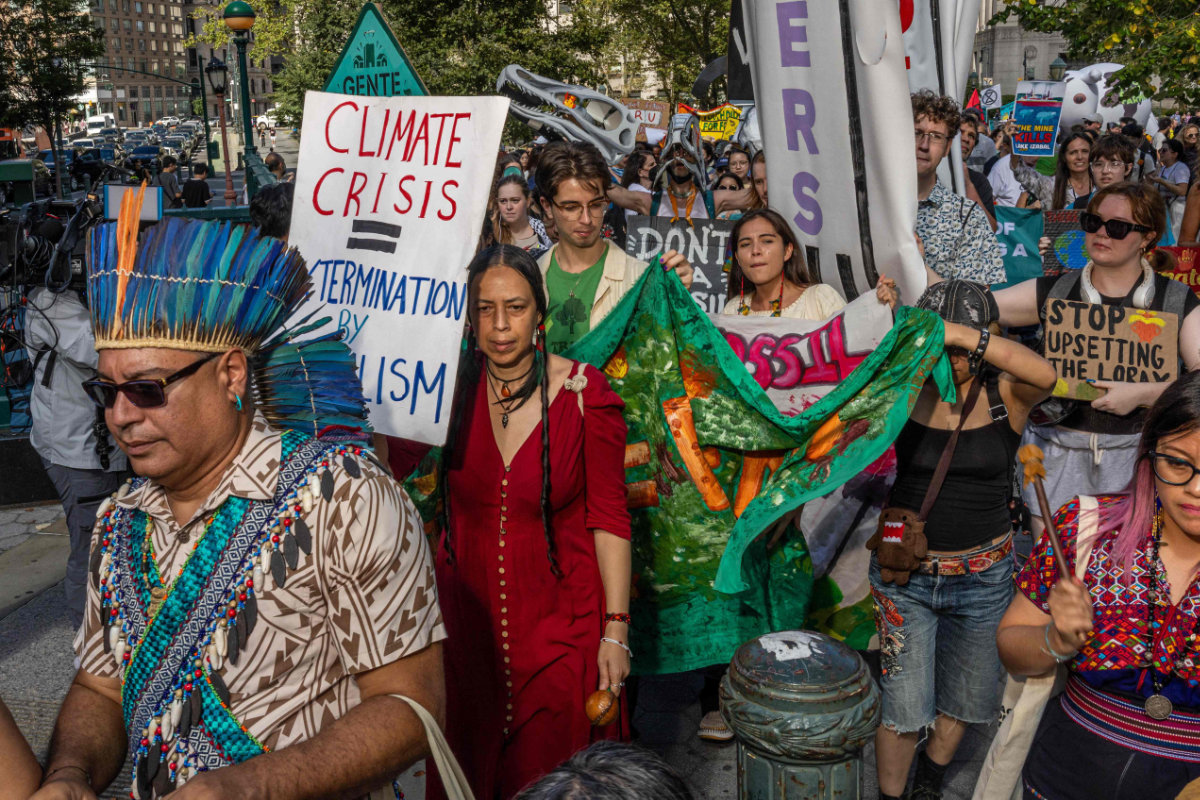


Activists cross the Brooklyn Bridge during a Youth Global Climate demonstration ahead of the UN Climate week and General Assembly in New York City on September 20, 2024. (AFP)

Leaders have also been grappling with a more urgent challenge on the climate agenda. There are just two months left until the UN’s COP29 climate summit in Baku, Azerbaijan, leaving little time for agreeing on a new global finance target to replace the annual $100 billion pledge that expires in 2025.
With some UN agencies estimating the annual financing need in the trillions, leaders are looking beyond their own budgets for ways to boost climate cash.
The World Bank and other multilateral development banks are undergoing reform processes this year, which could see them making more funding available or taking on more climate-related risk.
Under an initiative led by Barbados, France and Kenya, countries also continue to discuss imposing new global taxes to help pay for climate finance, such as a financial transaction tax or a shipping tax.
Commonwealth Secretary General Patricia Scotland noted that some of the world’s poorest countries were now facing climate-fueled disasters along with an increased debt burden.
“We have to do more to understand the fundamental unfairness of the debt crisis that most of our developing countries are going through,” Scotland told Reuters. “The development banks and the World Bank have to step up to that reality.”
(Reporting by Simon Jessop and Valerie Volcovici; Additional reporting by Michelle Nichols; Editing by Chris Reese and Stephen Coates)


Bitter pill: Taliban govt shakes up Afghan medicine market

Updated 3 sec ago
Follow

Bitter pill: Taliban govt shakes up Afghan medicine market

  • Afghanistan’s decision to overhaul its medicine market was meant to improve quality and boost domestic production, but industry specialists say the swift changes have led to a litany of problems
KABUL: Afghanistan’s decision to overhaul its medicine market was meant to improve quality and boost domestic production, but industry specialists say the swift changes have led to a litany of problems.
The Taliban authorities announced in November that the decades-long dependency on medicine imports from Pakistan would soon end, a step taken after deadly border clashes with their neighbor.
After the ban came into effect this month, finance ministry spokesman Abdul Qayoom Naseer told AFP that the government urged all importers to find “alternative and legal” sources to replace Pakistani supplies.
Despite a three-month grace period to end existing contracts and clear customs, the shift presents a huge challenge for a country which had imported more than half its medicine from Pakistan.
“Some of the prices have increased, some of them are short (unavailable), it has created a lot of problems for people,” said Mujeebullah Afzali, a pharmacist in the capital, Kabul.
Drugs now have to come from elsewhere, increasing transit time and transport costs, and adding logistical complexities.
The pharmacist said he had begun importing medicine through the Islam Qala crossing on the Iranian border, “which increased the transportation fee 10 to 15 percent.”
Transport costs used to account for six to seven percent of total spending on medicine, but this has now risen to 25 to 30 percent, said a person directly involved in the pharmaceutical industry, speaking to AFP on condition of anonymity due to security concerns.
He estimated that the overall losses to business owners had already reached millions of dollars.
“If a medicine was short in the market before, a call was made to Pakistan, and the medicine was delivered in two to three days,” he said.
Whether legally or not, it was “delivered quickly,” he added.
‘Fill the gap’
The illicit trade in pharmaceuticals was a key driver for the overhaul, according to the health ministry.
“The biggest problem with Pakistani medicine was that we used to receive counterfeit and fake medicines,” ministry spokesman Sharafat Zaman told AFP.
He acknowledged it will take some time to shift the market, saying that officials were working with Iran, India, Bangladesh, Uzbekistan, Turkiye, China and Belarus to source medicine.
“India was second in the market, which means that now, through Indian medicines, we can cover the percentage needed,” Zaman said.
And domestic production of 600 medicines has “solved the problems” of many patients, he said.
Afghanistan already produces a variety of serums including antibiotics, according to manufacturer Milli Shifa Pharmaceutical.
The company makes 100,000 bottles daily and “can double the capability” if demand merits, CEO Nasar Ahmad Taraki told AFP.
While Afghanistan has significantly expanded its pharmaceutical sector, domestic output still only meets a small fraction of the overall demand.
The industry source told AFP that the need to import raw materials, the high energy costs and limited infrastructure mean the country cannot be entirely self-sufficient in medicine production.
“If we are provided with the facilities, then we would be able to fill the gap created by Pakistan’s situation,” he said.
Shortages and higher costs
But reshaping an industry nationwide takes more than three months.
Some drugs made in Afghanistan have proven more expensive than those imported from Pakistan, which over the years have gained consumers’ trust.
Some people believe that “if they use Pakistani medicine, they will be cured” — but not if it came from India “or any other country,” the industry source said.
Physicians, meanwhile, are also struggling, a health care provider in Kabul told AFP.
Doctors “must change prescriptions, find suitable alternatives, and spend additional time adjusting treatment plans,” he said, requesting anonymity for security reasons.
The shake-up, which ultimately is meant to end reliance on Pakistan, is complicating care in the short term and could delay treatment, he warned.
“Patients face medicine shortages, frequent switches to alternative products, and sometimes higher costs.”