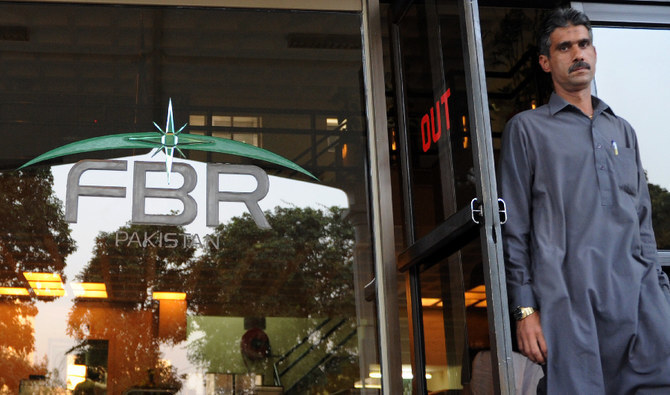
ISLAMABAD: Prime Minister Shehbaz Sharif on Friday approved the Federal Board of Revenue’s (FBR) homegrown transformation plan to improve tax collection, Pakistan state media reported on Friday, amid Islamabad’s efforts to support the dwindling $350 billion South Asian economy.
Pakistan last year came to the brink of default as the economy shriveled amid political chaos, impact of 2022 floods and decades of mismanagement. Last-minute loan rollovers from friendly countries as well as a $3 billion bailout from the International Monetary Fund (IMF) saved the nation.
The situation prompted Islamabad to introduce institutional reforms, as demanded by the IMF, to put the economy back on track but Pakistan’s finances remain in dire straits, with high inflation and staggering public debts.
Authorities prepared the FBR transformation plan in collaboration with economic and technological experts after a detailed analysis of tax collection in the last 25 years, the Radio Pakistan broadcaster reported.
“The plan includes a comprehensive strategy for the effective use of information technology, incentivizing officers and staff who demonstrate integrity and performance in improving tax collection and enhancing the enforcement of tax laws,” the report read.
“This will enable more tax to be collected in a better manner without hindering the journey of economic development and will provide more convenience to the people paying full tax.”
Strict measures can be taken against those who do not pay full tax on time and are involved in tax evasion, according to the proposals. Under the transformation plan, auditing capacity of the FBR will be enhanced.
Speaking at a meeting of stake-holders, PM Sharif directed the formulation of a comprehensive strategy to further enhance the effectiveness of the FBR’s enforcement system, describing it as a “pressing need.”
“FBR is the backbone of the country’s economy and its digitization is an important milestone in government’s economic reforms,” he was quoted as saying.
“Improvement in revenues will enhance the provision of services to the public and lead to betterment in the social sector.”
The prime minister also directed third party audit of all FBR projects.
In July, Sharif had asked FBR officials to re-evaluate and revise their strategy to enhance revenue collection to rid Pakistan of a massive public debt of $242 billion, according to Sharif’s office.
The statement came hours after Pakistan reached a staff-level agreement with the IMF for a new $7 billion loan deal. Islamabad agreed in exchange to conduct further unpopular reforms, including widening the South Asian nation’s chronically low tax base, and tax authorities have identified 4.9 million taxable persons in the country by using modern technology.
During the 2024-25 fiscal year beginning on July 1, Sharif’s government aims to raise nearly $46 billion in taxes, a 40 percent increase from the previous year. It has used more unusual methods, including blocking 210,000 mobile connections, to compel people to file their tax returns. Islamabad also aims to reduce its fiscal deficit by 1.5 percent to 5.9 percent in the coming year.
But Pakistan’s public debt of $242 billion remains a huge problem for the South Asian country and servicing it may swallow up half of the country’s income in 2024, according to the IMF.

Pakistan approves revamp of tax collection body in bid to support economy
https://arab.news/5qftx
Pakistan approves revamp of tax collection body in bid to support economy
- Pakistan last year came to the brink of default as economy shriveled amid political chaos, impact of 2022 floods and decades of mismanagement
- Islamabad reached the IMF for a bailout and agreed in exchange to conduct unpopular reforms, including widening the chronically low tax base
Pakistani politicians urge dialogue with Imran Khan’s party as PM offers talks
- National Dialogue Committee group organizes summit attended by prominent lawyers, politicians and journalists in Islamabad
- Participants urge government to lift alleged ban on political activities and media restrictions, form committee for negotiations
ISLAMABAD: Participants of a meeting featuring prominent politicians, lawyers and civil society members on Wednesday urged the government to initiate talks with former prime minister Imran Khan’s Pakistan Tehreek-e-Insaf (PTI) party, lift alleged bans on political activities after Prime Minister Shehbaz Sharif recently invited the PTI for talks.
The summit was organized by the National Dialogue Committee (NDC), a political group formed last month by former PTI members Chaudhry Fawad Husain, ex-Sindh governor Imran Ismail and Mehmood Moulvi. The NDC has called for efforts to ease political tensions in the country and facilitate dialogue between the government and Khan’s party.
The development takes place amid rising tensions between the PTI and Pakistan’s military and government. Khan, who remains in jail on a slew of charges he says are politically motivated, blames the military and the government for colluding to keep him away from power by rigging the 2024 general election and implicating him in false cases. Both deny his allegations.
Since Khan was ousted in a parliamentary vote in April 2022, the PTI has complained of a widespread state crackdown, while Khan and his senior party colleagues have been embroiled in dozens of legal cases. Prime Minister Shehbaz Sharif last month invited the PTI for talks during a meeting of the federal cabinet, saying harmony among political forces was essential for the country’s progress.
“The prime objective of the dialogue is that we want to bring the political temperatures down,” Ismail told Arab News after the conference concluded.
“At the moment, the heat is so much that people— especially in politics— they do not want to sit across the table and discuss the pertaining issues of Pakistan which is blocking the way for investment.”
Former prime minister Shahid Khaqan Abbasi, who heads the Awaam Pakistan political party, attended the summit along with Jamaat-e-Islami senior leader Liaquat Baloch, Muttahida Quami Movement-Pakistan’s Waseem Akhtar and Haroon Ur Rashid, president of the Supreme Court Bar Association. Journalists Asma Shirazi and Fahd Husain also attended the meeting.
Members of the Pakistan Peoples Party, the ruling Pakistan Muslim League-Nawaz (PML-N) and the PTI did not attend the gathering.
The NDC urged Prime Minister Shehbaz Sharif, President Asif Ali Zardari and PML-N chief Nawaz Sharif to initiate talks with the opposition. It said after the government forms its team, the NDC will announce the names of the opposition negotiating team after holding consultations with its jailed members.
“Let us create some environment. Let us bring some temperatures down and then we will do it,” Ismail said regarding a potential meeting with the jailed Khan.
Muhammad Ali Saif, a former adviser to the Khyber Pakhtunkhwa chief minister, told participants of the meeting that Pakistan was currently in a “dysfunctional state” due to extreme political polarization.
“The tension between the PTI and the institutions, particularly the army, at the moment is the most fundamental, the most prominent and the most crucial issue,” Saif noted.
‘CHANGED FACES’
The summit proposed six specific confidence-building measures. These included lifting an alleged ban on political activities and the appointment of the leaders of opposition in Pakistan’s Senate and National Assembly.
The joint communique called for the immediate release of women political prisoners, such as Khan’s wife Bushra Bibi and PTI leader Yasmin Rashid, and the withdrawal of cases against supporters of political parties.
The communiqué also called for an end to media censorship and proposed that the government and opposition should “neither use the Pakistan Armed Forces for their politics nor engage in negative propaganda against them.”
Amir Khan, an overseas Pakistani businessperson, complained that frequent political changes in the country had undermined investors’ confidence.
“I came here with investment ideas, I came to know that faces have changed after a year,” Amir Khan said, referring to the frequent change in government personnel.
Khan’s party, on the other hand, has been calling for a “meaningful” political dialogue with the government.
However, it has accused the government of denying PTI members meetings with Khan in the Rawalpindi prison where he remains incarcerated.
“For dialogue to be meaningful, it is essential that these authorized representatives are allowed regular and unhindered access to Imran Khan so that any engagement accurately reflects his views and PTI’s collective position,” PTI leader Azhar Leghari told Arab News last week.


