

Trump shooting: Secret Service admits complacency

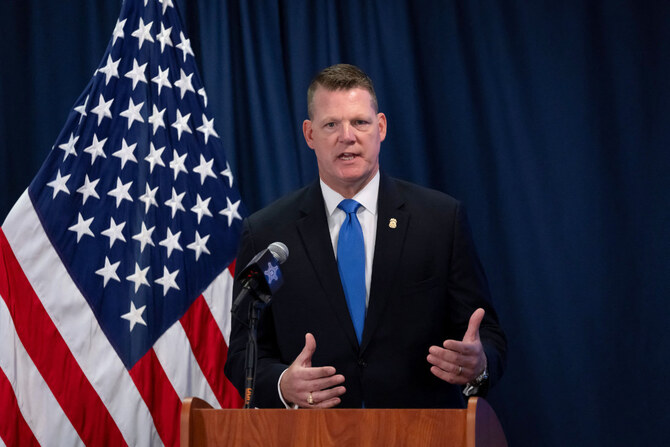
US Secret Service Acting Director Ronald Rowe speaks during a press conference in Washington, D.C., on September 20, 2024. (Pool photo/AFP)
Short Url
Updated 21 September 2024
Follow

Trump shooting: Secret Service admits complacency

  • Acting Secret Service chief details a list of failures uncovered during a review of the attempted assassination of former president Donald Trump at a rally in July
  • Trump has sought political advantage by blaming — without evidence — Biden and Democratic election rival Kamala Harris for fueling motivation behind the plots

WASHINGTON: The US Secret Service on Friday detailed a litany of failures uncovered by its review of the attempted assassination of former president Donald Trump at a rally in July.
Shooter Thomas Matthew Crooks was able to open fire from a nearby rooftop at the outdoor event held by Republican election candidate Trump, who narrowly escaped death and suffered a wound to his right ear.
The review “identified deficiencies in the advanced planning and its implementation,” Acting Director Ronald Rowe Jr. said at a press briefing.
“While some members of the advance team were very diligent, there was complacency on the part of others that led to a breach of security protocols.”

Among the failures identified by Rowe were poor communication with local law enforcement, an “over-reliance” on mobile devices “resulting in information being siloed” and line of sight issues, which “were acknowledged but not properly mitigated.”
“At approximately 18:10 local time, by a phone call, the Secret Service security room calls the countersniper response agent reporting an individual on the roof of the AGR building,” Rowe recounted.
“That vital piece of information was not relayed over the Secret Service radio network.”
Two attendees of the rally in Butler, Pennsylvania were injured from gunfire and a third, 50-year-old firefighter Corey Comperatore, died as a result.
Crooks was shot dead on the roof by Secret Service personnel.
Secret Service director Kimberly Cheatle resigned in the aftermath of the dramatic incident, and several Secret Service agents have been put on leave.
Rowe said the Secret Service needed additional funding, personnel and equipment to complete a “paradigm shift...from a state of reaction to a state of readiness.”
The Congressional task force investigating the attempted assassination of Trump issued a statement Friday encouraging Rowe to “follow through” on holding employees accountable and to cooperate with its independent investigation.
“Complacency has no place in the Secret Service,” the task force said.
The US House of Representatives unanimously passed a bill Friday to boost Secret Service protection for presidential candidates to the same level as sitting presidents and vice presidents.
The bill now awaits a vote in the Senate and a signature by President Joe Biden before it becomes law.
Rowe said that Trump is now being given the same levels of protection as the president.
The increased demand for security came into sharp focus again after a second apparent assassination attempt on Trump’s life at his golf course in West Palm Beach, Florida last weekend.
“What occurred on Sunday demonstrates that the threat environment in which the Secret Service operates is tremendous,” Rowe said.
The gunman in Florida did not have a line of sight on the former president and failed to fire a shot before he was discovered and arrested, officials say.
Trump has sought political advantage by blaming — without evidence — Biden and Democratic election rival Kamala Harris for fueling motivation behind the plots, citing their “rhetoric” about him endangering democracy.
Both Biden and Harris have repeatedly denounced the assassination bids and any political violence, with Biden calling for Congress to provide more resources for the Secret Service.


Asylum applications drop to 40-year low in Sweden

A picture taken on June 26, 2023, shows migrants receiving food and clothes from an NGO in Athens. (AFP)
Updated 7 sec ago
Follow

Asylum applications drop to 40-year low in Sweden

  • Asylum seekers and their family members accounted for just 6 percent of the total, compared with 31 percent in 2018, when total immigration was 133,000

STOCKHOLM: The number of people applying for asylum in Sweden dropped by 30 percent in 2025 to the lowest level since 1985, with the ​right-of-center government saying it planned to further tighten rules this year ahead of an election in September.
The ruling minority coalition, which is supported by the anti-immigration Sweden Democrats, has made cutting the number of asylum seekers a key policy platform since taking power in 2022. It blames a surge ‌in gang ‌crime on decades of loose ‌asylum laws and ​failed ‌integration measures under previous Social Democrat-led governments.

FASTFACT

The Swedish government has cracked down on asylum seekers, made it more difficult to gain residency and citizenship, and introduced financial incentives for immigrants to leave the country.

“The change is not just about numbers in terms of lower immigration, it’s also about the way that’s made up, who is coming to Sweden with the proportion from asylum at a record low,” said Immigration Minister Johan Forssell.
The number of immigrants, excluding refugees from Ukraine, fell to 79,684 last year from 82,857 in 2024, according to figures from the Migration Board. 
Asylum seekers and their family members accounted for just 6 percent of the total, compared with 31 percent in 2018, when total immigration was 133,000.
The number of people either voluntarily returning to another country or being expelled by authorities was also up.
“This is an area which is a high priority for us,” Forssell said.
The government has cracked down on asylum seekers, made it more difficult to gain residency and citizenship, and introduced financial incentives for immigrants to leave the country since it came to power.
Forssell said the government planned to further tighten regulations in the coming year, including a new law to increase the number of returnees and stricter citizenship rules, among other measures.
Swedes will ‌vote in what is expected to be a tight general election in September.
Meanwhile, Denmark’s strict immigration policies drove asylum admissions to a historic low in 2025, with 839 requests granted by the end of November, the government said.
“It is absolutely critical that as few foreigners as possible come to Denmark and obtain asylum. My main priority is to limit the influx of refugees,” said Immigration Minister Rasmus Stoklund in a press release.
According to the ministry, “there have been very few years when the annual total remained below 1,000 ... 2025 will be a year with a historically low number of residence permits granted on asylum grounds.”
Denmark registered 1,835 asylum requests by November 2025.
The country’s immigration approach has been influenced by far-right parties for more than 20 years, and Prime Minister Mette Frederiksen, leader of the Social Democrats, has pursued a “zero refugee” policy since taking office in 2019.
Copenhagen has, over the years, implemented a slew of initiatives to discourage migrants and make Danish citizenship harder to obtain.
In 2024, the country of 6 million people accepted some 860 of the 2,333 asylum requests lodged that year.