ISLAMABAD: The chief of a leading Pakistani religio-political party said on Friday he had suggested that the government undertake judicial reforms instead of passing an elaborate constitutional amendments package, posing a new challenge to the ruling coalition of Prime Minister Shehbaz Sharif, which is pushing for the changes.
The government last week sought to get a package of 52 constitutional amendments passed in parliament but postponed the move after it was unable to gather the two-thirds majority parliamentary votes required, most importantly as it did not get support from Fazl-ur-Rehman, the president of the Jamiat-e-Ulama-e-Islam (JUI-F) party.
The amendments propose increasing the retirement age of superior judges by three years, revisiting the seniority principle in the appointment of the country’s top judge and establishing a federal constitutional court, among other changes.
Opposition parties, mainly the Pakistan Tehreek-e-Insaf (PTI) party of jailed former premier Imran Khan, have criticized the package, calling it an “attack” on the independence of the judiciary. The PTI says the amendments are being done solely to grant an extension to incumbent Supreme Court Chief Justice Qazi Faez Isa, widely believed to be aligned with the ruling coalition and in opposition to its chief rival, the PTI.
The government has repeatedly said the amendments are not “individual specific.”
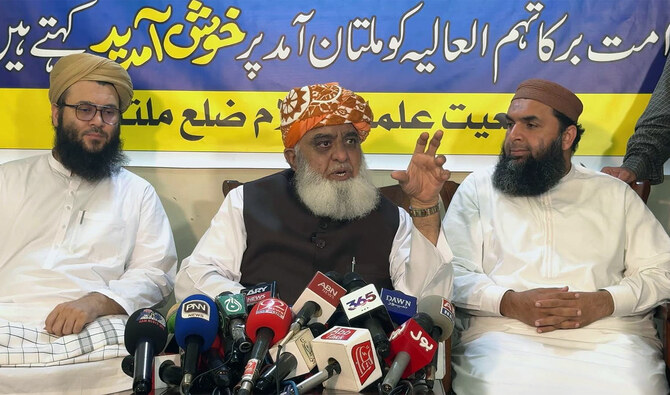
“We [Jamiat-e-Ulama-e-Islam] adopted a stance that instead of amending the constitution with individuals in mind, why not head toward judicial reforms?” Rehman said at a televised news conference in Multan.
He said that his party had sought a draft of the constitutional amendment package from the government, saying the government was initially not willing to share it but when it managed to get hold of a copy, it reflected a lack of preparation.
“When we received the copy [of the proposed constitutional amendments] and our lawyers reviewed it, we were deeply saddened by the fact that the constitution, which protects the fundamental rights of every citizen, but over here, human and fundamental rights had been restricted, and the role of [Pakistan’s] military had been significantly expanded.
“Additionally, matters relating to the appointment and transfer of judges, even in the high courts, were alarming. If a judge is not trusted or cannot deliver a favorable decision, they could be immediately transferred, or the case could be reassigned to another judge.”
He said he had met with a key coalition partner, Bilawal Bhutto Zardari, chairman of the Pakistan People’s Party, about the amendments package.
“We agreed that we could also make a draft [of amendments] and he could also create a draft before sharing them with each other,” Rehman said.
“We want consensus. The job of parliament is to legislate, bring constitutional legislation, make amendments, and pass laws. This is our job. And we are not ready to accept any restriction on this.”
The issue of the constitutional amendments has raised widespread concerns among opposition parties and independent experts who say the moves are aimed at increasing the government’s power in making key judicial appointments and dealing with the defection of lawmakers during house votes.


![]()

Constitutional Amendments: In new challenge to government, key Pakistani politician urges judicial reforms
Short Url
https://arab.news/6cc3b
Constitutional Amendments: In new challenge to government, key Pakistani politician urges judicial reforms
- Government reached out to Maulana Fazlur Rehman to push the constitutional amendment package in parliament
- Rehman says the package limited the scope of human rights, expanded the role of Pakistan’s powerful military
Latest updates


Recommended


© 2026 SAUDI RESEARCH & PUBLISHING COMPANY, All Rights Reserved And subject to Terms of Use Agreement.