ISLAMABAD: A major Chinese business group unveiled its plan to set up textile parks in two Pakistani provinces during a meeting with Prime Minister Shehbaz Sharif on Friday, saying these “international-standard” facilities will help generate up to $5 billion in textile exports from the country.
China’s Ruyi Shandong Group, one of the largest textile and clothing manufacturers, has expanded globally over the past decade through acquisitions and investments. It has also benefited from the multibillion-dollar China-Pakistan Economic Corridor (CPEC) in the past by investing in a coal power plant in the country.
The group’s chairman, Qiu Yafu, held a meeting with the prime minister to discuss the investment proposal and highlight its details.
“Ruyi Group will establish international-standard textile parks in Sindh and Punjab provinces, inviting around 100 major Chinese textile industries to invest,” he said in his briefing, according to an official statement circulated after the meeting.
“The primary focus of these textile parks is to boost Pakistan’s textile exports and make Pakistan a global hub for textiles and garments,” he continued.
The Chinese businessman added these parks will utilize solar energy, operate with zero carbon emissions and employ modern automated technology.
“In the first phase, these parks are expected to generate $2 billion in exports, with $5 billion anticipated in the second phase,” he noted. “The parks will create employment opportunities for 300,000 to 500,000 local individuals.”
According to the briefing, the foundation stone for the textile parks will be laid by the end of the year, with completion expected within three years.
Ruyi Group will also establish wholesale commodity centers in both Karachi and Lahore.
It was decided during the meeting to establish working groups in Islamabad and Beijing to advance matters between Pakistan and the Chinese business group.
“China has always stood by Pakistan in difficult times,” the prime minister said during the meeting. “Economic relations between China and Pakistan are growing stronger with each passing day.”
He also formed a special committee headed by Deputy Prime Minister Ishaq Dar to oversee the initiative.
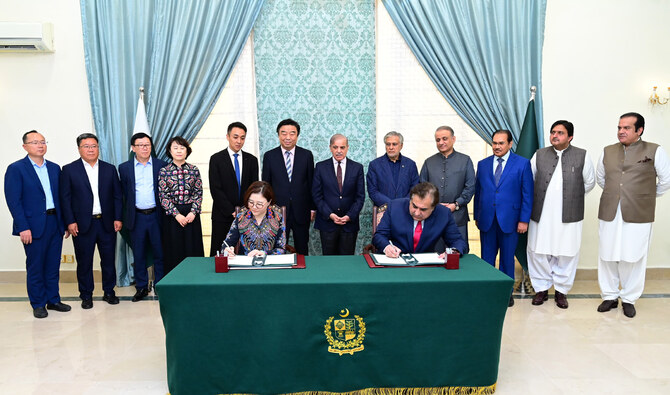
A memorandum of understanding was signed between Pakistan’s Board of Investment and Ruyi Shandong Group regarding the establishment of the parks, with the prime minister in attendance.


Chinese group to set up textile parks in Pakistan, aiming for $5 billion boost in exports
https://arab.news/cmca3
Chinese group to set up textile parks in Pakistan, aiming for $5 billion boost in exports

- Textile parks will utilize solar energy, modern automated technology and will operate with zero carbon emissions
- The foundation stone of the parks will be laid by the end of the year and they will employ up to 500,000 people

Bangladesh approves new rice imports from Pakistan amid price pressures
- The deal follows Bangladesh’s resumption of direct rice trade with Pakistan earlier this year for the first time since independence in 1971
- Diplomatic ties between the two nations have improved since the ouster of prime minister Sheikh Hasina after mass protests last year
DHAKA: Bangladesh has approved the import of 50,000 metric tons of white rice from Pakistan under a government-to-government deal as part of efforts to stabilize domestic prices, officials said on Tuesday.
The Cabinet Committee on Government Purchase cleared the deal at $395 per ton, reinforcing Dhaka’s renewed trade engagement with Islamabad.
Rice prices in Bangladesh have jumped by between 15 percent and 20 percent over the past year, with medium-quality rice selling at about 80 taka ($0.66) per kilogram. Despite increased imports and the removal of duties to ease supply constraints, prices for the staple grain remain stubbornly high.
The deal follows Bangladesh’s resumption of direct rice trade with Pakistan earlier this year for the first time since independence in 1971. In February, it imported 50,000 tons of rice from Pakistan at $499 per ton under a similar agreement.
Diplomatic ties between the two South Asian nations have improved since an interim government led by Nobel laureate Muhammad Yunus took office after mass protests forced then prime minister Sheikh Hasina to flee to neighboring India last year.
Formerly East Pakistan, Bangladesh gained independence after a nine-month war in 1971, and relations with Pakistan have remained fraught in the decades since the conflict.
Separately, the government approved another 50,000 tons of parboiled rice through an international tender, part of a series of recent purchases aimed at cooling local prices. India’s Pattabhi Agro Foods secured the contract with the lowest bid of $355.77 per ton.


