Indian general praises professionalism of Pakistani soldiers on UN mission in South Sudan

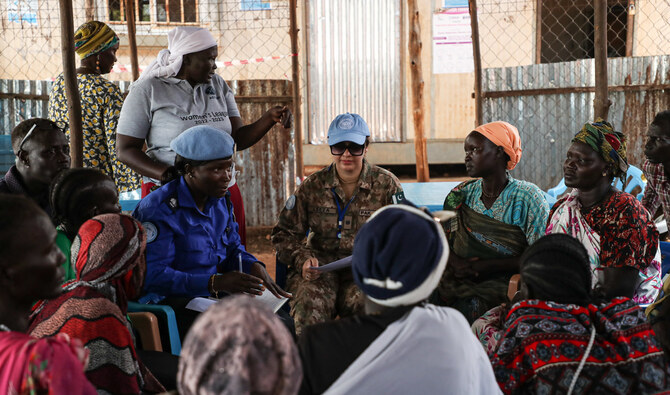
Displaced women speak to UN Mission Peacekeepers from Pakistan Army in a displacement camp in Juba, South Sudan on September 13, 2024. (Photo courtesy: UNMISS)
Short Url
Updated 20 September 2024
Follow

Indian general praises professionalism of Pakistani soldiers on UN mission in South Sudan

  • Severe flooding in Sudan last month led to the destruction of nearly two dozen villages and caused 30 confirmed deaths
  • Pakistani peacekeepers undertook daunting engineering tasks in a complex environment, ensuring protection of civilians

ISLAMABAD: Indian Force Commander at the United Nations (UN) mission in South Sudan, Lt. Gen. S Mohan, has commended the efforts of Pakistan’s peacekeeping contingent in saving hundreds of thousands of Sudanese people stranded in floods last month, the Pakistani military said on Thursday.
Severe flooding that resulted from torrential rains overwhelmed the Arbaat Dam and led to the destruction of nearly two dozen villages and caused at least 30 confirmed deaths in Sudan last month, Reuters reported.
Pakistani peacekeepers, who have been performing duties for peace and security in South Sudan, undertook daunting engineering tasks in a complex environment and ensured the protection of civilians, according to the Inter-Services Public Relations (ISPR), the Pakistani military’s media wing.
The Indian general acknowledged their professionalism in a letter written to Pakistan Army Chief General Asim Munir, in which Lt Gen Mohan commended the “dedication and unwavering commitment” of Pakistani peacekeepers in Sudan.
“Pakistani blue helmets have undertaken daunting engineers’ tasks in complex and challenging operational environment to ensure protection of civilians, which has always remained top priority for Pakistani peacekeepers,” the ISPR said in a statement.
“Pakistani contingent worked day and night and protected over 250,000 Internally Displaced Persons (IDPs) in worst flood affected areas.”
The complex and contentious relationship between Pakistan and India has been marred by territorial and other disputes, with the disputed Himalayan territory of Kashmir being the most significant of them. Ties between the two neighbors remain suspended since Aug. 2019, when New Delhi revoked semi-autonomous status of part of Kashmir it controls.
The ISPR said the Indian general specially acknowledged Pakistan’s Brig. Shafqat Iqbal and Lt. Col. Shahbaz Aslam for their role in saving the lives of Sudanese people, which served as a “testament” to Pakistan Army’s reputation in international peacekeeping efforts.
“Pakistan remains committed to play a pivotal role as a responsible member of the international community to help realize the ideals of global peace and security through active support in UN Peacekeeping Missions,” it added.


Pakistan likely to import around 7 million cotton bales this year as local production nearly halves

Updated 5 sec ago
Follow

Pakistan likely to import around 7 million cotton bales this year as local production nearly halves

  • Pakistan produced 5.3 million cotton bales by mid-December against 10 million targeted, government data shows
  • While the imports may ensure smooth supply of raw material, they may put pressure on foreign exchange reserves

KARACHI: Pakistan is likely to import around 7 million cotton bales this year owing to a decline of nearly half the annual target set by the Federal Committee on Agriculture (FCA), industry stakeholders said on Tuesday.

Pakistan’s cotton production stood at 5.3 million bales each weighing 170 kilograms as of Dec. 15, according to state-run Pakistan Central Cotton Committee (PCCC) data. The FCA had set a target of 10.2 million bales in April.

Karachi Cotton Brokers Forum (KCBF) Chairman Naseem Usman Osawala sees the country’s cotton production declining by 46 percent this season, compared to the FCA target.

“The country is expected to produce about 5.5 million bales this year,” he told Arab News, adding Pakistan would have to import around 7 million bales to meet requirement of its textile industry which consumes about 12 million bales a year.

The country had sown cotton over 2.002 million hectares, which was down by 11 percent from the targeted 2.26 million hectares.

Muhammad Waqas Ghani, head of research at Karachi-based JS Global Capital brokerage firm, said the South Asian country is likely to miss its cotton output target of 10 million bales.

“At the current rate of arrival, the output can reach 7 million bales at its best,” he added.

Cotton is a raw material for Pakistan’s largest textile industry and was the worst hit crop by climate-induced floods earlier this year.

Osawala said Pakistan’s cotton production has been falling because of an increasing number of sugar mills being established in the country’s cotton-producing regions.

Courts in Pakistan have been issuing significant rulings to bar the establishment of sugar mills in the designated cotton belt areas of the Punjab province. In 2018, the Supreme Court ordered relocation of three sugar mills from cotton-producing districts in southern Punjab to protect the crop.

Since cotton prices are low in the international market, textile millers would go for more imports, according to the KCBF chairman.

On Dec. 22, the price of cotton in the New York market stood at as much as 65.85 cents per pound, 1.64 cents lower than last year, according to the PCCC data.

Osawala said Pakistan’s increasing textile imports are also “hurting local cotton production.”

According to the Pakistan Bureau of Statistics’ (PBS) July-November data, the country had imported raw cotton, synthetic fiber, synthetic and artificial silk yarn and worn clothing worth $2.82 billion, 5 percent more than the imports during the same period last year.

Speaking of the impact of Pakistan’s falling cotton production, Kamran Arshad, chairman of All Pakistan Textile Mills Association (APTMA), said the millers would have to import “a lot of cotton” this year.

“I think approximately 7-7.5 million bales will have to be imported this year,” he said.

The textile and apparel sector is Pakistan’s largest exporter, accounting for more than half of the country’s overall exports and contributing around 8.5 percent of the gross domestic product (GDP) by employing nearly 40 percent of the industrial labor force. But high energy costs and outdated infrastructure among other factors continue to slow growth and leave the country trailing regional peers.

In the last fiscal year, Pakistan imported as much as 6.2 million cotton bales each weighing 220 kilograms, mostly from Brazil and the United States, according to KCBF Chairman Arshad.

Shankar Talreja, head of research at Karachi-based Topline Securities, said Pakistan is likely to import cotton worth $1.2 billion this year “considering the requirement.”

“The full-year import of cotton is likely to remain over $1 billion,” Talreja said.

Economic experts say while importing more cotton would ensure smooth supply of raw material to Pakistan’s textile sector, it may put pressure on the country’s foreign exchange reserves that rose to $15.9 billion last week after the International Monetary Fund (IMF) released a $1.2 billion tranche under Pakistan’s $7 billion loan program.