ISLAMABAD: Prime Minister Shehbaz Sharif said on Thursday the second phase of the China-Pakistan Economic Corridor (CPEC) would help Pakistan transform its economy, Pakistani state media reported.
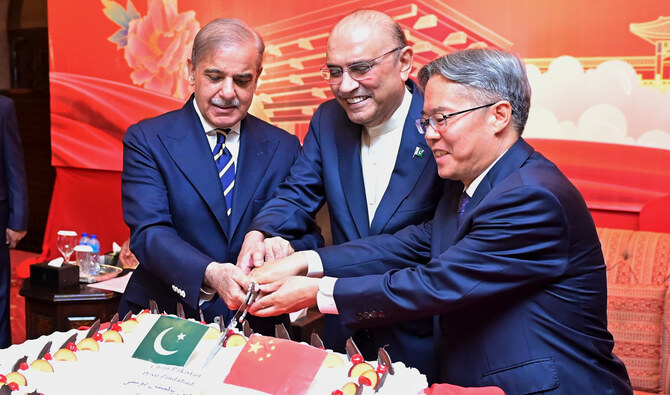
The statement came at a reception hosted by the Chinese embassy in Islamabad with regard to China’s National Day, which was attended by PM Sharif, President Asif Ali Zardari, diplomats, dignitaries, and senior civil and military officers.
CPEC, a part of China’s Belt and Road Initiative, aims to connect China to the Arabian Sea through a network of roads, railways, pipelines and ports in Pakistan and help Islamabad expand and modernize its economy.
China has also shown willingness for the second phase of CPEC and has given assurances for the establishment of five new corridors, including that of growth, livelihood, innovation, green economy and open regional inclusive development.
“We are entering into the second phase of CPEC which has huge potential of mutual cooperation in the field of agriculture, information technology, mines and minerals and many other important areas of mutual interests,” the state-run APP news agency quoted Sharif as saying at the event to commemorate China’s 75th anniversary.
He acknowledged China’s critical role in Pakistan’s talks with the International Monetary Fund (IMF) for a new $7 billion bailout program to keep its economy afloat. Islamabad has for years relied on China, Saudi Arabia and the United Arab Emirates (UAE) for assistance to meet such external financing requirements.
“The ongoing partnership not only fostered regional development and peace but also contributed to global stability and progress, aligning with President Xi Jinping’s vision,” Sharif added.
Speaking at the event, President Zardari reaffirmed Pakistan’s commitment to working together with China for shared prosperity, peace and stability in the world.
The high-quality development of CPEC would “help unlock greater benefits for our people, besides enhancing connectivity and prosperity of the region,” he was quoted as saying by the APP.
President Zardari felicitated the Chinese people on the auspicious occasion, saying the first of October marked the rebirth of a strong, united China that was achieved through the “heroic struggle” of the Chinese people under the leadership of the Communist Party.
He reflected on the invaluable contributions made by the successive generations in transforming the Pakistan-China friendship into an all-weather strategic cooperative partnership.


PM Sharif says second phase of CPEC to help transform Pakistan’s economy
https://arab.news/cw9mb
PM Sharif says second phase of CPEC to help transform Pakistan’s economy

- CPEC, a part of China’s Belt and Road Initiative, aims to connect China to the Arabian Sea and help Islamabad expand and modernize its economy
- Beijing has shown willingness for its second phase that includes new corridors for growth, livelihood, innovation, green economy and development

Pakistan’s Punjab deports more than 31,000 Afghans under nationwide removal campaign
- Police say hundreds more Afghans remain in holding centers as repatriation process continues
- Pakistan has expelled over 1.5 million Afghans since launching the drive campaign in late 2023
ISLAMABAD: Police in Pakistan’s Punjab province said on Saturday they have deported more than 31,000 Afghan nationals living in various districts without legal documentation, as authorities continue a sweeping campaign to expel such people.
Pakistan launched its nationwide deportation drive in late 2023, ordering all “illegal immigrants,” mostly Afghan nationals, to leave the country. The decision was taken after a series of deadly suicide attacks in which the government said Afghan nationals were involved. Kabul denied its citizens were involved in the bombings, describing Pakistan’s security challenges as its own internal issue.
Last month, state broadcaster Radio Pakistan said Islamabad had repatriated over 1.5 million Afghan citizens since November 2023.
“The Punjab Police have so far deported 31,377 Afghans among other illegally residing foreign nationals from Lahore and across the province,” the law enforcement agency said in a statement.
“Another 203 undocumented individuals are currently present in holding points,” it added.
The statement did not specify the period in which these people were rounded up and sent back to their home countries.
According to the statement, the deportees include 11,576 men, 6,679 women and 13,133 children.
Police said those removed comprised individuals with partial documentation such as proof of residence (10,043 people), Afghan Citizen Cards (11,067) and those found to be living illegally (10,267).
“There are five holding centers in Lahore and 46 across the province,” the statement said.
The province’s top cop, Inspector-General of Police Dr. Usman Anwar, said security had been heightened to ensure the removal of undocumented foreign nationals.
“Punjab Police is implementing the policy for the evacuation of illegally residing foreigners under international laws,” he said. “Human rights are being fully taken into account during the process.”
Pakistan has hosted millions of Afghans since the Soviet invasion of Afghanistan in 1979, but deteriorating security concerns and strained relations with Kabul have led Islamabad to initiate the latest deportation campaign, which rights groups have criticized as abrupt and lacking adequate safeguards.