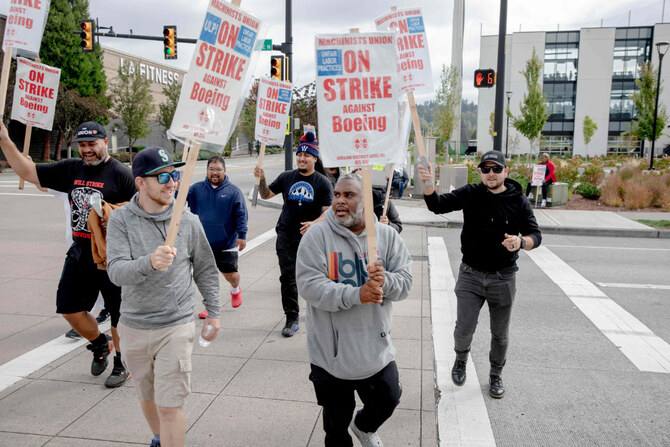
Boeing said on Wednesday it will temporarily furlough tens of thousands of employees after about 30,000 machinists went on strike on Friday, halting production of its 737 MAX and other airplanes.
“We are initiating temporary furloughs over the coming days that will impact a large number of US-based executives, managers and employees,” CEO Kelly Ortberg said in an email to employees. “We are planning for selected employees to take one week of furlough every four weeks on a rolling basis for the duration of the strike.”
Ortberg also said he and other Boeing leaders “will take a commensurate pay reduction for the duration of the strike.”
The extensive furloughs show Ortberg is preparing the company to weather a prolonged strike that is not likely to be easily resolved given the anger among rank-and-file workers.
The strike, Boeing’s first since 2008, adds to a tumultuous year for the planemaker which began when a door panel blew off a new 737 MAX jet in mid-air in January.
A protracted labor battle could cost Boeing several billion dollars, further straining finances and threatening its credit rating, analysts said.
“It’s unlikely that the cuts will fully offset the costs of a prolonged strike,” said Ben Tsocanos, aerospace director at S&P Global Ratings.
Boeing and the International Association of Machinists and Aerospace Workers (IAM) are talking in the presence of federal mediators. The union said Tuesday it was frustrated with the first day of mediation, which it said Boeing was not taking seriously.
The union has been pushing for a 40 percent raise over four years in its first full contract negotiations with Boeing in 16 years, well above the planemaker’s offer of 25 percent, which was resoundingly rejected.
Brian Bryant, the IAM’s international president, said actions like furloughs and the cutback in salaries amounted to “smoke and mirrors,” given earlier company spending on bonuses and compensation for top executives.
“This is just part of their plan to make it look like they’re trying to save money,” added Bryant who was in the Seattle area picketing on Wednesday with the “resilient” membership.
“The ball is in Boeing’s court. They could settle this strike tomorrow,” Bryant said, adding it would take fair pay, pension, restoring a bonus and health insurance.
In the email to employees, Ortberg said the company would not take any “actions that inhibit our ability to fully recover in the future. All activities critical to our safety, quality, customer support and key certification programs will be prioritized and continue, including 787 production.”
The company employs about 150,000 people in the United States. It is unclear exactly which employees are affected by the furloughs. A union representing Boeing’s engineers said their members were not affected.
The strike, now six days old, also carries risks for the company’s vast network of suppliers, some of whom are also considering furloughs, several told Reuters.
“Certainly suppliers are worried,” said Nikki Malcom, CEO of the Pacific Northwest Aerospace Alliance. “It’s going to have a significant impact on suppliers if it goes on a long time.”
Production halts
The strike has halted production of Boeing’s best-selling 737 MAX jets, along with its 777 and 767 widebody aircraft, delaying deliveries to airlines.
Boeing said on Monday it was freezing hiring to cut costs as its balance sheet is already burdened with $60 billion of debt.
The company has also stopped placing most orders for parts for all Boeing jet programs except the 787 Dreamliner, in a move that will hurt its suppliers.
One senior supplier dismissed the latest announcement as “panic mode” and said it underscored Boeing’s lack of room to maneuver due to its already-strained balance sheet.
“They would be better to settle; they are getting very near the precipice,” said the supplier, who asked not to be named.
Boeing shares have fallen about 40 percent so far this year.

Boeing furloughs thousands as it hunkers down for extended strike
Short Url
https://arab.news/9dntg
Boeing furloughs thousands as it hunkers down for extended strike
- The extensive furloughs show the company is preparing to weather a prolonged strike that is not likely to be easily resolved
- A protracted labor battle could cost Boeing several billion dollars, further straining finances and threatening its credit rating
- The strike has halted production of Boeing’s best-selling 737 MAX jets, along with its 777 and 767 widebody aircraft, delaying deliveries to airlines
Refugee firefighters in Mauritania battle bushfires to give back to the community that took them in
MBERA: The men move in rhythm, swaying in line and beating the ground with spindly tree branches as the sun sets over the barren and hostile Mauritanian desert. The crack of the wood against dry grass lands in unison, a technique perfected by more than a decade of fighting bushfires.
There is no fire today but the men — volunteer firefighters backed by the UN refugee agency — keep on training.
In this region of West Africa, bushfires are deadly. They can break out in the blink of an eye and last for days. The impoverished, vast territory is shared by Mauritanians and more than 250,000 refugees from neighboring Mali, who rely on the scarce vegetation to feed their livestock.
For the refugee firefighters, battling the blazes is a way of giving back to the community that took them in when they fled violence and instability at home in Mali.
Newcomers with an old tradition
Hantam Ag Ahmedou was 11 years old when his family left Mali in 2012 to settle in the Mbera refugee camp in Mauritania, 48 kilometers (30 miles) from the Malian border. Like most refugees and locals, his family are herders and once in Mbera, they saw how quickly bushfires spread and how devastating they can be.
“We said to ourselves: There is this amazing generosity of the host community. These people share with us everything they have,” he told The Associated Press. “We needed to do something to lessen the burden.”
His father started organizing volunteer firefighters, at the time around 200 refugees. The Mauritanians had been fighting bushfires for decades, Ag Ahmedou said, but the Malian refugees brought know-how that gave them an advantage.
“You cannot stop bushfires with water,” Ag Ahmedou said. “That’s impossible, fires sometimes break out a hundred kilometers from the nearest water source.”
Instead they use tree branches, he said, to smother the fire.
“That’s the only way to do it,” he said.
The volunteer ‘brigade’
Since 2018, the firefighters have been under the patronage of the UNHCR. The European Union finances their training and equipment, as well as the clearing of firebreak strips to stop the fires from spreading. The volunteers today count over 360 refugees who work with the region’s authorities and firefighters.
When a bushfire breaks out and the alert comes in, the firefighters jump into their pickup trucks and drive out. Once at the site of a fire, a 20-member team spreads out and starts pounding the ground at the edge of the blaze with acacia branches — a rare tree that has a high resistance to heat.
Usually, three other teams stand by in case the first team needs replacing.
Ag Ahmedou started going out with the firefighters when he was 13, carrying water and food supplies for the men. He helped put out his first fire when he was 18, and has since beaten hundreds of blazes.
He knows how dangerous the task is but he doesn’t let the fear control him.
“Someone has to do it,” he said. “If the fire is not stopped, it can penetrate the refugee camp and the villages, kill animals, kill humans, and devastate the economy of the whole region.”
A climate-vulnerable nation
About 90 percent of Mauritania is covered by the Sahara Desert. Climate change has accelerated desertification and increased the pressure on natural resources, especially water, experts say. The United Nations says tensions between locals and refugees over grazing areas is a key threat to peace.
Tayyar Sukru Cansizoglu, the UNHCR chief in Mauritania, said that with the effects of climate change, even Mauritanians in the area cannot find enough grazing land for their own cows and goats — so a “single bushfire” becomes life-threatening for everyone.
When the first refugees arrived in 2012, authorities cleared a large chunk of land for the Mbera camp, which today has more than 150,000 Malian refugees. Another 150,000 live in villages scattered across the vast territory, sometimes outnumbering the locals 10 to one.
Chejna Abdallah, the mayor of the border town of Fassala, said because of “high pressure on natural resources, especially access to water,” tensions are rising between the locals and the Malians.
Giving back
Abderrahmane Maiga, a 52-year-old member of the “Mbera Fire Brigade,” as the firefighters call themselves, presses soil around a young seedling and carefully pours water at its base.
To make up for the vegetation losses, the firefighters have started setting up tree and plant nurseries across the desert — including acacias. This year, they also planted the first lemon and mango trees.
“It’s only right that we stand up to help people,” Maiga said.
He recalls one of the worst fires he faced in 2014, which dozens of men — both refugees and host community members — spent 48 hours battling. By the time it was over, some of the volunteers had collapsed from exhaustion.
Ag Ahmedou said he was aware of the tensions, especially as violence in Mali intensifies and going back is not an option for most of the refugees.
He said this was the life he was born into — a life in the desert, a life of food scarcity and “degraded land” — and that there is nowhere else for him to go. Fighting for survival is the only option.
“We cannot go to Europe and abandon our home,” he said. “So we have to resist. We have to fight.”
There is no fire today but the men — volunteer firefighters backed by the UN refugee agency — keep on training.
In this region of West Africa, bushfires are deadly. They can break out in the blink of an eye and last for days. The impoverished, vast territory is shared by Mauritanians and more than 250,000 refugees from neighboring Mali, who rely on the scarce vegetation to feed their livestock.
For the refugee firefighters, battling the blazes is a way of giving back to the community that took them in when they fled violence and instability at home in Mali.
Newcomers with an old tradition
Hantam Ag Ahmedou was 11 years old when his family left Mali in 2012 to settle in the Mbera refugee camp in Mauritania, 48 kilometers (30 miles) from the Malian border. Like most refugees and locals, his family are herders and once in Mbera, they saw how quickly bushfires spread and how devastating they can be.
“We said to ourselves: There is this amazing generosity of the host community. These people share with us everything they have,” he told The Associated Press. “We needed to do something to lessen the burden.”
His father started organizing volunteer firefighters, at the time around 200 refugees. The Mauritanians had been fighting bushfires for decades, Ag Ahmedou said, but the Malian refugees brought know-how that gave them an advantage.
“You cannot stop bushfires with water,” Ag Ahmedou said. “That’s impossible, fires sometimes break out a hundred kilometers from the nearest water source.”
Instead they use tree branches, he said, to smother the fire.
“That’s the only way to do it,” he said.
The volunteer ‘brigade’
Since 2018, the firefighters have been under the patronage of the UNHCR. The European Union finances their training and equipment, as well as the clearing of firebreak strips to stop the fires from spreading. The volunteers today count over 360 refugees who work with the region’s authorities and firefighters.
When a bushfire breaks out and the alert comes in, the firefighters jump into their pickup trucks and drive out. Once at the site of a fire, a 20-member team spreads out and starts pounding the ground at the edge of the blaze with acacia branches — a rare tree that has a high resistance to heat.
Usually, three other teams stand by in case the first team needs replacing.
Ag Ahmedou started going out with the firefighters when he was 13, carrying water and food supplies for the men. He helped put out his first fire when he was 18, and has since beaten hundreds of blazes.
He knows how dangerous the task is but he doesn’t let the fear control him.
“Someone has to do it,” he said. “If the fire is not stopped, it can penetrate the refugee camp and the villages, kill animals, kill humans, and devastate the economy of the whole region.”
A climate-vulnerable nation
About 90 percent of Mauritania is covered by the Sahara Desert. Climate change has accelerated desertification and increased the pressure on natural resources, especially water, experts say. The United Nations says tensions between locals and refugees over grazing areas is a key threat to peace.
Tayyar Sukru Cansizoglu, the UNHCR chief in Mauritania, said that with the effects of climate change, even Mauritanians in the area cannot find enough grazing land for their own cows and goats — so a “single bushfire” becomes life-threatening for everyone.
When the first refugees arrived in 2012, authorities cleared a large chunk of land for the Mbera camp, which today has more than 150,000 Malian refugees. Another 150,000 live in villages scattered across the vast territory, sometimes outnumbering the locals 10 to one.
Chejna Abdallah, the mayor of the border town of Fassala, said because of “high pressure on natural resources, especially access to water,” tensions are rising between the locals and the Malians.
Giving back
Abderrahmane Maiga, a 52-year-old member of the “Mbera Fire Brigade,” as the firefighters call themselves, presses soil around a young seedling and carefully pours water at its base.
To make up for the vegetation losses, the firefighters have started setting up tree and plant nurseries across the desert — including acacias. This year, they also planted the first lemon and mango trees.
“It’s only right that we stand up to help people,” Maiga said.
He recalls one of the worst fires he faced in 2014, which dozens of men — both refugees and host community members — spent 48 hours battling. By the time it was over, some of the volunteers had collapsed from exhaustion.
Ag Ahmedou said he was aware of the tensions, especially as violence in Mali intensifies and going back is not an option for most of the refugees.
He said this was the life he was born into — a life in the desert, a life of food scarcity and “degraded land” — and that there is nowhere else for him to go. Fighting for survival is the only option.
“We cannot go to Europe and abandon our home,” he said. “So we have to resist. We have to fight.”
© 2025 SAUDI RESEARCH & PUBLISHING COMPANY, All Rights Reserved And subject to Terms of Use Agreement.