

Venezuelan opposition candidate says letter conceding election was coerced

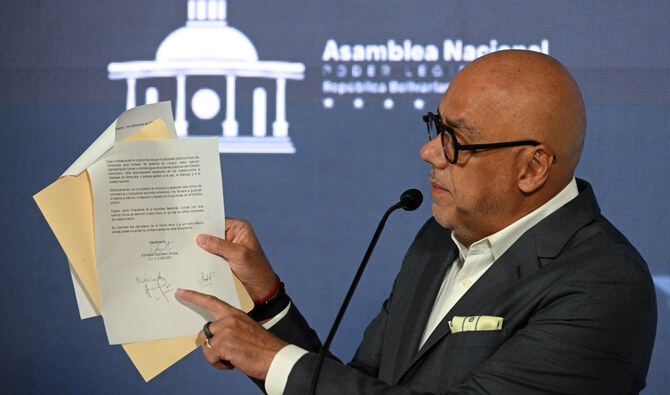
The president of the National Assembly Jorge Rodriguez shows the alleged letter from opposition candidate Edmundo Gonzalez Urrutia during a press conference at the National Assembly in Caracas on September 18, 2024. (AFP)
Short Url
Updated 19 September 2024
Follow

Venezuelan opposition candidate says letter conceding election was coerced

CARACAS: Venezuela’s opposition candidate Edmundo Gonzalez Urrutia said Wednesday he had been coerced into signing a letter distributed by Venezuelan authorities in which he supposedly conceded election defeat to strongman President Nicolas Maduro.

In the letter, dated September 7 and addressed to parliamentary leader Jorge Rodriguez, Gonzalez Urrutia said “I respect” the regime-aligned CNE electoral council’s proclamation of Maduro as the winner of the July 28 vote.

But on Wednesday, the 75-year-old retired diplomat published a message on X from Madrid, where he was given asylum after weeks in hiding in Venezuela, saying he was made to sign the letter in exchange for being allowed to leave.

Maduro aides brought him the letter at the Spanish embassy in Caracas and “I had to either sign it or deal with the consequences.”

Gonzalez Urrutia added “there were very tense hours of coercion, blackmail and pressure. At that point I considered I could be of more use free than if I were imprisoned.”

The letter, he said, was worthless as it was tainted by “coercion.”

Within hours of polls closing, the CNE declared Maduro the victor with 52 percent of votes cast.

The opposition immediately cried foul and dozens of countries refused to recognize Maduro’s claim to a third six-year term unless the CNE published a detailed vote breakdown, which it has not.

The United States has said there was “overwhelming evidence” that Gonzalez Urrutia had won.

The opposition presented its own figures based on polling station-level counts which it says proves Gonzalez Urrutia won by a landslide.

Gonzalez Urrutia vowed on Wednesday that “as the president elected by millions and millions of Venezuelans who voted for change, democracy and peace, I will not be silenced.”

He left for Spain under the cloud of an arrest warrant condemned by the international community for “serious crimes” related to his insistence that Maduro had stolen the vote.

Gonzalez Urrutia had ignored three successive summonses to appear before prosecutors investigating him for alleged crimes including “usurpation” of public functions, “forgery” of a public document, incitement to disobedience and sabotage.

The charges stem from the opposition’s publication of voting results, which the government says only authorized institutions have the right to do.

The CNE has said it cannot publish the voting records as hackers had corrupted the data, though observers have said there was no evidence of such interference.

Gonzalez Urrutia replaced opposition leader Maria Corina Machado on the ballot at the last minute after she was barred from running by institutions loyal to the Maduro regime.

She, too, has been mostly in hiding since the vote, except for appearing at a handful of organized demonstrations.

Maduro has said both Gonzalez Urrutia and Machado belong “behind bars,” blaming them for the deaths of 25 civilians and two soldiers in protests that broke out spontaneously after his alleged victory was announced.

Nearly 200 people were injured and more than 2,400 arrested.

Maduro has managed to cling to power despite sanctions stepped up after his 2018 reelection, also dismissed as a sham by dozens of countries.



Tarique Rahman-led BNP set to form Bangladesh’s next government after major election win

Updated 13 February 2026
Follow

Tarique Rahman-led BNP set to form Bangladesh’s next government after major election win

  • Jamaat-e-Islami, banned during Hasina’s government, won 68 seats
  • Majority of Bangladeshis endorsed sweeping reforms in national referendum

DHAKA: The Bangladesh Nationalist Party, led by Tarique Rahman, is set to form the country’s next government after securing a more than two-thirds majority in the first elections since a student-led uprising in 2024 ousted ex-prime minister, Sheikh Hasina.

The BNP has won at least 209 seats out of the 299 contested, according to the latest election results released by the Election Commission on Friday, paving the way for Rahman to become the country’s next prime minister.

Jamaat-e-Islami, banned during Hasina’s 15 years in power, has registered its best performance yet, winning at least 68 seats and emerging as the main opposition party.

The National Citizen Party, which was born out of the 2024 protests, was in third place with six seats, including for its leader Nahid Islam, while Hasina’s Awami League was barred from participating in the elections.

The majority of Bangladeshis also reportedly voted “yes” in a national referendum on the “July National Charter” that was held alongside the general vote on Thursday.

Named after the month when the uprising that toppled Hasina began, the charter is aimed at achieving sweeping democratic reforms to prevent authoritarian administrations, including term limits for premiers, stronger presidential powers and greater judicial independence, while also proposing increased representation of women in parliament.

The BNP-led government is likely to follow the commitments made under the charter, said Prof. A.S.M. Amanullah, vice chancellor of the National University in Dhaka, adding that the implementation of the July charter was also included in the party’s election manifesto that covers reform of the state and rebuilding of the economy.

“Mr. Tarique Rahman is a highly trained politician, highly sensitive politician, and he takes decisions based on facts. I believe he prepared himself to run this country locally and play a role internationally,” Amanullah told Arab News.

Rahman is the son of former Prime Minister Khaleda Zia and former President Ziaur Rahman. He returned to Bangladesh late last year after nearly two decades of self-imposed exile in the UK, and assumed BNP’s leadership days later, following his mother’s death from a prolonged illness.

In an interview with Arab News earlier this week, the 60-year-old pledged to pursue accountability for the former leadership and meet the political and economic expectations of the youth movement that brought about the change.

The new government is likely to be a mix of young and old politicians, Amanullah said, with Jemaat-e-Islami set to balance out the BNP’s rule.

“This is a very good size of opposition to press the issues or to challenge the government on different issues, different policies and decisions of the government. I’m hopeful about Jemaat,” he said.

“The way the people voted for these major two parties, the BNP and Jemaat, I think if they could work jointly, Bangladesh should see a stable political situation in the near future.”

Mohiuddin Ahmad, a political analyst and researcher, described Jemaat-e-Islami as “the most organized party” in Bangladesh and that it would therefore play an “instrumental” role as the opposition party.

Voter turnout averaged 59.44 percent, the EC said, with many Bangladeshis considering this week’s vote as their first “free and fair” election after more than 17 years.

“Such a result of an election we haven’t actually experienced before,” Muhiuddin Iqbal, a history student at Dhaka University, told Arab News.

“The festive feeling has not gone yet, so we’re very much excited about it and hopeful for the future.”