

Experts explore pathways for faster electric vehicle integration

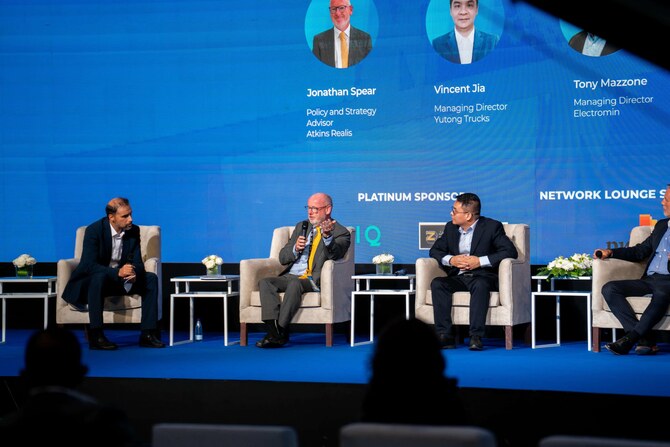
Industry leaders speak at a panel on the second day of the EV Auto Show in Riyadh. AN photo
Short Url
Updated 18 September 2024
Follow

Experts explore pathways for faster electric vehicle integration

RIYADH: Experts discussed the progress of electrification in the private vehicle market, noting that while advancements are being made, mass adoption has not yet been achieved.

Jonathan Spear, policy and strategy adviser at Atkins Realis, shared these insights during a keynote panel titled “How Electric Vehicles Can See Faster Commercial Adoption” at the EV Auto Show on Wednesday.

Key challenges facing the sector include high purchase prices driven by battery costs and the necessity for robust charging infrastructure. Spear pointed out that leading nations in electric vehicle adoption include China, Europe, and the US, while emerging economies are lagging due to the logistical difficulties of electrifying their vehicle fleets.

He emphasized that national regulations and city-level policies play a critical role in promoting the adoption of zero-emission fleets, particularly through public procurement strategies for cleaner vehicles and infrastructure.

Tony Mazzone, managing director at Electromin, highlighted the importance of government support in accelerating the development of EV charging infrastructure. He noted that the cost of electric vehicles remains significantly higher than that of diesel vehicles, largely due to the high expenses associated with technology and batteries.

Mazzone also mentioned that the electrification of larger trucks is progressing more slowly due to technological challenges. For instance, he explained that electrifying a 40-ton truck involves substantial battery weight, making the establishment of charging infrastructure along key routes equally demanding.

Looking ahead, Mazzone expressed optimism that advancements in technology, such as solid-state batteries, could address these challenges by 2030.

Vincent Jia, managing director at Yutong Trucks, discussed the company’s focus on three primary markets in the Middle East: Saudi Arabia, the UAE, and Qatar. He observed that Saudi Arabia’s electric truck market is slower to adopt compared to its neighbors, attributing this to the kingdom’s lower fuel prices.

Spear reiterated the importance of implementing the right policies, legislation, and national regulations to foster EV adoption in Saudi Arabia. He also stressed the need for openness to innovation and technological trials that suit the region’s climatic conditions.

In conclusion, Spear suggested that effective practices should consider the entire lifecycle of electric vehicles, including their construction and supply chain, to ensure a comprehensive approach to reducing carbon emissions.


PIF’s Humain invests $3bn in Elon Musk’s xAI prior to SpaceX acquisition

Updated 18 February 2026
Follow

PIF’s Humain invests $3bn in Elon Musk’s xAI prior to SpaceX acquisition

JEDDAH: Humain, an artificial intelligence company owned by Saudi Arabia’s Public Investment Fund, invested $3 billion in Elon Musk’s xAI shortly before the startup was acquired by SpaceX.

As part of xAI’s Series E round, Humain acquired a significant minority stake in the company, which was subsequently converted into shares of SpaceX, according to a press release.

The transaction reflects PIF’s broader push to position Saudi Arabia as a central hub in the global AI ecosystem, as part of its Vision 2030 diversification strategy.

Through Humain, the fund is seeking to combine capital deployment with infrastructure buildout, partnerships with leading technology firms, and domestic capacity development to reduce reliance on oil revenues and expand into advanced industries.

The $3 billion commitment offers potential for long-term capital gains while reinforcing the company’s role as a strategic, scaled investor in transformative technologies.

CEO Tareq Amin said: “This investment reflects Humain’s conviction in transformational AI and our ability to deploy meaningful capital behind exceptional opportunities where long-term vision, technical excellence, and execution converge, xAI’s trajectory, further strengthened by its acquisition by SpaceX, one of the largest technology mergers on record, represents the kind of high-impact platform we seek to support with significant capital.” 

The deal builds on a large-scale collaboration announced in November at the US-Saudi Investment Forum, where Humain and xAI committed to developing over 500 megawatts of next-generation AI data center and computing infrastructure, alongside deploying xAI’s “Grok” models in the Kingdom.

In a post on his X handle, Amin said: “I’m proud to share that Humain has invested $3 billion into xAI’s Series E round, just prior to its historic acquisition by SpaceX. Through this transaction, Humain became a significant minority shareholder in xAI.”

He added: “The investment builds on our previously announced 500MW AI infrastructure partnership with xAI in Saudi Arabia, reinforcing Humain’s role as both a strategic development partner and a scaled global investor in frontier AI.”

He noted that xAI’s trajectory, further strengthened by SpaceX’s acquisition, exemplifies the high-impact platforms Humain aims to support through strategic investments.

Earlier in February, SpaceX completed the acquisition of xAI, reflecting Elon Musk’s strategy to integrate AI with space exploration.

The combined entity, valued at $1.25 trillion, aims to build a vertically integrated innovation ecosystem spanning AI, space launch technology, and satellite internet, as well as direct-to-device communications and real-time information platforms, according to Bloomberg.

Humain, founded in August, consolidates Saudi Arabia’s AI initiatives under a single entity. From the outset, its vision has extended beyond domestic markets, participating across the global AI value chain from infrastructure to applications.

The company represents a strategic initiative by PIF to diversify the Kingdom’s economy and reduce oil dependence by investing in knowledge-based and advanced technologies.