

Italian business body of 7,000 firms eyes investments in Saudi Arabia

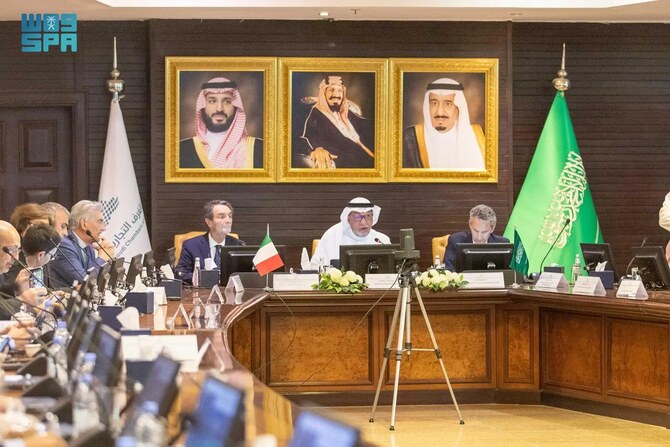
This announcement was made during the Saudi-Italian Business Forum, held at the Saudi Chambers Federation. SPA
Short Url
Updated 18 September 2024
Follow

Italian business body of 7,000 firms eyes investments in Saudi Arabia

RIYADH: An Italian business federation representing 7,000 companies has announced plans to increase Italian investments in Saudi Arabia, focusing on opportunities aligned with Vision 2030.

According to the Saudi Press Agency, the federation includes major Italian firms across key economic sectors. This announcement was made during the Saudi-Italian Business Forum, held at the Saudi Chambers Federation. The event featured the newly appointed Italian Ambassador to Saudi Arabia, Carlo Baldocchi, along with representatives from over 140 companies and officials from both nations.

Attilio Fontana, president of the Lombardy Regional Government, emphasized that Lombardy, which has a gross domestic product exceeding $444 billion, is a crucial part of the Italian economy and offers significant opportunities for international investors. He noted that the visit aims to enhance the role of Italian expertise in Saudi investments, scientific collaboration, and cultural exchange, while committing to provide incentives for Saudi investors.

Kamel Al-Majid, chairman of the Saudi-Italian Business Council, highlighted the growth in bilateral trade between Saudi Arabia and Italy, which is now approaching SR38 billion ($10.1 billion). Lombardy has made substantial contributions through key exports such as machinery, chemicals, and automotive products.

He also pointed out that cooperation in logistics, infrastructure development, and digital technologies could create significant opportunities for Italian investors, while Italian expertise in construction can support major projects in Saudi Arabia.

Lombardy, a financial and industrial powerhouse, hosts the Italian stock exchange and attracts global investments in sectors like automotive, aerospace, life sciences, biotechnology, artificial intelligence, and advanced technologies.

Saudi Arabia is actively enhancing its efforts to attract foreign investments across various sectors. The recent update to its investment law aligns with international best practices to create a more favorable business environment.

Announced in August, the new legislation replaces the Foreign Investment Law of 2000, aiming to ensure equal treatment for domestic and foreign investors. At the launch of the new law, Saudi Investment Minister Khalid Al-Falih stated that the legislation “reaffirms Saudi Arabia’s commitment to creating a welcoming and secure environment for investors.”

In January, Hassan Al-Huwaizi, president of the Federation of Saudi Chambers of Commerce and Industry, announced that the number of Saudi foreign business councils had reached 70, including those with major global economic players such as China, the US, Japan, and the UK, as well as Italy, France, and the UAE.

The recent reestablishment of the business council with Canada in July is the latest step in a plan led by the federation to strengthen the Kingdom’s international trade relationships as part of the Vision 2030 economic diversification strategy.



Silver crosses $77 mark while gold, platinum stretch record highs

Updated 27 December 2025
Follow

Silver crosses $77 mark while gold, platinum stretch record highs

  • Spot silver touched an all-time high of $77.40 earlier today, marking a 167% year-to-date surge driven by supply deficits
  • Spot platinum rose 9.8% to $2,437.72 per ounce, while palladium surged 14 percent to $1,927.81, its highest level in over 3 years

Silver breached the $77 mark for the first time on Friday, while gold and platinum hit record highs, buoyed by expectations of US Federal Reserve rate cuts and geopolitical tensions that fueled safe-haven demand.

Spot silver jumped 7.5% to $77.30 per ounce, as of 1:53 p.m. ET (1853 GMT), after touching an all-time high of $77.40 earlier today, marking a 167% year-to-date surge driven by supply deficits, its designation ‌as a US ‌critical mineral, and strong investment inflows.

Spot gold ‌was ⁠up ​1.2% at $4,531.41 ‌per ounce, after hitting a record $4,549.71 earlier. US gold futures for February delivery settled 1.1% higher at $4,552.70.

“Expectations for further Fed easing in 2026, a weak dollar and heightened geopolitical tensions are driving volatility in thin markets. While there is some risk of profit-taking before the year-end, the trend remains strong,” said Peter Grant, vice president and senior metals strategist ⁠at Zaner Metals.

Markets are anticipating two rate cuts in 2026, with the first likely ‌around mid-year amid speculation that US President Donald ‍Trump could name a dovish ‍Fed chair, reinforcing expectations for a more accommodative monetary stance.

The US ‍dollar index was on track for a weekly decline, enhancing the appeal of dollar-priced gold for overseas buyers.

On the geopolitical front, the US carried out airstrikes against Daesh militants in northwest Nigeria, Trump said on Thursday.

“$80 in ​silver is within reach by year-end. For gold, the next objective is $4,686.61, with $5,000 likely in the first half of next ⁠year,” Grant added.

Gold remains poised for its strongest annual gain since 1979, underpinned by Fed policy easing, central bank purchases, ETF inflows, and ongoing de-dollarization trends.

On the physical demand side, gold discounts in India widened to their highest in more than six months this week as a relentless price rally curbed retail buying, while discounts in China narrowed sharply from last week’s five-year highs.

Elsewhere, spot platinum rose 9.8% to $2,437.72 per ounce, having earlier hit a record high of $2,454.12 while palladium surged 14% to $1,927.81, its highest level in more than three years.

All precious ‌metals logged weekly gains, with platinum recording its strongest weekly rise on record.