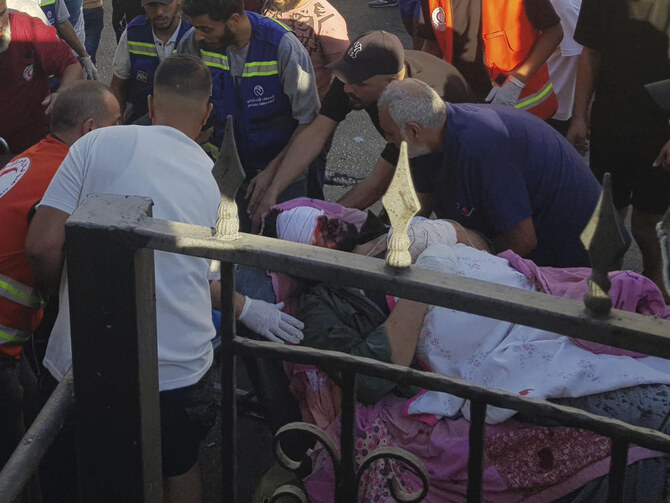
BEIRUT: Doctors in Lebanon spoke Wednesday of horrific eye injuries and finger amputations, a day after Hezbollah paging devices exploded across the country, killing 12 people and wounding up to 2,800.
“The injuries were mainly to the eyes and hands, with finger amputations, shrapnel in the eyes — some people lost their sight,” said doctor Joelle Khadra, who was working in emergency at Beirut’s Hotel-Dieu hospital.
Hundreds of wireless paging devices belonging to members of the Iran-backed group exploded simultaneously on Tuesday, hours after Israel said it was broadening the aims of the Gaza war to include its fight against Hamas’s Lebanese ally.
Khadra told AFP that Hotel-Dieu, located in the Lebanese capital’s Christian-majority Ashrafieh district, treated about 80 injured.
Around 20 “were admitted to intensive care immediately and were put on ventilators to ensure they wouldn’t suffocate due to the swelling in their faces,” she said.
“The rest are going one after the other to the operating room. Today, we have 55 surgeries,” she added, wearing her white doctor’s coat over her blue scrubs.
Hezbollah, which has traded near daily cross-border fire with Israeli forces in support of Hamas in the Gaza Strip, has vowed to retaliate for the pager blasts, which it blamed on Israel.
Israel has not yet comment on the explosions, which went off in Hezbollah strongholds across Lebanon, from Beirut’s southern suburbs to Lebanon’s south and in the east near the Syrian border.
A doctor at another hospital in Beirut said he worked all night and that the injuries were “out of this world — never seen anything like it.”
“It’s beyond what can be described,” he said, requesting anonymity because he was not authorized by the hospital to speak to the media.
“We have a lot of injuries with amputated fingers” because people were holding the pagers in one or both hands, he said, while some people who had been sitting on the floor also had wounded feet.
But the “most devastating” wounds were when the pagers blew up in people’s faces, he said, citing up to 40 patients with eye injuries, most of them severe.
Around three-quarters of those patients “lost one eye completely, and the other eye is either somewhat salvageable or barely salvageable,” he said, while “15 to 20 percent... lost both eyes in a way that’s irreparable.”
“A lot of colleagues have been saying this is worse compared to the August 4... (eye) injuries that we saw,” he said.
On August 4, 2020, a catastrophic explosion at Beirut’s port killed more than 220 people and injured some 6,500, with several hundred at least suffering ocular injuries and some people even blinded in one eye by flying shards of glass and other debris.
The doctor also reported “a lot of burns and foreign bodies — metallic pieces of pagers being retrieved from patients’ eyes, brains, faces, sinuses, from their insides, from their bones.”
He said there was “a lot of tissue loss, fingers lost — things that we can’t repair, we can’t replace.”
Health Minister Firass Abiad said Wednesday that two children were among 12 people killed, while almost 300 people were “in critical condition,” some suffering facial injuries and brain haemorrhaging.
Of some 1,800 people who were admitted to hospital, “460 needed operations on their eyes, face or limbs, particularly the hands,” he said, noting “multiple finger or hand amputations.”
Lebanon, enduring a grinding five-year economic crisis, received a delivery of medical aid from Iraq on Wednesday morning, while doctors and nurses from Iran’s Red Crescent also arrived to assist, Lebanon’s official National News Agency reported, and Jordan said it sent aid and medical supplies.
The office of the United Nations special coordinator for Lebanon said on X that “praise must go to the medical corps and emergency professionals,” adding the importance of their work after the pager blasts “cannot be overstated.”


![]()

Lebanon doctors tell of horror after pager blasts
Short Url
https://arab.news/52pnu
Lebanon doctors tell of horror after pager blasts
- “The injuries were mainly to the eyes and hands, with finger amputations, shrapnel in the eyes,” said doctor Joelle Khadra
- A doctor at another hospital in Beirut said he worked all night and that the injuries were “out of this world — never seen anything like it“


Latest updates


© 2026 SAUDI RESEARCH & PUBLISHING COMPANY, All Rights Reserved And subject to Terms of Use Agreement.