

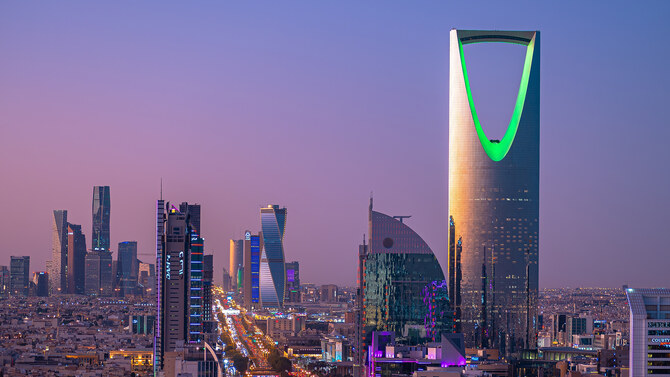
Growth of Saudi banking sector accelerated by diversification initiatives: Moody’s

Emphasizing the banking sector’s growth, the Saudi Central Bank, also known as SAMA, reported that the aggregate profit before zakat and tax of banks operating in the Kingdom reached an unprecedented SR7.83 billion ($2.1 billion) in July, reflecting a 23 percent annual increase. File
Short Url
Updated 18 September 2024
Follow

Growth of Saudi banking sector accelerated by diversification initiatives: Moody’s

RIYADH:Saudi Arabia’s efforts toward economic diversification are fueling the growth of its banking sector, with industries such as construction and tourism offering appealing lending opportunities, according to a recent analysis.

In its latest report, the US-based credit rating agency Moody’s said that the performance of the banking sector’s loan portfolio has continued to improve, particularly following the rollout of the Kingdom’s national diversification agenda aimed at reducing dependence on hydrocarbon revenue.

Emphasizing the banking sector’s growth, the Saudi Central Bank, also known as SAMA, reported that the aggregate profit before zakat and tax of banks operating in the Kingdom reached an unprecedented SR7.83 billion ($2.1 billion) in July, reflecting a 23 percent annual increase.

“We expect this trend to persist over the coming 12 to 18 months, further boosting the non-hydrocarbon economy where banks largely operate. Saudi borrowers’ repayment capacity is also supported by government policies and reforms,” said Lea Hanna, an analyst at Moody’s.

She added: “Saudi banks are enjoying lower delinquencies in their loan portfolios, while provisions cover nonperforming loans fully.”

According to Moody’s, Saudi Arabia’s real non-hydrocarbon gross domestic product is expected to grow robustly, by approximately 5.5 percent in both 2024 and 2025, driven by government investments in large infrastructure projects that will increase demand for credit during these years.

The agency also highlighted that construction, along with sectors such as tourism and entertainment, will play a vital role in shaping the growth of Saudi banks’ loan books.

“Although the contribution of giga projects, such as Red Sea and Qiddiyah, to total corporate lending will remain significant, diversification into new sectors, such as tourism, entertainment and renewable energy provide attractive lending opportunities,” said Moody’s.

The report further indicated that lending to small and medium enterprises in Saudi Arabia has increased, although it still represents a small fraction of the overall sector loan book.

Moody’s also pointed out potential risks that could impact the asset quality of banks, including a prolonged period of low oil prices and possible changes in government policy.

“They (banks in Saudi Arabia) remain exposed to downside risks should there be a reversal in economic momentum or a relaxation in authorities’ active support in managing system asset risks,” said Hanna.

In July, another report from Moody’s stated that Saudi banks are likely to see their client base expand due to government-backed economic diversification efforts that are promoting innovation and boosting productivity in the Kingdom.

The analysis also noted that Saudi Arabia and Oman were the top two Gulf Cooperation Council countries with the lowest volatility in non-oil sector expansion from 2020 to 2023.


Closing Bell: Saudi main market sheds 85 points to finish at 11,098 

Updated 17 February 2026
Follow

Closing Bell: Saudi main market sheds 85 points to finish at 11,098 

RIYADH: Saudi Arabia’s Tadawul All Share Index closed lower in the latest session, falling 85.79 points, or 0.77 percent, to finish at 11,098.06. 

The MSCI Tadawul 30 Index declined 0.63 percent to close at 1,495.23, while the parallel market index Nomu dropped 0.91 percent to 23,548.56.  

Market breadth was firmly negative, with 42 gainers against 218 decliners on the main market. Trading activity saw 226 million shares exchanged, with total turnover reaching SR4.5 billion ($1.19 billion).  

Among the session’s gainers, Tourism Enterprise Co. rose 9.40 percent to SR15.02. SHL Finance Co. advanced 4.51 percent to SR16.00, while Almasar Alshamil for Education Co. gained 3.56 percent to SR23.88.  

Dar Alarkan Real Estate Development Co. added 3.03 percent to SR19.70, and Banque Saudi Fransi climbed 2.61 percent to SR19.30. 

On the losing side, Almasane Alkobra Mining Co. recorded the steepest decline, falling 6.61 percent to SR96.

Al Moammar Information Systems Co. dropped 5.14 percent to SR164.20, while National Company for Learning and Education declined 4.60 percent to SR124.30. Saudi Ceramic Co. slipped 4.14 percent to SR27.30, and Arabian Contracting Services Co. fell 4.12 percent to SR116.50. 

On the announcement front, Saudi Telecom Co. announced the distribution of interim cash dividends for the fourth quarter of 2025 in line with its approved dividend policy.  

The company will distribute SR2.74 billion, equivalent to SR0.55 per share, to shareholders for the quarter.  

The number of shares eligible for dividends stands at approximately 4.99 billion shares. The eligibility date has been set for Feb. 23, with distribution scheduled for March 12.  

The company noted that treasury shares are not entitled to dividends and that payments will be made through Riyad Bank via direct transfer to shareholders’ bank accounts. stc shares last traded at SR44.80, unchanged on the session. 

Separately, National Environmental Recycling Co., known as Tadweer, reported its annual financial results for the year ended Dec. 31, 2025, posting significant growth in revenue and profit.  

Revenue rose 53.5 percent year on year to SR1.24 billion, compared with SR806 million in the previous year. Net profit attributable to shareholders increased 68.4 percent to SR60.9 million, up from SR36.2 million a year earlier, driven by higher sales volumes and operational expansion.

Tadweer shares last traded at SR3.80, up 2.70 percent.