Beirut, Lebanon: Hezbollah vowed on Wednesday to punish Israel for a deadly attack in which hundreds of paging devices used by the militant group’s members exploded almost simultaneously across Lebanon.
There was no immediate comment from Israel on the wave of explosions that killed nine people, including the 10-year-old daughter of a Hezbollah member, and wounded around 2,800 others.
The attack came just hours after Israel announced it was broadening the aims of the war sparked by Hamas’s October 7 attacks to include its fight against the Palestinian militant group’s ally Hezbollah along the country’s border with Lebanon.
“We hold the Israeli enemy fully responsible for this criminal aggression,” the group said in a statement on Tuesday, adding that Israel “will certainly receive its just punishment for this sinful aggression.”
On Wednesday, the group vowed in another statement on Telegram it would continue its fight in support of Gaza while reiterating it would avenge Tuesday’s blasts.
“This path is ongoing and separate from the difficult reckoning that the criminal enemy must await for its massacre on Tuesday,” the group said in a statement on Telegram.
Hezbollah leader Hassan Nasrallah will make a previously unscheduled speech at 5:00 p.m. (1400 GMT) on Thursday, the group said.
The wave of blasts killed nine people, including a girl, and wounded 2,800 others, 200 of them critically, Lebanese Health Minister Firass Abiad said Tuesday.
“This was more than lithium batteries being forced into override,” said Charles Lister of the Middle East Institute.
“A small plastic explosive was almost certainly concealed alongside the battery, for remote detonation via a call or page.”
Israel’s spy agency “Mossad infiltrated the supply chain,” he said.
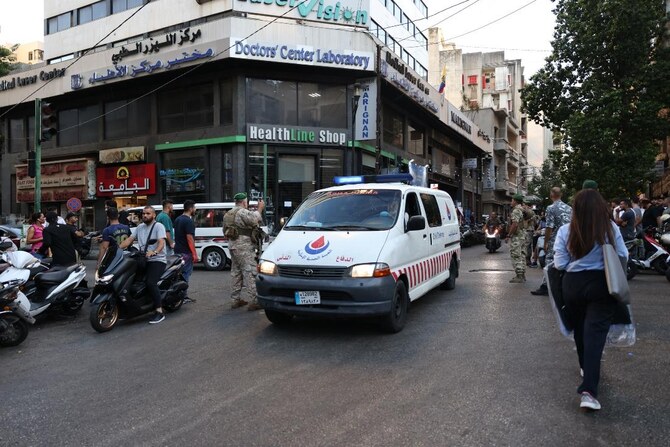
The influx of so many casualties all at once overwhelmed hospitals in Hezbollah strongholds.
At one hospital in Beirut’s southern suburbs, an AFP correspondent saw people being treated in a car park on thin mattresses, with medical gloves on the ground and ambulance stretchers covered in blood.
“In all my life I’ve never seen someone walking on the street... and then explode,” said Musa, a resident of the southern suburbs, requesting to be identified only by his first name.
The 10-year-old daughter of a Hezbollah member was killed in east Lebanon’s Bekaa Valley when his pager exploded, the family and a source close to the group said.
A son of Hezbollah lawmaker Ali Ammar was also among the dead, a source close to the group told AFP, requesting anonymity to discuss sensitive matters.
Tehran’s ambassador in Beirut was wounded but his injuries were not serious, Iranian state media reported.
The blasts hit Hezbollah strongholds across Lebanon and dealt a heavy blow to the militant group, which already had concerns about the security of its communications after losing several key commanders to targeted air strikes in recent months.
A source close to Hezbollah, asking not to be identified, told AFP that “the pagers that exploded concern a shipment recently imported by Hezbollah of 1,000 devices” which appear to have been “sabotaged at source.”
After The New York Times reported the pagers had been ordered from Taiwanese manufacturer Gold Apollo, the company denied any link to the products.
Early Tuesday, Israel announced it was broadening the aims of the Gaza war to include its fight against Hezbollah along its border with Lebanon.
To date, Israel’s objectives have been to crush Hamas and bring home the hostages seized by Palestinian militants during the October 7 attacks.
“The political-security cabinet updated the goals of the war” to include “the safe return of the residents of the north to their homes,” Israeli Prime Minister Benjamin Netanyahu’s office said in a statement.
Since October, the unabating exchanges of fire between Israeli troops and Hamas ally Hezbollah in Lebanon have killed hundreds of mostly fighters in Lebanon, and dozens including soldiers on the Israeli side.
They have also forced tens of thousands of people on both sides of the border to flee their homes.
On Monday, Israeli Defense Minister Yoav Gallant warned that failing a political solution, “military action” would be “the only way left to ensure the return” of displaced residents to the border area.
Major airlines Lufthansa and Air France on Tuesday announced suspensions of flights to Tel Aviv, Tehran and Beirut until Thursday.
US Secretary of State Antony Blinken arrived back in the region at dawn on Wednesday to try to revive stalled ceasefire talks for the Israel-Hamas war in Gaza.
After months of mediated negotiations failed to pin down a ceasefire, Washington said it was still working with mediators Qatar and Egypt to finalize an agreement.
US officials have expressed increasing frustration with Israel as Netanyahu has publicly rejected US assessments that a deal is nearly complete and has insisted on an Israeli military presence on the Egypt-Gaza border.
The October 7 attack on southern Israel that sparked the war resulted in the deaths of 1,205 people, mostly civilians, according to an AFP tally based on official Israeli figures.
Militants also seized 251 hostages, 97 of whom are still held in Gaza, including 33 the Israeli military says are dead.
Israel’s retaliatory military offensive has killed at least 41,252 people in Gaza, according to the Hamas-run territory’s health ministry, which does not provide a breakdown of civilian and militant deaths.
On Tuesday, UN member states were debating a draft resolution demanding an end to the Israeli occupation of all Palestinian territories within 12 months.
General Assembly resolutions are not binding, but Israel has already denounced the new text as “disgraceful.”


![]()

Hezbollah vows to punish Israel after deadly pager blasts
Short Url
https://arab.news/pseat
Hezbollah vows to punish Israel after deadly pager blasts
- The attack came just hours after Israel announced it was broadening the aims of the war sparked by Hamas’s October 7 attacks
- Hezbollah leader Hassan Nasrallah will make a previously unscheduled speech at 5:00 p.m.


Latest updates


© 2026 SAUDI RESEARCH & PUBLISHING COMPANY, All Rights Reserved And subject to Terms of Use Agreement.