Russian deputy prime minister arrives in Pakistan on two-day visit

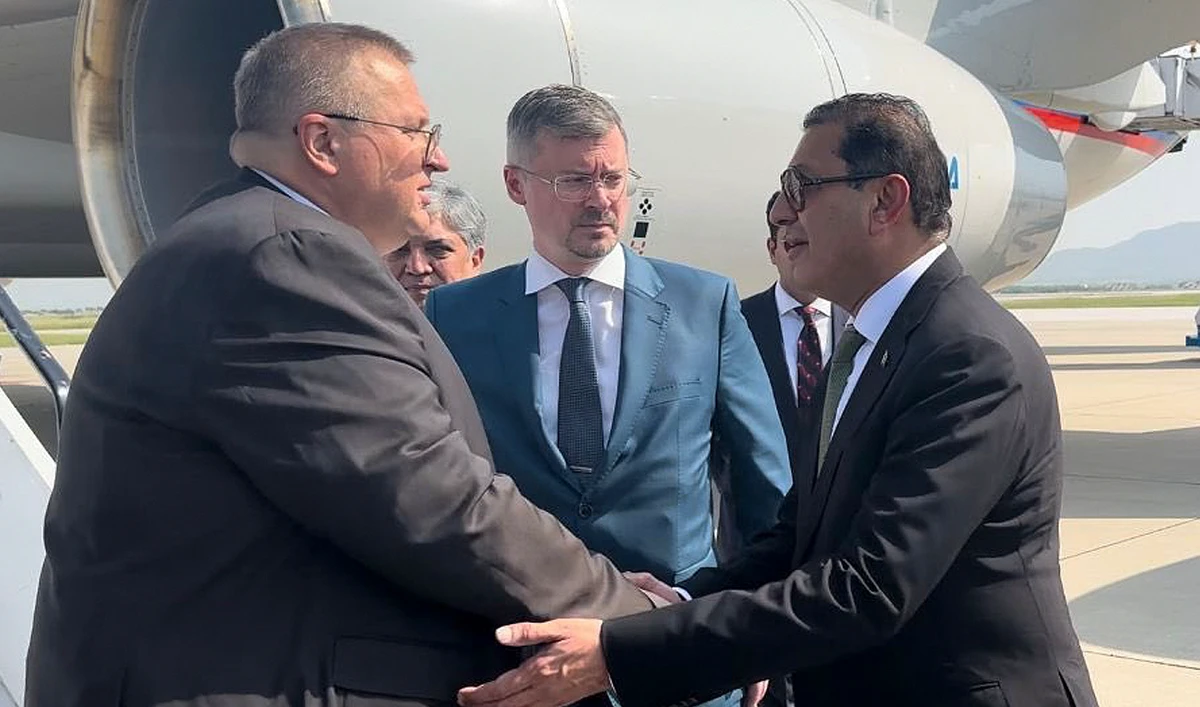
Ambassador of Pakistan to Russia Muhammad Khalid Jamali (right) receives Russian Deputy Prime Minister Alexei Overchuk in Islamabad on September 18, 2024. (Photo courtesy: MOFA)
Short Url
Updated 18 September 2024
Follow

Russian deputy prime minister arrives in Pakistan on two-day visit

  • Islamabad last year started purchasing Russian crude oil at a discount
  • Pakistan also received first shipment of LPG from Russia last September

ISLAMABAD: Deputy Prime Minister of the Russian Federation, Alexey Overchuk, arrived in Pakistan on Wednesday on a two-day visit accompanied by a high-level delegation, the foreign office said.
Islamabad last year started purchasing Russian crude oil at a discount as high prices caused by geopolitical tensions have caused fuel prices to more than double in Pakistan. Pakistan also received its first shipment of liquified petroleum gas from Russia last September, marking Islamabad’s second major Russian energy purchase.
“Deputy Prime Minister Overchuk will hold meetings with the President, the Prime Minister and the Deputy Prime Minister/Foreign Minister of Pakistan,” Radio Pakistan said on Tuesday about the Russian deputy PM’s Islamabad visit. 
In a statement, Foreign Office Spokesperson Mumtaz Zahra Baloch said Pakistan and Russia enjoyed “cordial relations based on goodwill, amity and trust, which is reflected in the multi-faceted bilateral cooperation including in trade, energy and connectivity.”
Energy imports make up the majority of Pakistan’s external payments and discounted imports from Russia offer a respite as Islamabad faces an economic crisis. It is targeting 100,000 bpd of imports from Russia, compared with the total 154,000 bpd of crude it imported in 2022, in the hopes that will lower its import bill, address a foreign exchange crisis and keep a lid on inflation.
However, the benefits are being offset by increased shipping costs and lower quality refined products compared with the fuels produced with crude from Pakistan’s main suppliers, Saudi Arabia and the United Arab Emirates.
As a long-standing Western ally and the arch-rival of neighboring India, which historically is closer to Moscow, analysts say the crude deal would have been difficult for Pakistan to accept, but its financing needs are great.
World Bank president in Pakistan to discuss development projects, policy issues

Updated 01 February 2026
Follow

World Bank president in Pakistan to discuss development projects, policy issues

  • Pakistan, World Bank are currently gearing up to implement a 10-year partnership framework to grant $20 billion loans to the cash-strapped nation
  • World Bank President Ajay Banga will hold meetings with Pakistan Prime Minister Shehbaz Sharif and other senior officials during the high-level visit

ISLAMABAD: World Bank President Ajay Banga has arrived in Pakistan to hold talks with senior government officials on development projects and key policy issues, Pakistani state media reported on Sunday, as Islamabad seeks multilateral support to stabilize economy and accelerate growth.

The visit comes at a time when Pakistan and the World Bank are gearing up to implement a 10-year Country Partnership Framework (CPF) to grant $20 billion in loans to the cash-strapped nation.

The World Bank’s lending for Pakistan, due to start this year, will focus on education quality, child stunting, climate resilience, energy efficiency, inclusive development and private investment.

"World Bank President Ajay Banga arrives in Pakistan for a high-level visit," the state-run Pakistan TV Digital reported on Sunday. "During his stay, he will meet Prime Minister Shehbaz Sharif and other senior officials to discuss economic reforms, development projects, and key policy issues."

Pakistan, which nearly defaulted on its foreign debt obligations in 2023, is currently making efforts to stabilize its economy under a $7 billion International Monetary Fund (IMF) program.

Besides efforts to boost trade and foreign investment, Islamabad has been seeking support from multilateral financial institutions to ensure economic recovery.

“This partnership fosters a unified and focused vision for your county around six outcomes with clear, tangible and ambitious 10-year targets,” Martin Raiser, the World Bank vice president for South Asia, had said at the launch of the CPF in Jan. last year.

“We hope that the CPF will serve as an anchor for this engagement to keep us on the right track. Partnerships will equally be critical. More resources will be needed to have the impact at the scale that we wish to achieve and this will require close collaboration with all the development partners.”

In Dec., the World Bank said it had approved $700 million in ​financing for Pakistan under a multi-year initiative aimed at supporting the country's macroeconomic stability and service delivery.

It ‍followed a $47.9 ‍million World Bank grant ‍in August last year to improve primary education in Pakistan's most populous Punjab province.