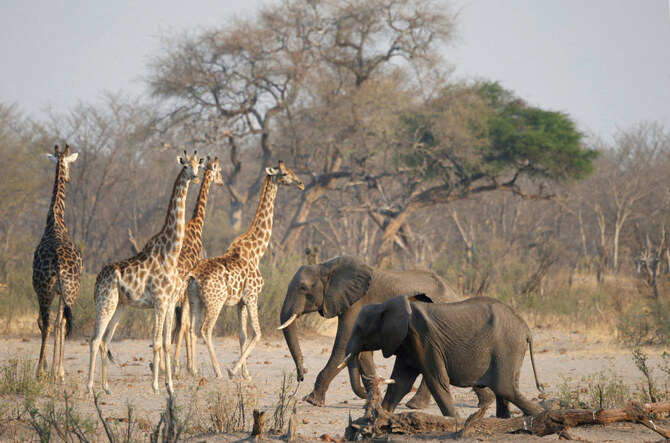
HARARE: Zimbabwe plans to cull 200 elephants to feed communities facing acute hunger after the worst drought in four decades, wildlife authorities said on Tuesday.
The El Nino-induced drought wiped out crops in southern Africa, impacting 68 million people and causing food shortages across the region.
“We can confirm that we are planning to cull about 200 elephants across the country. We are working on modalities on how we are going to do it,” Tinashe Farawo, Zimbabwe Parks and Wildlife Authority (Zimparks) spokesperson, told Reuters.
He said the elephant meat would be distributed to communities in Zimbabwe affected by the drought.
The cull, the first in the country since 1988, will take place in Hwange, Mbire, Tsholotsho and Chiredzi districts. It follows neighboring Namibia’s decision last month to cull 83 elephants and distribute meat to people impacted by the drought.
More than 200,000 elephants are estimated to live in a conservation area spread over five southern African countries — Zimbabwe, Zambia, Botswana, Angola and Namibia — making the region home to one of the largest elephant populations worldwide.
Farawo said the culling is also part of the country’s efforts to decongest its parks, which can only sustain 55,000 elephants. Zimbabwe is home to over 84,000 elephants.
“It’s an effort to decongest the parks in the face of drought. The numbers are just a drop in the ocean because we are talking of 200 (elephants) and we are sitting on plus 84,000, which is big,” he said.
With such a severe drought, human-wildlife conflicts can escalate as resources become scarcer. Last year Zimbabwe lost 50 people to elephant attacks.
The country, which is lauded for its conservation efforts and growing its elephant population, has been lobbying the UN’s Convention on International Trade in Endangered Species (CITES) to reopen trade of ivory and live elephants.
With one of the largest elephant populations, Zimbabwe has about $600,000 worth of ivory stockpiles which it cannot sell.

Zimbabwe to cull 200 elephants to feed people left hungry by drought
Short Url
https://arab.news/zqmjm
Zimbabwe to cull 200 elephants to feed people left hungry by drought
- The El Nino-induced drought wiped out crops in southern Africa, impacting 68 million people and causing food shortages across the region
France to vaccinate cattle for lumpy skin disease as farmers protest against cull
PARIS: France will vaccinate 1 million head of cattle in the coming weeks against lumpy skin disease, Agriculture Minister Annie Genevard said on Saturday, as protesting farmers blocked roads in opposition to the government’s large-scale culling policy.
The announcement comes after several outbreaks of the highly contagious disease prompted authorities to order the culling of entire herds, sparking demonstrations by farmers who consider the measure excessive.
Lumpy skin disease is a virus spread by insects that affects cattle and buffalo, causing blisters and reducing milk production. While not harmful to humans, it often results in trade restrictions and severe economic losses.
“We will vaccinate nearly one million animals in the coming weeks and protect farmers. I want to reiterate that the state will stand by affected farmers, their losses will be compensated as well as their operating losses,” Genevard told local radio network ICI.
France says that total culling of infected herds, alongside vaccination and movement restrictions, is necessary to contain the disease and allow cattle exports. If the disease continues to spread in livestock farms, it could kill “at the very least, 1.5 million cattle,” Genevard told Le Parisien daily in a previous interview.
A portion of the A64 motorway south of Toulouse remained blocked since Friday afternoon, with about 400 farmers and some 60 tractors still in place on Saturday morning, according to local media.
The government, backed by the main FNSEA farming union, maintains that total culling of infected herds is necessary to prevent the disease from spreading and triggering export bans that would devastate the sector.
But the Coordination Rurale, a rival union, opposes the systematic culling approach, calling instead for targeted measures and quarantine protocols.
“Vaccination will be mandatory because vaccination is protection against the disease,” Genevard said, adding that complete culling remains necessary in some cases because the disease can be asymptomatic and undetectable.
France detected 110 outbreaks across nine departments and culled about 3,000 animals, according to the agriculture ministry. It has paid nearly six million euros to farmers since the first outbreak on June 29.
The announcement comes after several outbreaks of the highly contagious disease prompted authorities to order the culling of entire herds, sparking demonstrations by farmers who consider the measure excessive.
Lumpy skin disease is a virus spread by insects that affects cattle and buffalo, causing blisters and reducing milk production. While not harmful to humans, it often results in trade restrictions and severe economic losses.
“We will vaccinate nearly one million animals in the coming weeks and protect farmers. I want to reiterate that the state will stand by affected farmers, their losses will be compensated as well as their operating losses,” Genevard told local radio network ICI.
France says that total culling of infected herds, alongside vaccination and movement restrictions, is necessary to contain the disease and allow cattle exports. If the disease continues to spread in livestock farms, it could kill “at the very least, 1.5 million cattle,” Genevard told Le Parisien daily in a previous interview.
A portion of the A64 motorway south of Toulouse remained blocked since Friday afternoon, with about 400 farmers and some 60 tractors still in place on Saturday morning, according to local media.
The government, backed by the main FNSEA farming union, maintains that total culling of infected herds is necessary to prevent the disease from spreading and triggering export bans that would devastate the sector.
But the Coordination Rurale, a rival union, opposes the systematic culling approach, calling instead for targeted measures and quarantine protocols.
“Vaccination will be mandatory because vaccination is protection against the disease,” Genevard said, adding that complete culling remains necessary in some cases because the disease can be asymptomatic and undetectable.
France detected 110 outbreaks across nine departments and culled about 3,000 animals, according to the agriculture ministry. It has paid nearly six million euros to farmers since the first outbreak on June 29.
© 2025 SAUDI RESEARCH & PUBLISHING COMPANY, All Rights Reserved And subject to Terms of Use Agreement.


