

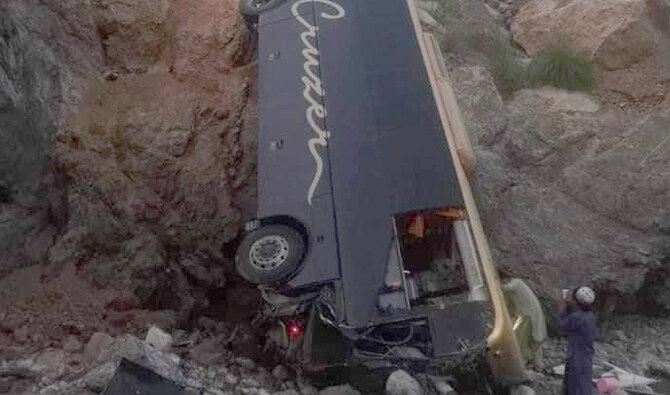
Four killed, 14 injured after bus falls into ravine in Pakistan’s Balochistan

Bystanders stand next to the wreckage of a bus after an accident in in Dana Sar, some 80 kilometers away from Zhob city, Balochistan on September 14, 2024. (Photo courtesy: Levis Force Sherani district)
Short Url
Updated 14 September 2024
Follow

Four killed, 14 injured after bus falls into ravine in Pakistan’s Balochistan

  • The incident occurred in Dana Sar mountainous area that lies along the Koh-e-Sulaiman range
  • District officials say the driver of the Quetta-bound bus fell asleep and lost control of vehicle

QUETTA: At least four people were killed and 14 others injured after a passenger bus fell into a ravine in Pakistan’s southwestern Balochistan province on Saturday, officials said.
The bus was traveling to Quetta from Islamabad, when the driver reportedly fell asleep and the bus fell into a gorge near Dana Sar area in Balochistan’s Sherani district, according to Sana Mahjabeen Umrani, a senior district administration official.
The deceased included the bus driver, while his assistant was among the critically wounded persons.
“Eight critically injured persons, including women, have been referred to Quetta for better medical treatment,” Umrani told Arab News.
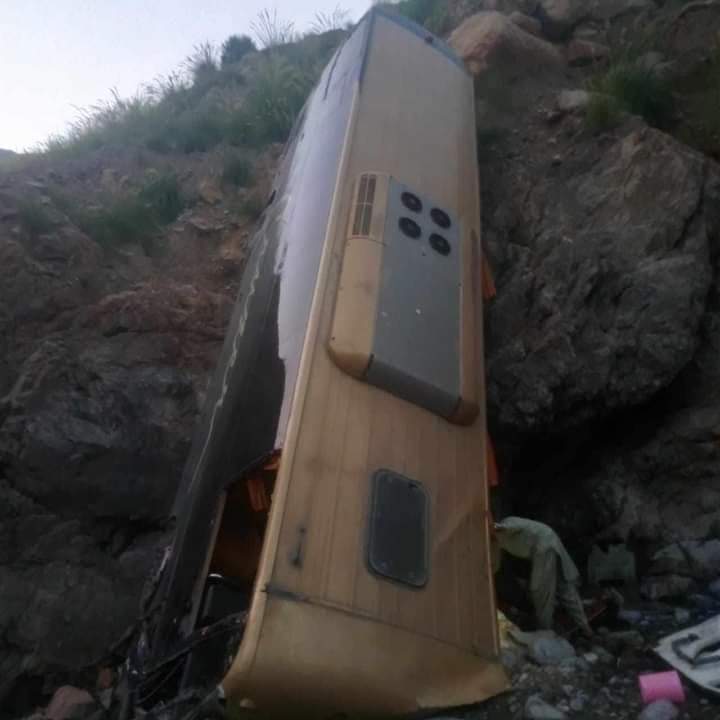


Bystanders stand next to the wreckage of a bus after an accident in in Dana Sar, some 80 kilometers away from Zhob city, Balochistan on September 14, 2024. (Photo courtesy: Levis Force Sherani district)

Dana Sar is a mountainous area that lies along the Koh-e-Sulaiman mountain range, with a curvy and narrow N-50 highway passing through it.
In July 2022, 20 passengers were killed and more than a dozen others injured after a Quetta-bound passenger bus fell into a ravine in the area notorious for fatal road accidents.
Last month, a bus carrying pilgrims from Iran to Pakistan’s Karachi fell into a ditch near the Buzi Top area on the Makran Coastal Highway in Balochistan, killing 12 people and injuring 35 others.
Fatal accidents are common in Pakistan, where traffic rules are rarely followed and roads, particularly in many rural and mountainous areas, are in poor condition.
Such incidents are particularly common in Balochistan where single carriage roads connect various cities and even some highways lack modern safety features.


Pakistan consults banks on financial stability as Middle East conflict rattles global markets

Updated 5 sec ago
Follow

Pakistan consults banks on financial stability as Middle East conflict rattles global markets

  • Finance minister says government monitoring global supply chains, energy markets amid regional tensions
  • Banks pledge coordination with government and central bank to ensure uninterrupted financial services

KARACHI: Pakistan’s finance minister held consultations with the country’s banking sector on Wednesday to review potential economic risks from the escalating Middle East conflict and ensure financial stability, according to a government statement.

The virtual meeting between Finance Minister Muhammad Aurangzeb and senior representatives of the Pakistan Banks’ Association (PBA) came as tensions involving the United States, Israel and Iran have driven volatility in global oil and financial markets, raising concerns for import-dependent economies such as Pakistan.

Islamabad has already faced pressure from rising fuel prices and potential supply disruptions in energy markets, prompting officials to closely monitor global developments and assess possible impacts on inflation, external accounts and broader macroeconomic stability.

“The discussion focused on the evolving economic and financial situation in light of prevailing regional developments and the importance of close coordination between the government, the State Bank of Pakistan, and the banking sector to ensure financial stability and uninterrupted financial services,” the finance ministry said in a statement after the minister's meeting with PBA officials. 

Aurangzeb told banking leaders the government had established a high-level coordination mechanism involving key economic ministries and institutions to continuously review developments in global markets, particularly in supply chains and energy.

He said authorities were conducting regular scenario analysis to evaluate possible implications for inflation, external accounts and overall economic stability while ensuring the continuity of essential supplies.

“The government remains engaged with relevant stakeholders and international partners as part of its efforts to safeguard the country’s economic interests,” the minister said, according to the statement.

Aurangzeb also emphasized the importance of coordinated decision-making and operational resilience within the financial sector during periods of uncertainty, encouraging banks to continue supporting businesses and customers while maintaining responsible risk management.

PBA Chairman Zafar Masud briefed the finance minister on the banking sector’s internal consultations and preparedness measures in response to the evolving situation, the statement said. 

Masud said the banking industry had set up a coordination framework for timely consultation and information sharing among financial institutions, aimed at ensuring the smooth functioning of financial services and payment systems.

He added that banks would remain in close engagement with the State Bank of Pakistan and other stakeholders while maintaining regular consultations within the industry to monitor developments and support financial market stability.