

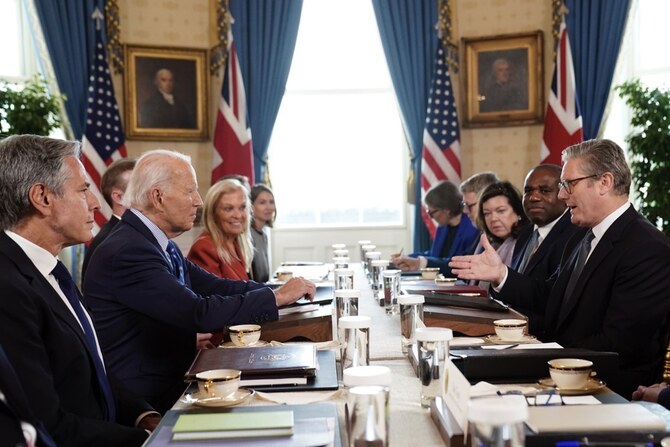

WASHINGTON: British Prime Minister Keir Starmer and US President Joe Biden on Friday delayed a decision to let Ukraine fire long-range Western-supplied missiles into Russia, a plan that sparked dire threats from Moscow of a war with NATO.
Starmer told reporters at the White House that he had a “wide-ranging discussion about strategy” with Biden but that it “wasn’t a meeting about a particular capability.”
Before the meeting officials had said Starmer would press Biden to back his plan to send British Storm Shadow missiles to Ukraine to hit deeper inside Russia as allies become increasingly concerned about the battlefield situation.
But the Labour leader indicated that he and Biden would now discuss the plan at the UN General Assembly in New York the week after next “with a wider group of individuals.”
As they met with their teams across a long table in the White House, backed by US and British flags, Biden played down a warning by Russian President Vladimir Putin that allowing Ukraine to fire the weapons would mean the West was “at war” with Russia.
“I don’t think much about Vladimir Putin,” Biden told reporters when asked about the comments.
But while Biden said it was “clear that Putin will not prevail in this war,” he is understood to be reluctant to grant Ukraine’s insistent demand to be able to use long-range US-made ATACMS missiles against Russian territory.
US officials believe the missiles would make a limited difference to Ukraine’s campaign and also want to ensure that Washington’s own stocks of the munitions are not depleted.
The two leaders said they also discussed the war in Gaza, with Britain having recently suspended arms deliveries to Israel over concerns that they could be used to violate international humanitarian law.
The US, Israel’s main military and diplomatic backer, has held off such a step.
Biden and Starmer agreed on their “ironclad commitment” to Israel — but stressed the “urgent need” for a ceasefire deal and a “need for Israel to do more to protect civilians” in Gaza, the White House said in a readout.
The White House had earlier played down the chances of a Ukraine decision coming from Friday’s visit by Starmer, the Labour leader’s second to the White House since he took office in July.
“I wouldn’t expect any major announcement in that regard coming out of the discussions, certainly not from our side,” National Security Council spokesman John Kirby told reporters.
Ukrainian President Volodymyr Zelensky however pushed Kyiv’s Western allies to do more.
Speaking in Kyiv, Zelensky accusing the West of being “afraid” to even help Ukraine shoot down incoming missiles as it has done with Israel.
Zelensky added that he will meet Biden “this month” to present his “victory plan” on how to end two and a half years of war with Russia.
Russia has reacted angrily to the prospect of the West supplying long-range weapons to the country it invaded in February 2022.
In another sign of increasing tensions, Russia revoked the credentials of six British diplomats whom it accused of spying in what London termed “baseless” allegations.
Russia’s UN ambassador Vassily Nebenzia warned separately that letting Ukraine use long-range weapons would plunge NATO into “direct war with... a nuclear power.”
Ukraine and the United States’s allies are all meanwhile anxiously waiting for the result of a tense US presidential election in November that could upend Washington’s Ukraine policy.
Biden is on his way out of office while the election is a toss-up between his Democratic political heir Kamala Harris and Republican former president Donald Trump.
Trump has repeatedly praised Putin, and refused to take sides on the war during a debate with Harris on Tuesday, saying only: “I want the war to stop.”
Starmer denied he was worried about a Trump presidency, and said the need to help Ukraine in coming weeks and months was urgent “whatever timetables are going on in other countries.”


