Summit of the Future: Pakistan says plight of Gazans ‘mockery’ of international community

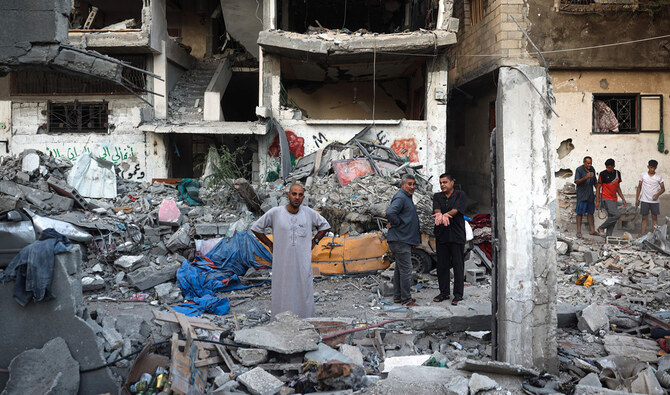
Palestinians check the area following Israeli strikes in Nuseirat in the central Gaza Strip, on September 13, 2024, amid the ongoing war in the Palestinian territory between Israel and Hamas. (AFP)
Short Url
Updated 13 September 2024
Follow

Summit of the Future: Pakistan says plight of Gazans ‘mockery’ of international community

  • The statement comes days after Israeli strikes on a Gaza school-turned-shelter killed 18 people, including six UNRWA staff
  • Pakistan does not recognize the state of Israel and calls for an independent Palestinian state based on pre-1967 borders

ISLAMABAD: Prime Minister Shehbaz Sharif on Friday said the plight of the Gazans was a “mockery” of the international community and in stark contrast to the idea of global unity and justice days after Israeli forces killed another 18 people in strikes on a school-turned-shelter in Gaza.
The Pakistan prime minister said this while addressing the first virtual session of the Summit of the Future at the United Nations (UN) in New York, where he spoke about the ongoing Israeli military actions in Gaza.
The statement came after an Israeli attack flattened part of the UN-run Al-Jawni school in Nuseirat on Wednesday. UNRWA said six of its staff were killed in two Israeli strikes on the school, drawing global condemnation.
“Today, in times of unprecedented global challenges and escalating conflicts, we are at risk of permanently damaging the notion of we,” PM Sharif said in his virtual address. “A collective we that requires a degree of justice. The plight of the people of Gaza is a mockery of this we.”
Israel launched a war on Gaza on Oct. 7 after Hamas fighters stormed into southern Israel, killing 1,200 and taking more than 250 hostages, according to Israeli figures. Israeli military campaign has since demolished swathes of the besieged enclave, killed more than 40,500 people, displaced nearly all of its 2.3 million people multiple times, and given rise to deadly hunger and disease.
Pakistan does not recognize the state of Israel and calls for an independent Palestinian state based on “internationally agreed parameters” and the pre-1967 borders with Al-Quds Al-Sharif as its capital.
Since the beginning of Israel’s war on Gaza, the South Asian country has repeatedly raised the issue at the UN and demanded international powers and multilateral bodies stop Israeli military actions. Pakistan has also dispatched several aid consignments for the Palestinians.
Speaking further, Sharif warned the prevailing global issues could undermine the sense of unity between countries, saying the world was facing significant problems that were straining international relations and cooperation. 
“This we becomes marred amidst rising debt burdens for the poor, increasing poverty, growing inequality, intolerance, terrorist violence, illegal foreign occupation and a skewed approach to climate adaptation,” he added.
He called for significant reforms in the international financial framework to achieve sustainable developmental goals for economically weak nations. This required enhanced concessional financing, increased official development assistance, and greater lending from multilateral development banks, he added.


Pakistan mulls enforcing remote work, online classes rules to conserve energy amid Mideast crisis

Updated 5 sec ago
Follow

Pakistan mulls enforcing remote work, online classes rules to conserve energy amid Mideast crisis

  • Government committee reviews contingency plans as Iran closes Strait of Hormuz, disrupting global oil supply
  • Petroleum Division official warns fuel costs may rise if Pakistan is forced to import oil from longer routes

ISLAMABAD: Pakistan is considering a range of options to conserve energy which include ordering corporate offices to ensure work-from-home facility for staff and directing universities to shift classes online, a senior official confirmed on Thursday as the ongoing Middle East conflict threatens to disrupt the global supply of petroleum products. 

These proposals were discussed by a cabinet committee constituted by Prime Minister Shehbaz Sharif to monitor petroleum prices on Wednesday. The committee meets daily to review the stock of petroleum products in Pakistan and assess the evolving regional situation.

Tensions in the Middle East have surged since Saturday after the US and Israel’s coordinated strikes against Iran and Tehran’s retaliatory attacks against both and Gulf nations. Iran has closed the crucial Strait of Hormuz waterway, through which roughly 20 percent of global oil and gas supply passes through. 

Pakistan relies heavily on Middle Eastern crude oil, with the majority of its energy imports typically transiting through the strait, making any disruption a major risk to domestic fuel supplies.

“Yes, proposals such as work-from-home for corporate offices and online classes for higher education institutions were discussed in the high-level committee,” a senior official of the finance ministry told Arab News on condition of anonymity, as he was not authorized to speak to the media.

“However, final decisions will be taken in a couple of days after the action plan is finalized based on priority areas.”

The official said the government may also advise the public to avoid unnecessary travel, adding that fuel supplies would be ensured for various industries and other critical sectors.

Meanwhile, Pakistani authorities have imposed a ban on the export of petroleum condensate, a chemical used by oil refineries, to secure its domestic supply in case the Middle East crisis worsens further.

A senior official from Pakistan’s Petroleum Division told a Senate committee on Wednesday that the country currently has petroleum reserves sufficient to last around one month.

“The country has around one month of refined petroleum products available, along with more than ten days’ worth of crude oil stocks,” the official said, also requesting anonymity. 

He added that the government is working on contingency planning to meet future energy requirements if the conflict continues.

“Pakistan is exploring options to import fuel from Saudi Arabia through the Red Sea to ensure uninterrupted supplies,” he said. 

Pakistan’s petroleum ministry confirmed the same in a statement on Wednesday, following Petroleum Minister Ali Pervaiz Malik’s meeting with Saudi Ambassador Nawaf bin Said Al-Malki. 

The official warned that petroleum product prices may rise in line with global market trends, particularly if supplies have to be transported through alternative, longer routes.

He added that in the event of a prolonged conflict, Pakistan may consider importing fuel from the US and other countries.