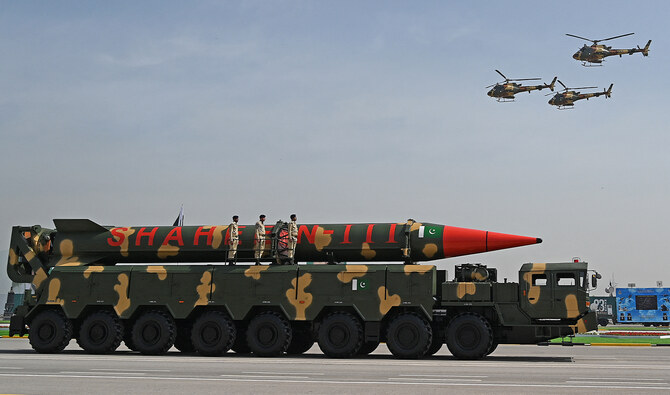
The US State Department on Thursday imposed sanctions on a Chinese research institute and several companies it said have been involved in supplying Pakistan’s ballistic missile program.
Washington similarly targeted three China-based companies with sanctions in October 2023 for supplying missile‐applicable items to Pakistan.
Department spokesperson Matthew Miller said in a statement that the Beijing Research Institute of Automation for Machine Building Industry had worked with Pakistan to procure equipment for testing rocket motors for the Shaheen-3 and Ababeel systems and potentially for larger systems.
The sanctions also targeted China-based firms Hubei Huachangda Intelligent Equipment Co, Universal Enterprise, and Xi’an Longde Technology Development Co, alongside Pakistan-based Innovative Equipment and a Chinese national, for knowingly transferring equipment under missile technology restrictions, Miller said.
“As today’s actions demonstrate, the United States will continue to act against proliferation and associated procurement activities of concern, wherever they occur,” Miller said.
The embassies of China and Pakistan in Washington did not immediately respond to requests for comment.

US imposes sanctions on suppliers to Pakistan’s ballistic missile program
https://arab.news/rbg5a
US imposes sanctions on suppliers to Pakistan’s ballistic missile program
- State Department says a Chinese research institute worked with Pakistan to procure equipment for Shaheen-3, Ababeel systems
- The latest sanctions also targeted three China-based firms alongside Pakistan-based Innovative Equipment and a Chinese national
Pakistan terms climate change, demographic pressures as ‘pressing existential risks’
- Pakistan has suffered frequent climate change-induced disasters, including floods this year that killed over 1,000
- Pakistan finmin highlights stabilization measures at Doha Forum, discusses economic cooperation with Qatar
ISLAMABAD: Pakistan’s Finance Minister Muhammad Aurangzeb on Saturday described climate change and demographic pressures as “pressing existential risks” facing the country, calling for urgent climate financing.
The finance minister was speaking as a member of a high-level panel at the 23rd edition of the Doha Forum, which is being held from Dec. 6–7 in the Qatari capital. Aurangzeb was invited as a speaker on the discussion titled: ‘Global Trade Tensions: Economic Impact and Policy Responses in MENA.’
“He reaffirmed that while Pakistan remained vigilant in the face of geopolitical uncertainty, the more pressing existential risks were climate change and demographic pressures,” the Finance Division said.
Pakistan has suffered repeated climate disasters in recent years, most notably the 2022 super-floods that submerged one-third of the country, displaced millions and caused an estimated $30 billion in losses.
This year’s floods killed over 1,000 people and caused at least $2.9 billion in damages to agriculture and infrastructure. Scientists say Pakistan remains among the world’s most climate-vulnerable nations despite contributing less than 1 percent of global greenhouse-gas emissions.
Aurangzeb has previously said climate change and Pakistan’s fast-rising population are the only two factors that can hinder the South Asian country’s efforts to become a $3 trillion economy in the future.
The finance minister noted that this year’s floods in Pakistan had shaved at least 0.5 percent off GDP growth, calling for urgent climate financing and investment in resilient infrastructure.
When asked about Pakistan’s fiscal resilience and capability to absorb external shocks, Aurangzeb said Islamabad had rebuilt fiscal buffers. He pointed out that both the primary fiscal balance and current account had returned to surplus, supported significantly by strong remittance inflows of $18–20 billion annually from the Middle East and North Africa (MENA) and Gulf Cooperation Council (GCC) regions.
Separately, Aurangzeb met his Qatari counterpart Ali Bin Ahmed Al Kuwari to discuss bilateral cooperation.
“Both sides reaffirmed their commitment to strengthening economic ties, particularly by maximizing opportunities created through the newly concluded GCC–Pakistan Free Trade Agreement, expanding trade flows, and deepening energy cooperation, including long-term LNG collaboration,” the finance ministry said.
The two also discussed collaboration on digital infrastructure, skills development and regulatory reform. They agreed to establish structured mechanisms to continue joint work in trade diversification, technology, climate resilience, and investment facilitation, the finance ministry said.


