



ISLAMABAD: Maritime experts on Thursday urged the Pakistani government to expand its blue economy to $100 billion as the country hosted an international maritime exhibition in Islamabad.
The International Maritime Sustainability Exhibition and Conference (IMSEC) was attended by International Maritime Organization (IMO) Secretary-General Arsenio Antonio Dominguez Velasco and several other maritime experts.
This is the first-ever visit to Pakistan by the chief of the IMO, a specialized agency of the United Nations responsible for regulating shipping and ensuring maritime safety, environmental protection and security on international waters.
During the maritime conference, panelists suggested the Pakistani government to work on increasing its share in the global blue economy, which means sustainable use of ocean resources to benefit people, livelihoods and ocean ecosystem health.
“Blue economy is a responsibility in which we do a business in maritime domain which is safe and secure as far as the environment is concerned, its ecosystem is preserved as well as it is centered around the people that was the message which was given by the secretary general of IMO as well,” Vice Admiral (retired) Ahmed Saeed, president of Pakistan’s National Institute of Maritime Affairs, told Arab News.
“So, today’s conference was actually centered around giving the details of the potential of Pakistan’s maritime economy. It is around $100 billion so at the moment our contribution into our national economy is less than 1 percent whereas it should be close to 6-10 percent.”
Professor Dr. Sajid Mahmood Shahzad, vice chancellor of MinHajj University in Lahore, said Pakistan should focus on the country’s maritime potential to fix the country’s fragile economy.
“We are always talking of fragile economy of Pakistan, if you really would like to ask me, answer to all those fragile economy of Pakistan is blue economy. We need to put up a lot of efforts to achieve, to gain whatever we have out at sea,” he told Arab News.
“The potential we have that is enormous, but being a maritime nation how to accrue those benefits from the sea, we are ignorant. I think now the time has come we should focus on our blue economy,” he said.

Participants attend International Maritime Sustainability Exhibition and Conference (IMSEC) in Islamabad, Pakistan on September 12, 2024. (AN photo)
Fisheries and maritime trade
In his meeting with the IMO chief, Prime Minister Shehbaz Sharif vowed to expand the country’s fisheries and maritime trade, and explore offshore resources, according to Sharif’s office.
Established in 1948, the IMO’s primary role is to develop and maintain a comprehensive regulatory framework for shipping, which includes standards for safety, pollution prevention and legal matters surrounding global maritime operations.
The prime minister “underlined Pakistan’s desire for expanding fisheries and maritime trade, exploring offshore resources, promoting coastal tourism, and fostering a sustainable shipbreaking industry,” Sharif’s office said, after his meeting with the IMO chief.
It said the premier prioritized blue economy as a “central pillar” of his economic development strategy and highlighted the role of Pakistan’s Special Investment Facilitation Council (SIFC), a civil-military body set up in June last year, in attracting investments and introducing modern technologies to advance fisheries and the shipbreaking sector.
“PM Sharif renewed Pakistan’s firm commitment to work with the international partners and the IMO to contribute to global efforts aimed at reducing maritime emissions,” the statement from Sharif’s office said.
“Secretary-General Velasco appreciated the prime minister’s leadership and Pakistan’s proactive approach toward leveraging its maritime resources for economic progress and its role in the global maritime community.”
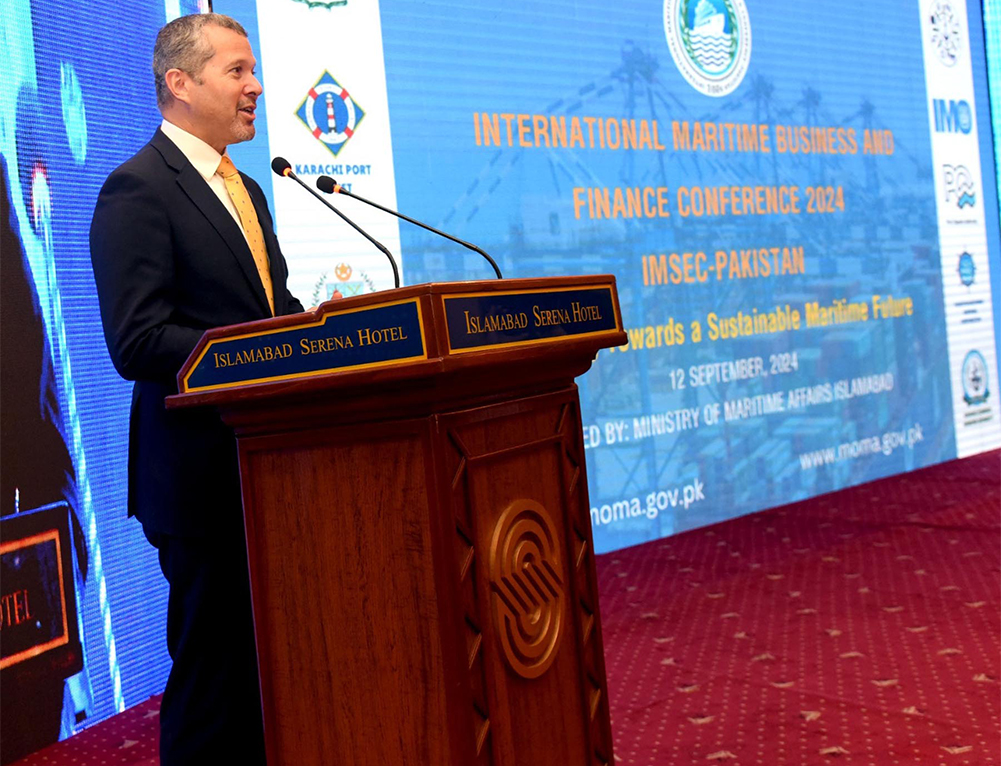
International Maritime Organization (IMO) Secretary-General Arsenio Antonio Dominguez Velasco speaks during International Maritime Sustainability Exhibition and Conference (IMSEC) in Islamabad, Pakistan on September 12, 2024. (PID)
He assured continued support to Pakistan from the IMO in furthering maritime collaboration for sustainable development.
Maritime decarbonization, environment-friendly ship-recycling
Earlier at the conference, the Pakistani government pledged to reduce greenhouse gas (GHG) emissions from the global maritime sector, make greater use of green technology to improve ships’ energy efficiency and carry out more environment-friendly ship recycling.
“Pakistan fully complies with IMO regulation,” Maritime Affairs Minister Qaiser Ahmed Sheikh said at the opening session of the conference. “We are striving to reduce the global [carbon] footprint and make greater use of green technology. Such measures must be taken in every institution to deal with climate change.”
The minister said Pakistan was invested in ensuring the protection of biodiversity and the oceans and would work to make ship recycling “safe and environmentally friendly.”
“We are ready to work with global organizations to promote ship-making, ship-recycling and the blue economy,” Sheikh added.
Addressing the conference, IMO chief Velasco said his visit to Pakistan would give him the opportunity to “come back in the future and assess and evaluate all the promises and the conversations and the challenges that we are going to put toward each other, from Pakistan government as well as from IMO in order to work better in the different aspects of shipping.”
He said he looked forward to working with Pakistan on decarbonization and ship recycling, where Pakistan is one of the leading nations in the world.


