- The Saudi-Bahraini artist discusses his roots and how it helped develop his experimental style
DUBAI: The seasoned Saudi-Bahraini artist Faisal Samra always knew what he wanted to achieve in his life, and faced down resistance with his rebellious nature.
“Everything was fixed and planned,” he says, looking back on his formative years. “Since my childhood, I knew what I wanted to do.”
Born in Bahrain in 1956, Samra is the descendant of a Saudi family that had settled in British-ruled Bahrain, where, he says, work opportunities were, at the time, more readily available than in the Kingdom. Samra, who is based between Bahrain and Spain, describes his early years in Bahrain, spent in a large and old Khaleeji-style house, as crucial to his future career.
“As a child, when my family had people over for big meals, they cooked over fire and wood, which transformed into charcoal. I took this charcoal and made lines on walls,” he tells Arab News with a laugh. “It all started from this moment. This was an important stage because I still work with charcoal. My parents would paint over the scribbles, but I drew again. I wasn’t just drawing on walls at home, but also on the streets. At school, I was drawing on tables and I couldn’t control myself; I was obsessed. When I was six or seven, my art teacher told me, ‘Instead of drawing on tables, here is a piece of paper and some coloring pencils,’ and it was through him that I discovered colors. My parents never bought for me art materials to encourage me, but I kept drawing until this day.”
At the age of 12, Samra and his family moved to Saudi Arabia, settling in the Eastern Province. At school, he continued his pursuit of art and theater. He and his friends, he says, became “the talk of town.” When he was 14, he received his first art book — a collection of Michelangelo’s drawings. All in all, art was, and still is, his life.
“Art is not separate from me. It is not a job, but an activity of making life. On a daily basis, whether I am working on a project or not, I have to draw something,” he says. “If you truly want to do art the right way and live in it, it has to be a disease. You can’t get rid of it, as if you’re pressing a ‘Stop’ button. True art has to live inside your body and surround you every moment. It’s a question of existence: If I’m not an artist, then I don’t exist.”
During the 1970s, in his late teens, Samra decided he wanted to study art abroad, specifically in Paris — an idea that was quickly rejected by his family. He says that back then the regional art scene lacked both mentors and access, so he wanted to go where the action was: Europe.
“In one way or another, I had to leave,” he says. “And I didn’t want to study art (just) anywhere: I wanted Paris, I wanted the École Nationale Supérieure des Beaux-Arts because it was the most challenging art school to get into at that time.”
To save up money, Samra worked as a clerk at the petroleum company Aramco, while applying for delegations, via Riyadh, for educational opportunities abroad. And, in 1974, aged 18, he travelled to Paris, thanks to support provided by the Ministry of Media. It was there that he would learn about modern and contemporary European artists, and also attend art critique sessions.
During the 1980s, Samra spent his time in Saudi Arabia and, later, in France, where he took on the role of art consultant at the Institut du Monde Arabe, the then-newly founded cultural center for Arab affairs. As for his own art, a few exhibitions were set up in Paris in the late Eighties and early Nineties. Today, his works have been acquired by, among others, the British Museum, the Jameel Art Foundation, Mathaf: Arab Museum of Modern Art, and the Bahrain National Museum, and he is currently represented by Ayyam Gallery in Dubai.
Over the years, Samra has experimented with film, performance, painting and photography. “I don’t like still water; I like it to be moving. I’m exploring to find something different,” he says. “The core of my research is man’s existence in our world, and how we react to it, and how the world reacts to him.”

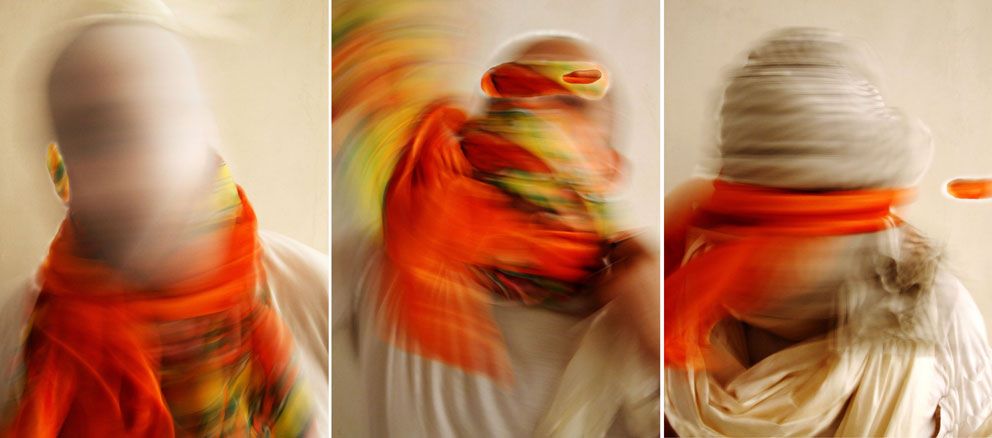
A sense of disturbing movement occupies some of his figurative works, as in his recent painting series “Immortal Moment (Coping With The Shock),” which depicts open-mouthed faces, partially covered with an explosion of paint, as if they have been shot. One of his best-known series, “Distorted Reality,” which was intended to confront media biases in the early 2000s, features covered individuals in blurred motion. In essence, such bold works portray the troubled state of the world, and he doesn’t sugarcoat his words.
“We are living in times of change, but not development — “development” means that you are headed to something better,” says Samra. “If we developed in a certain area, then we destroyed something else. We invented things but we lost things at the same time.”