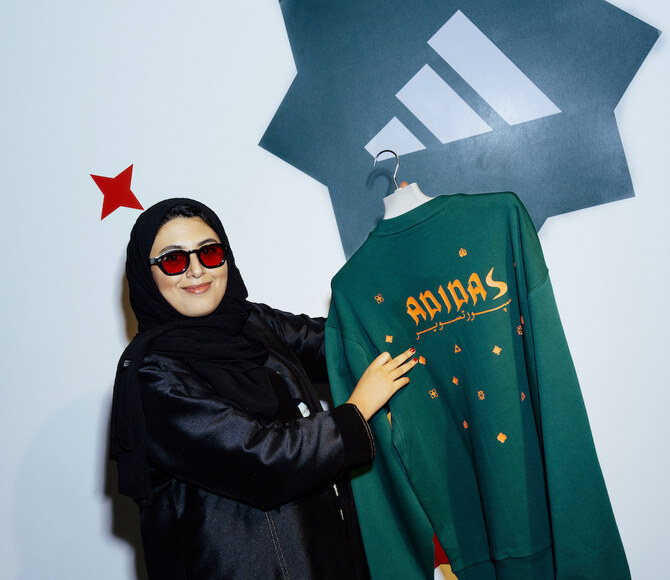
Saudi artist Raghad Al-Ahmad discusses her Adidas collaboration 

Al-Ahmad has collaborated with Adidas on their first capsule collection tailored for the Saudi market, in celebration of the Kingdom’s upcoming National Day on Sept. 23. (Supplied)
Short Url
Updated 12 September 2024
Follow

Saudi artist Raghad Al-Ahmad discusses her Adidas collaboration 

  • Al-Ahmad worked on the brand’s first capsule collection tailored for the Saudi market 

DUBAI: For Saudi artist Raghad Al-Ahmad, the chance to incorporate her roots and identity into the fabric of the famed apparel company Adidas was a dream come true. 

Al-Ahmad has collaborated with Adidas on their first capsule collection tailored for the Saudi market, in celebration of the Kingdom’s upcoming National Day on Sept. 23. 

The collection — called “Bloom Sky” — features the usual crop of functional unisex pieces including pants, shorts, sweaters, jackets, hoodies and t-shirts. 


The collection — called “Bloom Sky” — features the usual crop of functional unisex pieces including pants, shorts, sweaters, jackets, hoodies and t-shirts. (Supplied)

In addition, it has women’s modest-wear pieces including abayas and hijabs, all with a distinct Al-Ahmad touch. 

“I believe we need to respect and integrate cultural elements into our collection. By including modest wear, we can connect with individuals who value this aspect of their culture, creating a complete experience,” Al-Ahmad tells Arab News. 

“As a designer who wears abayas daily and strives to be modest through layering and matching, I understand the importance of these elements. Adding them to our collection will have a significant impact, allowing us to craft something that truly resonates with the culture we are embracing.” 


A piece from the 'Bloom Sky' collection. (Supplied)

The name of the collection is inspired by a poem by Makkah Governor Prince Khaled Al-Faisal. The first sentence of the Arabic poem translates to: “The sky is pink and my desert is blooming.” 

“As an Arab, I’ve grown up in a culture where poetry is a significant form of expression. I remember my grandmother always reading poems she had written, and my mother, who loved collecting poetry books,” Al-Ahmad says. “I am particularly inspired by Prince Khaled’s poetry and his vivid descriptions of the natural world around him.” 

The collection, which depicts iconography symbolizing flowers and stars, is an ode to all things Saudi and Al-Ahmad took inspiration from her everyday surroundings. 


Al-Ahmad (R) working on her designs with a member of the Adidas team. (Supplied)

“My dad, an adventurer, retired from flight maintenance and began exploring Saudi Arabia in his motorhome. He opened a gateway to the country’s wonderful nature, camping amid the desert’s beauty,” the Jeddah-born artist explains. 

“He introduced me to the captivating Saudi lavender flowers, showing his happiness surrounded by them in the desert. We found inspiration in the contrast between the sand’s color and the vibrant lavender.” 

Al-Ahmad is a multi-disciplinary experimental artist who likes to work in mediums including collage, installation, sculpture and digital films 

This isn’t Al-Ahmad’s first partnership with an international brand. For example, in 2021 she collaborated with French luxury label Jean Paul Gaultier to create playing cards that represent and celebrate the Kingdom’s culture on the occasion of Saudi National Day. 

The “Bloom Sky” collection is part of Adidas’ efforts to collaborate with and promote artists from the region. 

In recent years, the company has forged strategic partnerships across the region with governing bodies, sporting organizations, teams, and clubs, with a focus on promoting women's participation in sports and improving access to athletic opportunities. 

“I was amazed by the Adidas team’s curiosity and their ability to adopt my culture in many ways, translating it into a product that everyone appreciates,” Al-Ahmad says. “The team paid attention to every detail, and for that, I am deeply grateful. Special thanks to each member … for bringing an innovative approach to my culture.” 


Saudi waste sector offers opportunities worth $112bn

Updated 6 sec ago
Follow

Saudi waste sector offers opportunities worth $112bn

JEDDAH: Saudi Arabia’s waste management sector is undergoing a structural transformation, positioning itself as a promising investment avenue.

The shift is driven by a modern regulatory framework, a national strategy aligned with Vision 2030, and environmental and economic targets.

The National Center for Waste Management, known as MWAN, told Al-Eqtisadiah that investment opportunities in the sector are estimated at about SR420 billion ($112 billion) by 2040, primarily targeting private sector participation.

According to MWAN’s licensing database, the number of licensed entities in the sector reached 1,348, with an additional 145 permits for recycling facilities, bringing the total number of investing companies to 1,493, underscoring the sector’s growing investment base and the diversity of activities.

Leap in treatment indicators, reduced landfilling

MWAN reported notable improvements in 2024, with the proportion of waste diverted from landfills reaching 18 percent, signaling progress in recycling and treatment initiatives.

The comprehensive national plan aims to increase this figure to 90 percent by 2040, with the private sector as the main driver.

The center oversees all waste types in the Kingdom, excluding radioactive and military waste, spanning seven main categories: municipal solid waste, industrial waste, and healthcare waste, as well as sludge, agricultural waste, construction and demolition debris, and special waste such as tires and electronic devices.

230 landfills … shifting from dumping to value

Saudi Arabia currently has more than 230 landfills, ranging from engineered sites that meet environmental standards to traditional facilities, with Riyadh’s Al-Sulay landfill among the largest.

However, strategic priorities have shifted from expanding landfill capacity to reducing it and turning waste into an economic resource through recycling, advanced treatment, and waste-to-energy initiatives.

Sustainability and circular economy

Saudi Arabia’s waste management model is based on circular economy principles, maximizing resource utilization, minimizing environmental impact, and promoting investment in advanced technologies and smart solutions.

MWAN is also developing an electronic waste transport document system, enabling tracking from source to final destination, enhancing oversight, preventing irregular practices, and providing a reliable database to support long-term investment planning.

Landfill scientifically selected

The Saudi Geological Survey confirmed that landfill locations are chosen based on rigorous technical criteria, including geological, environmental, and hydrological factors, ensuring urban needs are met for at least 25 years.

Waheed Baamer, director of the Applied Geology Center, said studies have been conducted for major cities, including Riyadh, Tabuk, and Taif, to protect natural resources and minimize environmental impact, supporting sustainable development.

Jeddah figures reflects market size 

Jeddah Municipality reported that its landfills received nearly 5 million tonnes of waste in the first half of 2025, including 3.9 million tonnes of construction and demolition debris and 693,000 tonnes of household and bulky waste collected through cleaning contracts.

The municipality added that the Corniche area alone recorded 4,237 tonnes, underlining the urgent need for advanced treatment and recycling investment solutions.

Promising market for the private sector by 2040

The sector is expected to offer SR420 billion in investment opportunities by 2040, reflecting its transformation from a service burden to a fully-fledged economic industry.

With a clear regulatory framework, rising demand, and adoption of sustainability and circular economy principles, the waste management sector is set to become a key long-term investment path in Saudi Arabia and a vital contributor to environmental and economic targets.