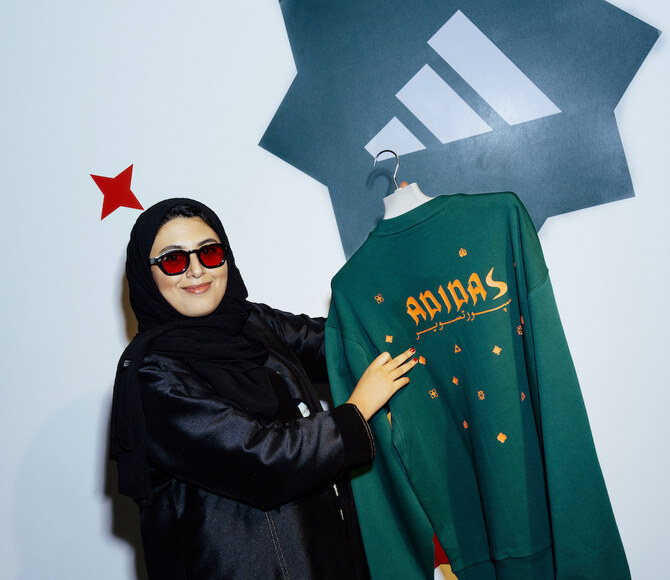

DUBAI: For Saudi artist Raghad Al-Ahmad, the chance to incorporate her roots and identity into the fabric of the famed apparel company Adidas was a dream come true.
Al-Ahmad has collaborated with Adidas on their first capsule collection tailored for the Saudi market, in celebration of the Kingdom’s upcoming National Day on Sept. 23.
The collection — called “Bloom Sky” — features the usual crop of functional unisex pieces including pants, shorts, sweaters, jackets, hoodies and t-shirts.

The collection — called “Bloom Sky” — features the usual crop of functional unisex pieces including pants, shorts, sweaters, jackets, hoodies and t-shirts. (Supplied)
In addition, it has women’s modest-wear pieces including abayas and hijabs, all with a distinct Al-Ahmad touch.
“I believe we need to respect and integrate cultural elements into our collection. By including modest wear, we can connect with individuals who value this aspect of their culture, creating a complete experience,” Al-Ahmad tells Arab News.
“As a designer who wears abayas daily and strives to be modest through layering and matching, I understand the importance of these elements. Adding them to our collection will have a significant impact, allowing us to craft something that truly resonates with the culture we are embracing.”

A piece from the 'Bloom Sky' collection. (Supplied)
The name of the collection is inspired by a poem by Makkah Governor Prince Khaled Al-Faisal. The first sentence of the Arabic poem translates to: “The sky is pink and my desert is blooming.”
“As an Arab, I’ve grown up in a culture where poetry is a significant form of expression. I remember my grandmother always reading poems she had written, and my mother, who loved collecting poetry books,” Al-Ahmad says. “I am particularly inspired by Prince Khaled’s poetry and his vivid descriptions of the natural world around him.”
The collection, which depicts iconography symbolizing flowers and stars, is an ode to all things Saudi and Al-Ahmad took inspiration from her everyday surroundings.

Al-Ahmad (R) working on her designs with a member of the Adidas team. (Supplied)
“My dad, an adventurer, retired from flight maintenance and began exploring Saudi Arabia in his motorhome. He opened a gateway to the country’s wonderful nature, camping amid the desert’s beauty,” the Jeddah-born artist explains.
“He introduced me to the captivating Saudi lavender flowers, showing his happiness surrounded by them in the desert. We found inspiration in the contrast between the sand’s color and the vibrant lavender.”
Al-Ahmad is a multi-disciplinary experimental artist who likes to work in mediums including collage, installation, sculpture and digital films
This isn’t Al-Ahmad’s first partnership with an international brand. For example, in 2021 she collaborated with French luxury label Jean Paul Gaultier to create playing cards that represent and celebrate the Kingdom’s culture on the occasion of Saudi National Day.
The “Bloom Sky” collection is part of Adidas’ efforts to collaborate with and promote artists from the region.
In recent years, the company has forged strategic partnerships across the region with governing bodies, sporting organizations, teams, and clubs, with a focus on promoting women's participation in sports and improving access to athletic opportunities.
“I was amazed by the Adidas team’s curiosity and their ability to adopt my culture in many ways, translating it into a product that everyone appreciates,” Al-Ahmad says. “The team paid attention to every detail, and for that, I am deeply grateful. Special thanks to each member … for bringing an innovative approach to my culture.”